


Learn how long reach end mills improve deep cavity machining in injection molds, including tool geometry, mold steel, cutting conditions, and common issues.


Reading volume: 9

Release time :2026-10-03
Estimated reading time:
Learn how long reach end mills improve deep cavity machining in injection molds, including tool geometry, mold steel, cutting conditions, and common issues.
Deep cavity features are common in injection molds, but their depth and restricted geometry can make tool selection more demanding than standard pocket or profile milling.
The cutter must reach the required surface while maintaining enough stability for accurate machining. This makes tool geometry an important part of the machining strategy, particularly when the cavity includes narrow openings, recessed areas, deep ribs, or complex contours.
A deep mold cavity may not provide enough space for a standard end mill and toolholder to reach the required surface without interference.
A long neck design adds clearance behind the cutting section, allowing the tool to reach recessed areas while keeping the holder away from surrounding walls. Long Neck End Mills are designed for deep cavities, grooves, and hard to access machining areas.
The reduced neck is positioned behind the cutting flutes rather than extending the cutting length unnecessarily. This allows the tool to access deeper features while keeping the active cutting section relatively compact.
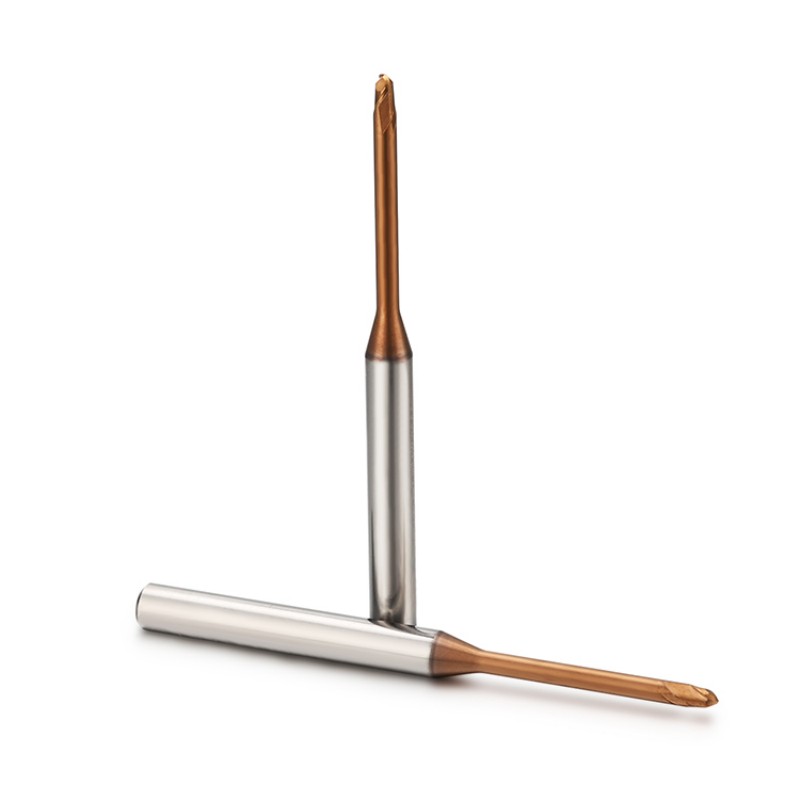
Long reach tooling involves a balance between accessibility and rigidity. As tool projection increases, the cutter becomes more sensitive to cutting forces and vibration.
For this reason, the neck length should match the actual cavity geometry rather than simply using the longest available tool.
The long neck structure provides clearance where a conventional tool may interfere with the workpiece. The practical objective is to use sufficient reach while keeping unnecessary tool projection to a minimum.
Deep ribs and narrow slots can restrict access to the cutting area, particularly when the surrounding mold geometry limits toolholder clearance.
A long neck cutter can provide the additional clearance required to reach these features. Tool diameter, flute length, neck length, and available opening should be considered together when selecting the tool.
Recessed surfaces require the cutter to extend below surrounding mold geometry. If the toolholder or shank contacts the cavity wall, the cutting edge cannot reach the target surface effectively.
A reduced neck provides additional space between the tool body and workpiece. This makes long neck tools suitable for deep pockets, recessed contours, and internal mold features where standard tool geometry may create interference.
Complex injection molds can contain curved surfaces and three dimensional profiles that require controlled finishing. Ball nose geometry is commonly used for these features because the rounded cutting end can follow changing surface angles.
For deep or restricted curved features, a long neck ball nose end mill combines extended access with the contouring capability required for three dimensional mold surfaces.
The cutting diameter should be large enough to provide appropriate tool strength while still fitting through the cavity opening. Smaller diameters can improve access to narrow features, but they also provide less cross sectional support.
Reach should therefore be based on the actual cavity depth and clearance requirements. Excessive tool length can make the cutter more susceptible to deflection and vibration.
Ball nose end mills are suitable for curved surfaces, mold cavities, freeform profiles, and three dimensional contours. The ball radius should correspond to the surface geometry and required finishing detail.
When the feature is both deep and curved, a long neck ball nose configuration can provide the necessary access without relying on an unnecessarily long cutting section.
Corner radius end mills can be useful for shoulders, side walls, steps, and profile features where a reinforced cutting corner is beneficial.
The radius should match the required mold geometry. For deep features, clearance and tool projection should also be considered when determining the appropriate tool configuration.
Mold steels can vary significantly in hardness and machining behavior. P20, 718H, NAK80, and H13 are commonly encountered materials in mold applications, and tool selection should reflect the material condition and machining operation.
The required geometry and cutting conditions may differ between roughing, semi finishing, and finishing operations.
Higher hardness places greater demands on cutting edge strength and wear resistance. When deep cavity machining involves hardened mold steel, the tool must be selected according to the material hardness, cutting operation, and required surface quality.
Dohre's Hardened Steel End Mills are designed for hardened steel applications from HRC60 to HRC68 and include square, ball nose, and corner radius geometries.
Coating should be selected according to the workpiece material and cutting conditions. Dohre's mold and die tooling information includes coated carbide cutters for hardened steel applications.
However, coating is only one part of tool selection. Tool geometry, carbide grade, cutting parameters, tool projection, and workpiece material also affect machining stability.
Extended reach tools are more sensitive to cutting forces than shorter tools. Excessive radial engagement can increase bending and vibration, particularly when machining deep or narrow features.
Reducing cutting load can improve stability, but the appropriate value depends on tool diameter, material, flute configuration, cutting speed, feed rate, and machining operation.
Chip evacuation becomes more difficult as cavity depth increases. Chips that remain in a narrow pocket can be recut, increasing heat and cutting edge wear.
Air or coolant delivery, toolpath direction, cavity geometry, and cutting parameters all influence chip evacuation. The appropriate approach depends on the workpiece material and machining operation.
Deep cavity machining benefits from toolpaths that control cutting engagement rather than creating sudden increases in cutting load.
For finishing operations, the toolpath should also maintain consistent contact with the workpiece where possible. This can help reduce sudden load changes and improve surface consistency on deep cavity walls and contours.
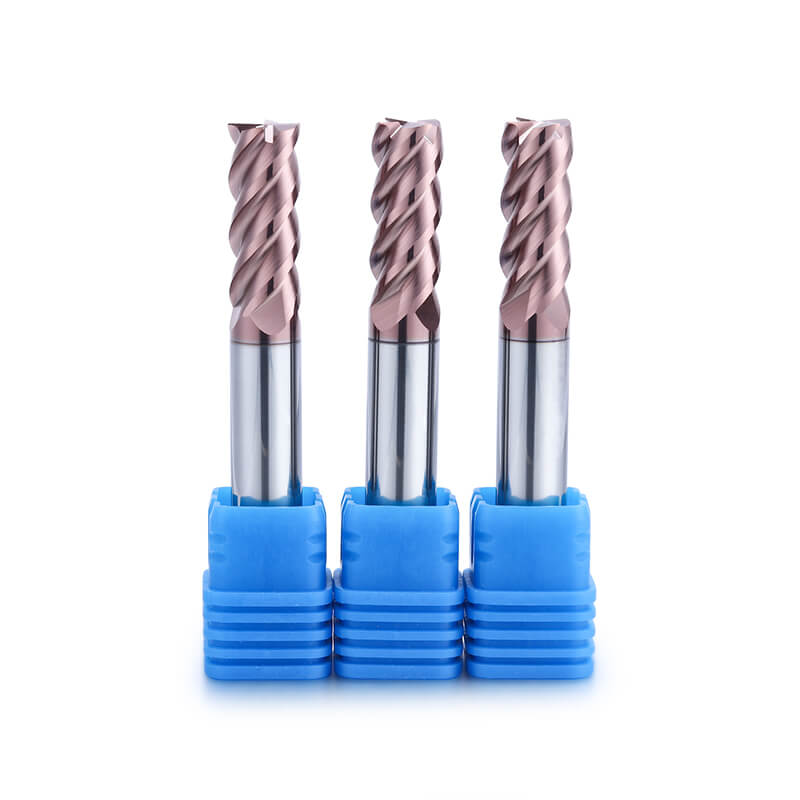
Tool deflection can cause dimensional errors, wall taper, and uneven surface finish. The risk increases when tool projection becomes excessive or cutting forces are too high.
The first step is to use the shortest practical reach that provides sufficient cavity clearance. Cutting load should then be controlled through suitable tool diameter, radial engagement, axial depth, and machining strategy.
Chatter can occur when the tool, holder, machine, and cutting conditions do not provide sufficient dynamic stability. Long reach tools are more sensitive to this problem because of their extended projection.
Reducing unnecessary overhang, improving tool holding, and adjusting cutting conditions can help stabilize the process.
Poor surface finish may result from tool deflection, vibration, unsuitable geometry, excessive cutting load, or chip recutting.
For curved mold surfaces, ball nose geometry can provide controlled contouring. For flat walls, shoulders, and steps, square or corner radius geometries may be more appropriate.
Deep cavity machining requires the right balance between tool access and machining stability. Long reach end mills can provide the clearance needed for recessed, narrow, and deep mold features, while tool geometry should be selected according to the cavity shape and workpiece material.
For a long neck end mill or a custom tooling requirement, Contact Dohre to discuss the required tool dimensions and machining conditions.
By continuing to use the site you agree to our privacy policy Terms and Conditions.