


Cutting speed, feed rate, and depth of cut for end mills on P20, 718H, NAK80, and H13 mold steel. Includes calculation examples and coolant guidance.


Reading volume: 281

Release time :2026-07-06
Estimated reading time:
Cutting speed, feed rate, and depth of cut for end mills on P20, 718H, NAK80, and H13 mold steel. Includes calculation examples and coolant guidance.
Cutting parameter selection for mold steel end mills determines tool life, surface finish, and dimensional accuracy simultaneously. Speed, feed, depth of cut, and engagement width must be matched to steel hardness, tool coating, and cavity geometry to achieve stable, productive machining outcomes.

Mold steel grades span a wide hardness range from 28 HRC for P20 to 52 HRC for H13, directly governing feasible cutting speed and chip load. Higher hardness reduces the maximum stable cutting speed and narrows the feed rate window that avoids edge fracture.
Hardness also changes the dominant wear mechanism. Steels below 36 HRC produce adhesive wear and built-up edge, requiring lower friction coatings and moderate feeds. Steels above 44 HRC shift to thermal oxidation wear, demanding heat-resistant coatings and reduced cutting speeds.
Pre-hardened mold steels (30–40 HRC) bridge both regimes. Machining parameters must account for the transition from adhesive-dominant to thermal-dominant wear as local cutting temperature rises during sustained engagement in deep pockets.
| Mold Steel Grade | Hardness (HRC) | Recommended Coating | Cutting Speed (m/min) |
|---|---|---|---|
| P20 (low alloy) | 28–36 | ALTIN | 120–180 |
| 718H (pre-hardened) | 33–38 | TIALSIN | 100–160 |
| NAK80 (pre-hardened) | 37–41 | TIALSIN | 80–140 |
| H13 (hot-work) | 44–52 | TIALSIN | 60–120 |
| S7 (shock-resistant) | 44–50 | DR3 | 70–130 |
| A2 (air-hardening) | 48–52 | DR3 | 50–100 |
Cutting speed values assume flood coolant at 15 L/min. Dry machining reduces these ranges by 30–40%. Through-tool coolant at 20 bar enables the upper range for deep cavity operations on hardened steels.
Feed per tooth (fz) determines chip thickness, cutting force, and surface finish. The target chip thickness for stable mold steel milling ranges from 0.05 mm for finishing to 0.25 mm for roughing.
The spindle feed rate is calculated from feed per tooth, flute count, and spindle RPM:
Feed Rate (mm/min) = fz × Z × RPM
Where fz is feed per tooth (mm), Z is number of flutes, and RPM is spindle speed.
A 10 mm diameter, 4-flute AlTiN-coated end mill machining H13 at 44 HRC:
Cutting speed: 100 m/min
Spindle RPM = (100 × 1000) / (π × 10) = 3,183 RPM
Feed per tooth: 0.10 mm (finishing range)
Feed rate = 0.10 × 4 × 3,183 = 1,273 mm/min
For roughing the same tool at fz = 0.20 mm:
Feed rate = 0.20 × 4 × 3,183 = 2,546 mm/min
Axial depth of cut (Ap) and radial engagement width (Ae) control heat input and mechanical load on the cutting edge. Conservative parameters extend tool life; aggressive parameters raise material removal rate at the cost of faster wear.
| Operation | Axial Depth (Ap) | Radial Width (Ae) | Application |
|---|---|---|---|
| Light finishing | 0.1–0.5 mm | 0.05–0.20 × D | Surface finish and precision cavities |
| Semi-finishing | 0.5–1.5 mm | 0.20–0.40 × D | Pre-finish passes and corner cleanup |
| Roughing (conventional) | 1.0–3.0 mm | 0.40–0.60 × D | Open pocket and face milling |
| Roughing (trochoidal) | 1.0–2.0 mm | 0.05–0.15 × D | Deep pocket with constant engagement |
Trochoidal milling reduces Ae to maintain uniform chip thickness and thermal load, allowing deeper Ap values in confined mold cavities.
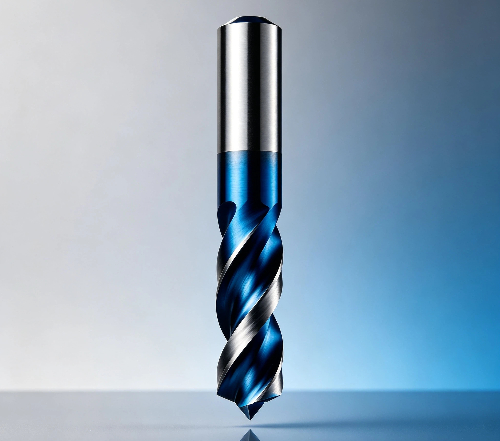
Small-diameter end mills (3–6 mm) require lower cutting speeds and reduced feed rates due to limited core strength and heat dissipation capacity. Reduce speed by 20–30% from the base range and limit fz to 0.03–0.08 mm for stable cutting.
Large-diameter tools (16–25 mm) can sustain higher material removal rates but demand proportionally higher coolant volume. Increase coolant flow to 20–30 L/min for roughing operations with large end mills on hardened mold steels.
Two-flute tools enable aggressive chip evacuation for roughing in gummy mold steels below 36 HRC. Four-flute and six-flute tools provide better surface finish and rigidity for finishing passes on pre-hardened and hardened steels.
Q: How do I adjust parameters when switching from P20 to H13?
A: Reduce cutting speed by 40–50%, lower feed per tooth by 30–40%, and decrease depth of cut by 50–70%. Switch from TiCN to AlTiN coating and increase coolant flow by 50%. These adjustments reflect the shift from adhesive-dominant to thermal-dominant wear conditions.
Q: What happens if I exceed the recommended cutting speed range?
A: Exceeding the speed range accelerates thermal oxidation of the coating and carbide substrate. Tool life drops by 30–60% per 20% speed increase above the recommended ceiling. Surface finish degrades as edge wear progresses rapidly during sustained engagement.
Q: Can I use the same parameters for trochoidal and conventional milling?
A: Trochoidal milling uses smaller radial width (Ae) but can increase axial depth (Ap) beyond conventional limits. Feed per tooth remains the same. The reduced engagement angle lowers peak cutting temperature, enabling deeper cuts at the same speed that conventional paths cannot sustain.
Q: Does tool diameter affect the cutting speed formula?
A: Tool diameter determines spindle RPM for a given surface speed. A smaller diameter requires higher RPM to reach the same cutting speed in m/min. The surface speed itself does not change with diameter, but RPM and feed rate calculations must adjust accordingly.
Q: When should I switch from flood coolant to through-tool delivery?
A: Switch to through-tool coolant when cavity depth exceeds 30 mm or when vapor barrier formation is observed at the cutting edge. Through-tool delivery maintains consistent thermal control regardless of pocket geometry and is essential for stable machining of hardened steels in deep molds.
Mold steel cutting parameters must align with steel hardness, tool coating, and cavity geometry to balance tool life, surface finish, and productivity. Speed and feed calculations based on empirical ranges for each steel grade provide a reliable starting point. Adjustments for tool diameter, coolant delivery, and milling strategy refine these parameters for specific mold manufacturing applications.
For detailed cutting parameter recommendations and custom tool specifications for mold steel machining, contact Dohrecnc Tools engineering team. Request a rapid sourcing quote from Dohrecnc Tools for solid carbide end mills with application-optimized coatings and geometries matched to your mold steel grades.
• Ultra-fine submicron carbide (
Learn More>
• Extra-fine submicron carbide (grain
Learn More>
• Ultra-fine carbide grain
Learn More>By continuing to use the site you agree to our privacy policy Terms and Conditions.