Product Description
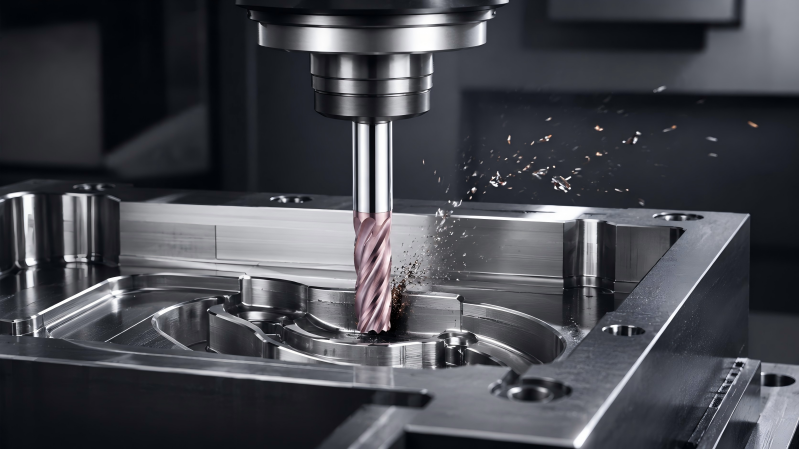
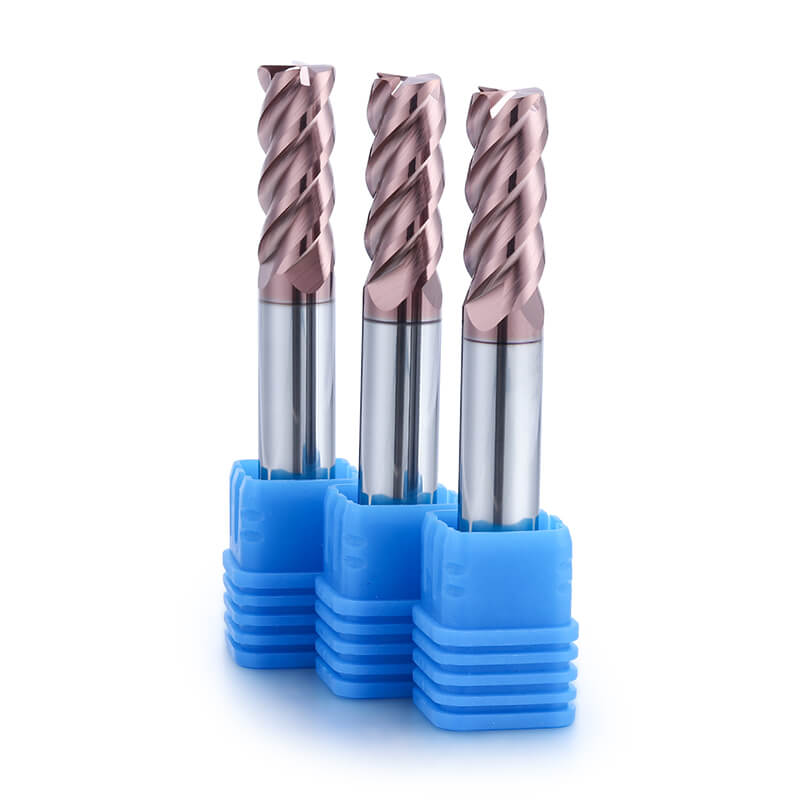
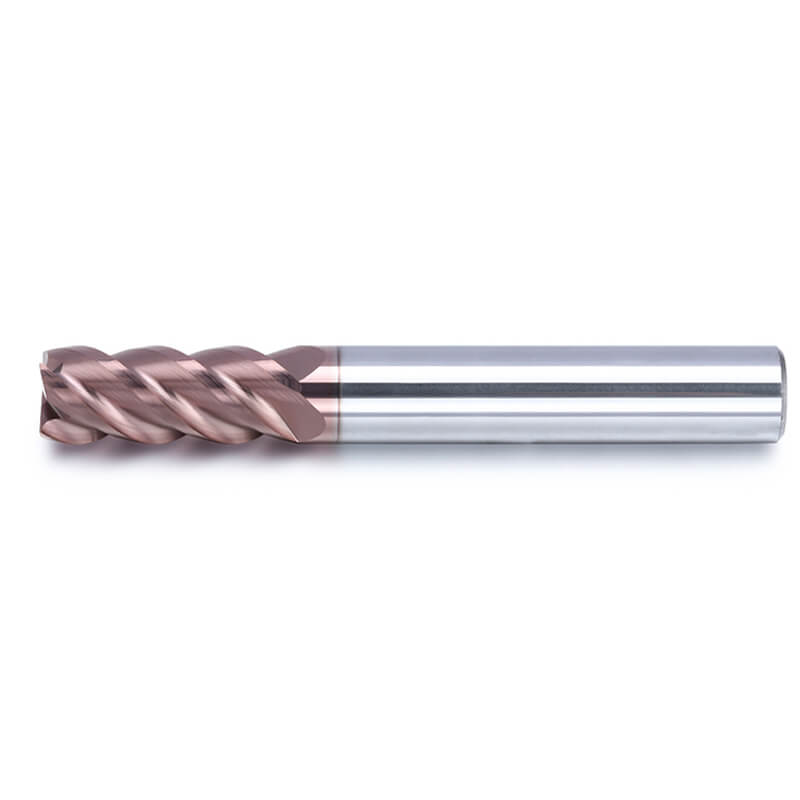
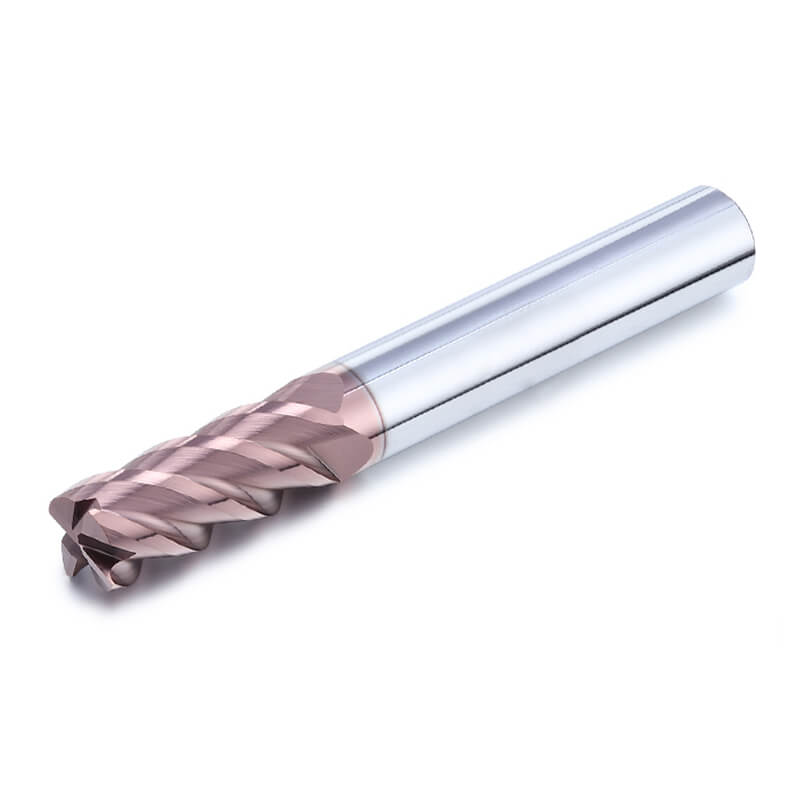
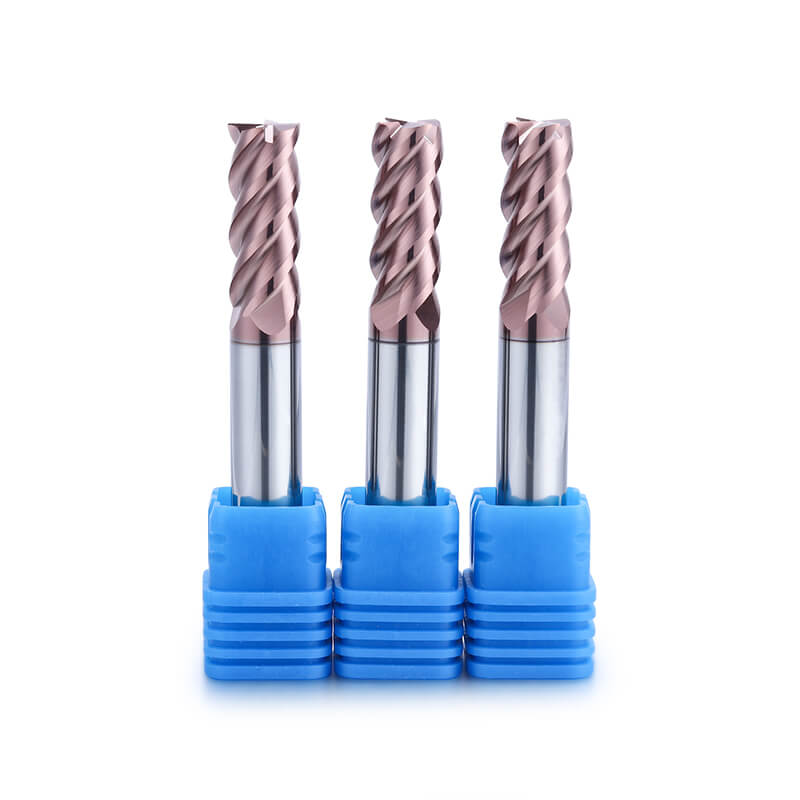
The HEX corner radius end mill is specially developed for hardened steel machining from HRC60 to HRC68. It is designed for shoulder finishing, step machining, side-wall finishing, profile machining, and mold cavity transition areas where edge strength, dimensional accuracy, and stable cutting performance are required.
Specification
| Item | Range / Notes |
|---|
| Tool type | Corner radius end mill |
| Diameter range | D1.0–D12.0 |
| Corner radius range | R0.2–R3.0 |
| Hardness range | HRC60–68 |
| Application | Shoulder, side wall, step, profile, cavity transition |
| Custom service | Diameter, flute length, corner radius, coating, shank, special geometry |
Product Features
1.Material – Ultra-Fine Carbide for HRC60–68 Machining
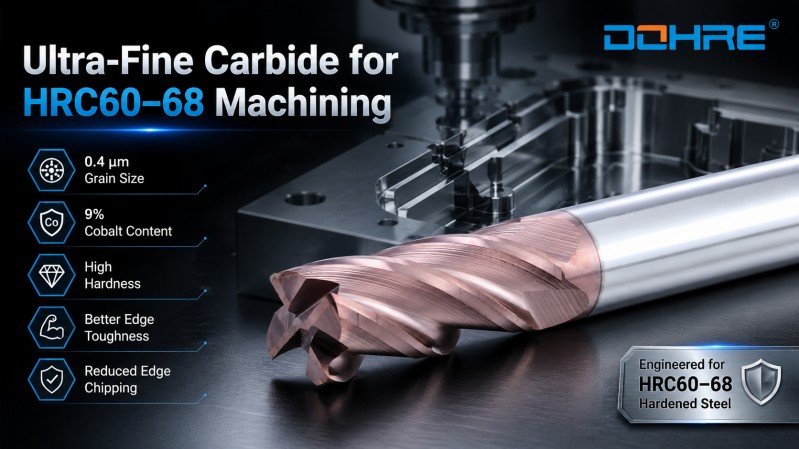
The HEX series corner radius end mill is produced from imported ultra-fine grain carbide with a grain size of 0.4 μm and 9% cobalt content.
This substrate provides:
• High hardness for machining HRC 60–68 hardened steel
• Increased edge toughness to withstand interrupted cutting
• Reduced risk of edge chipping at shoulders and corners
The material is especially suitable for profile and side-wall finishing in mold and die applications.
2. Coating –DR3 High-Wear-Resistant Coating
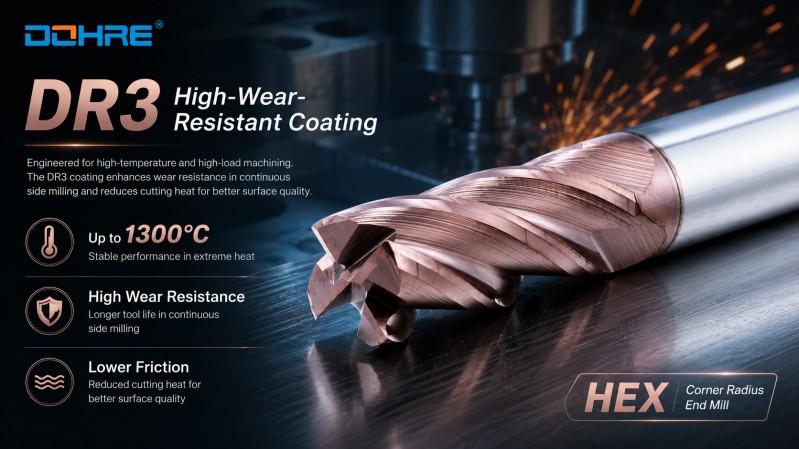
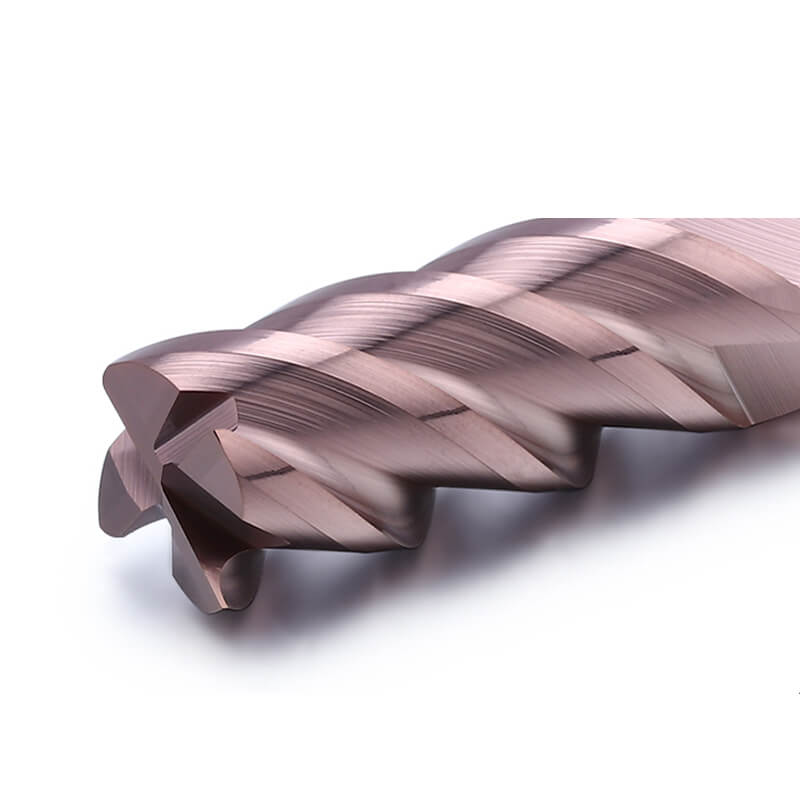
The cutting edges are coated with DR3 high wear-resistant coating (bronze color), designed for high-temperature and high-load machining conditions.
Key benefits:
• Heat resistance up to 1300°C
• Excellent wear resistance in continuous side milling
• Lower friction to reduce cutting heat and improve surface quality
This coating helps maintain stable cutting performance and extends tool life when machining hardened mold steels.
3. Design Features – Optimized for Shoulder and Side Milling
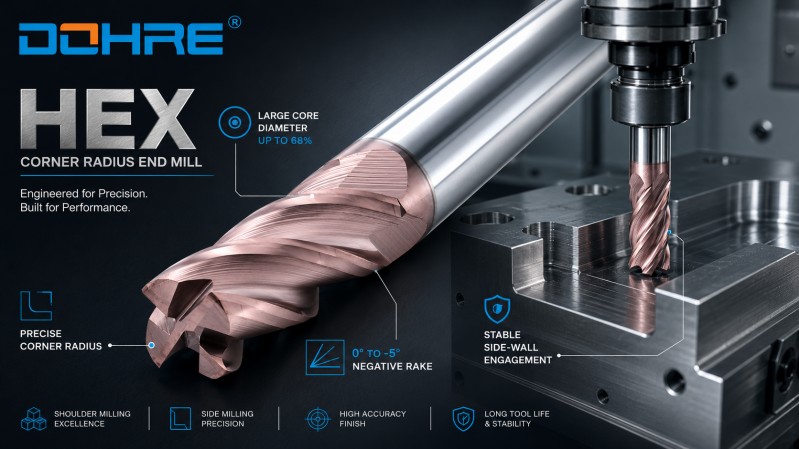
The geometry of the HEX corner radius end mill is optimized for strength, stability, and accuracy:
• Large core diameter (up to 68%) for enhanced rigidity during side and shoulder milling
• Peripheral cutting edge with 0° to -5° negative rake angle, improving edge strength
• Precisely controlled corner radius, reducing stress concentration at the cutting edge
• Geometry optimized for consistent tool engagement along the side wall
This design performs especially well in:
• Shoulder and step finishing
• Profile and contour machining
• Side-wall finishing of hardened mold cavities
The corner radius structure helps distribute cutting load more evenly, reducing stress concentration and improving edge durability compared with sharp-corner square end mills.
4. Application Range
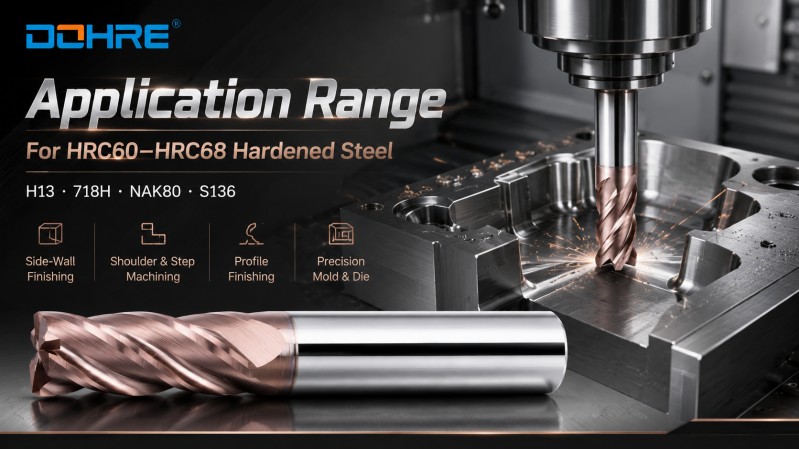
Suitable for machining hardened steel from HRC 60 to HRC 68, including:
• H13
• 718H
• NAK80
• S136
• Other mold and die steels
Typical applications:
• Mold cavity side-wall finishing
• Shoulder and step machining
• Profile finishing after roughing
• Precision mold and die manufacturing
Why Choose a Corner Radius End Mill for Hardened Steel?
Choosing the right tool geometry is critical when machining hardened steel.
Compared with square end mills and ball nose end mills, the corner radius end mill offers a more balanced solution for stability, tool life, and dimensional accuracy.
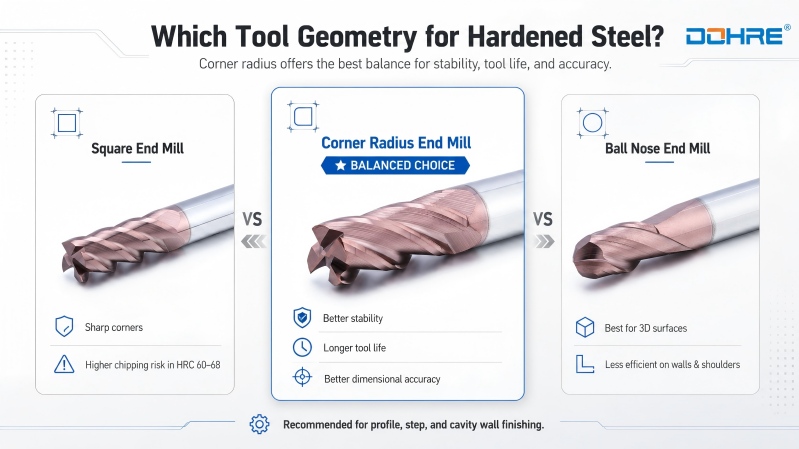
Corner Radius End Mill VS Square End Mill
Square end mills have sharp corners that are prone to chipping when machining HRC 60–68 hardened steel, especially in shoulder and side-wall finishing.
The corner radius design:
• Reduces stress concentration at the cutting edge
• Significantly lowers the risk of edge chipping
• Improves tool life in continuous side milling
For hardened mold steels, a corner radius end mill provides more reliable and stable performance than a square end mill.
Corner Radius End Mill VS Ball Nose End Mill
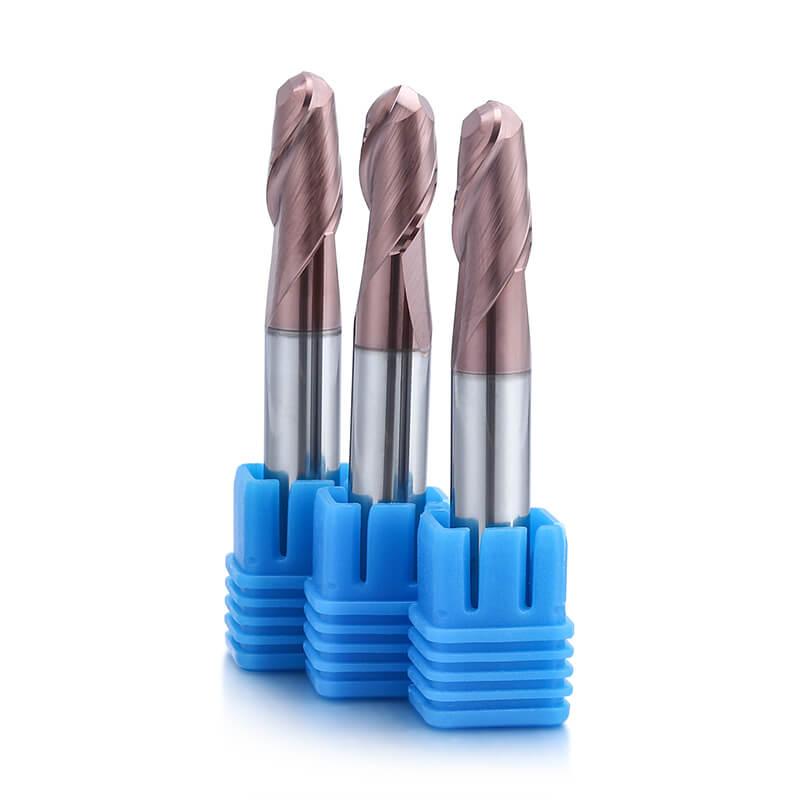
Ball nose end mills are ideal for 3D surfaces and curved profiles, but they are less efficient for straight walls and shoulders.
Compared with ball nose milling tools, corner radius end mills offer:
• Higher material removal rate in side-wall machining
• Better dimensional control on vertical surfaces
• More stable cutting engagement during shoulder finishing
This makes the corner radius end mill a better choice for profile, step, and cavity wall finishing.
Manufacturing & Quality Control
Dohre CNC focuses on precision grinding, edge preparation, dimensional consistency, and strict inspection for high-hardness machining tools. HEX corner radius end mills are produced under controlled manufacturing processes to ensure stable cutting performance, consistent edge quality, and reliable batch accuracy.
German Walter 5-Axis Grinding Machines
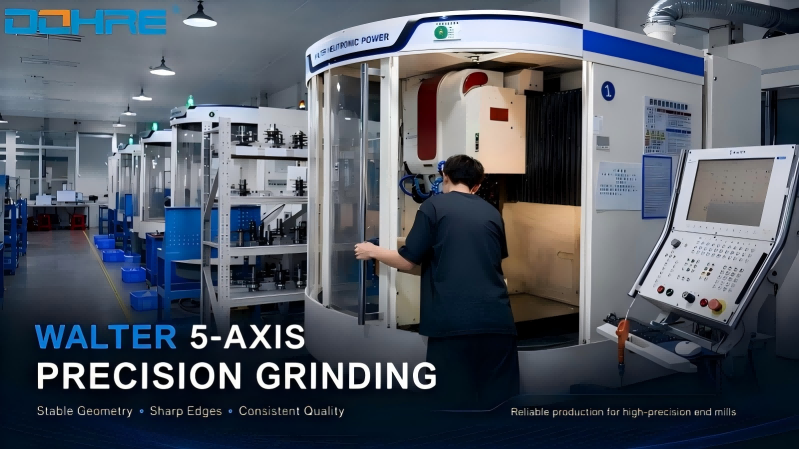
HEX corner radius end mills are produced using German Walter 5-axis high-precision grinding machines. This helps maintain accurate flute geometry, sharp cutting edges, and stable dimensional consistency, making cutting smoother and more stable in hardened steel machining.
For HEX corner radius tools, radius grinding accuracy can be controlled within 0.003–0.005 mm, helping improve corner accuracy, edge protection, and finishing stability.
Edge Preparation and Passivation
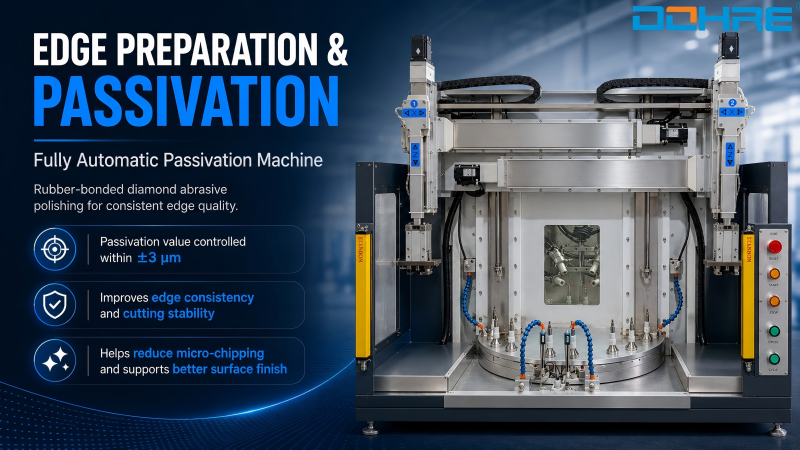
The cutting edges are treated by a fully automatic passivation machine using rubber-bonded diamond abrasive polishing. This process helps ensure consistent edge quality across all tools, with the passivation value controlled within ±3 μm.
For hardened steel machining, consistent edge preparation is especially important because unstable edge quality can lead to micro-chipping, poor surface finish, and shortened tool life.
Precision Inspection
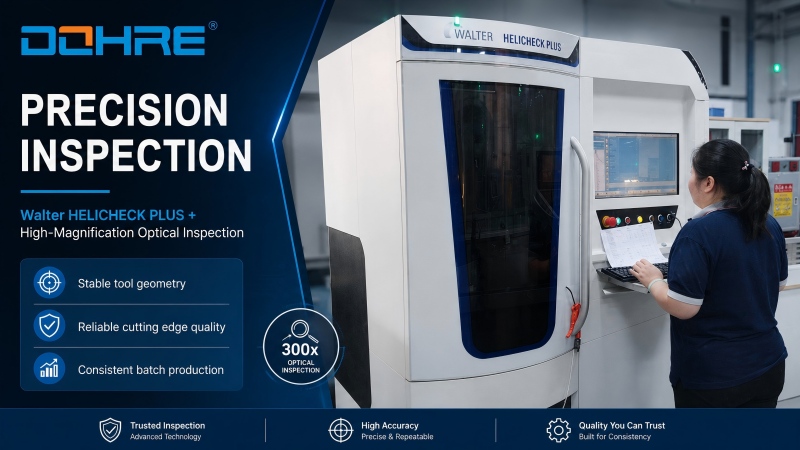
Tool profile, corner radius accuracy, and cutting edge quality are inspected using precision measuring equipment, including Walter HELICHECK PLUS and high-magnification optical inspection. This helps ensure stable geometry, reliable edge quality, and consistent batch production.
Stable Batch Quality
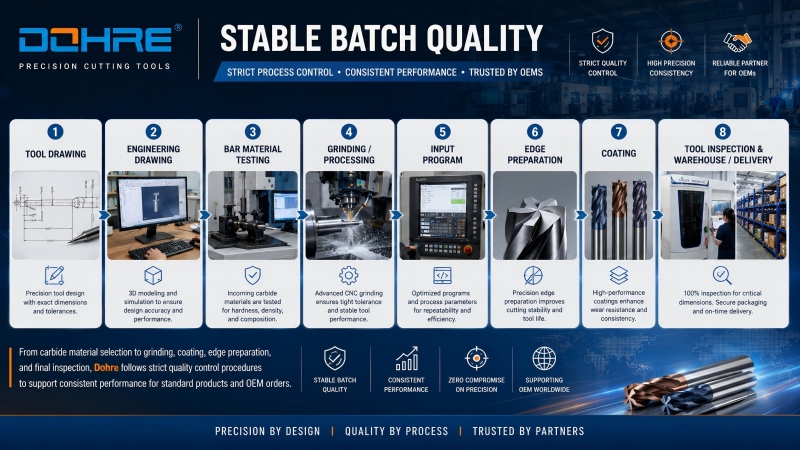
From carbide material selection to grinding, coating, edge preparation, and final inspection, Dohre follows strict quality control procedures to support consistent performance for standard products and OEM orders.
FAQ & Contact us
Q1: Why does a corner radius end mill last longer than a square end mill in hard steel?
In hardened steel machining, sharp corners on square end mills are more likely to chip due to stress concentration.
The corner radius distributes cutting forces more evenly along the edge, reducing localized stress and improving edge durability during continuous side milling.
Q2: Can corner radius end mills be used for bottom surface finishing?
They can be used for bottom finishing where a filleted corner is acceptable.
However, if a sharp internal corner is required, a square end mill or secondary finishing operation may still be needed.
Q3: Is a corner radius end mill suitable for interrupted cutting?
Yes.
Compared with square end mills, the rounded corner helps absorb impact during interrupted cutting, reducing the risk of edge chipping in applications such as step machining or cavity transitions.
Q4: Can one corner radius end mill be used for both roughing and finishing?
Corner radius end mills are primarily optimized for semi-finishing and finishing.
Using the same tool for roughing may shorten tool life and affect finishing quality. For best results, roughing and finishing operations should be separated.
Q5: Are all standard sizes produced with the same quality level?
Yes. All standard sizes of the HEX series corner radius end mills are manufactured using the same carbide substrate, coating process, and grinding standards, ensuring consistent cutting performance across the entire size range.
Q6: Do you offer customized corner radius end mills?
Yes. In addition to standard sizes, customized specifications such as special corner radius, cutting length, or overall length can be provided upon request after technical evaluation.