End Mills for Stainless Steel: How to Make Them Last Longer
Introduction
Stainless steel is harder on end mills because it creates higher cutting resistance, more heat, and faster wear than many easier-to-machine materials. This guide explains how to extend end mill life in stainless steel machining through better tool geometry, coating selection, parameter control, and more stable cutting conditions
Stainless steel is harder on end mills because it creates higher cutting resistance, more heat, and faster wear than many easier-to-machine materials. This guide explains how to extend end mill life in stainless steel machining through better tool geometry, coating selection, parameter control, and more stable cutting conditions.
In practice, tool life problems in stainless steel rarely come from one single mistake. They usually come from a combination of cutter choice, coating suitability, unstable chip evacuation, and cutting parameters that are not well matched to the workpiece. That is why improving end mill life starts with understanding how stainless steel changes the cutting environment.
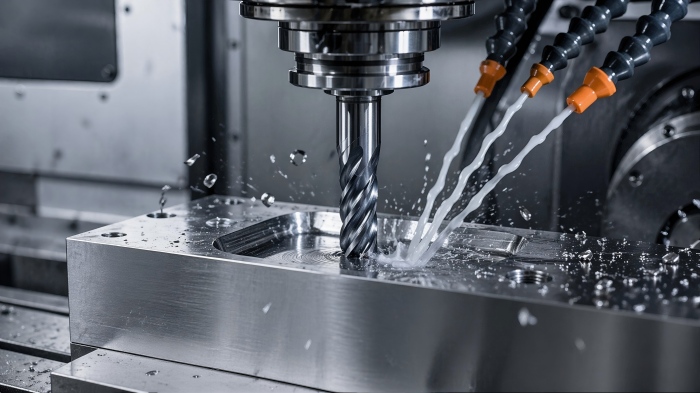
Why End Mills Wear Faster in Stainless Steel
Compared with aluminum and many lower-resistance materials, stainless steel usually places more stress on the cutting edge. Heat builds more easily, cutting pressure stays higher, and edge wear can become visible sooner if the tool, coating, or setup is not well matched to the job.
This is one reason why a general discussion of the best end mills for stainless steel often leads naturally into tool life. A cutter that can machine the material is not always the same as a cutter that can hold stable performance for a longer production run.
Start with the Right End Mill Geometry
Tool life often improves before parameters are changed, simply by choosing a cutter geometry that better matches the work. Flute count, edge strength, helix angle, and overall cutter form all affect how the tool enters the material, evacuates chips, and handles heat.
That is why stainless steel machining is not only about tool material. The relationship between flute count, chip space, and rigidity becomes especially important, which is explained in more detail in our guide to stainless steel end mill flutes.
Choose a Coating and Carbide Grade That Match Stainless Steel
Coating has a direct effect on wear resistance in stainless steel machining. A coating that can tolerate higher heat and reduce wear more effectively will usually help the edge last longer, especially in repeated production work. Carbide grade also matters, because tool life depends not only on the outer coating but also on how the substrate supports the cutting edge.
In other words, a longer-lasting stainless steel end mill is usually the result of the whole tool design rather than one feature alone.
Control Speed, Feed, and Chip Evacuation Together
Many premature wear problems are really process-control problems. Excessive speed, unstable feed, or poor chip evacuation can all shorten tool life quickly, even when the selected end mill is technically suitable for stainless steel.
This becomes even more obvious in slotting and roughing operations, where chips have less room to escape and cutting heat stays concentrated near the edge. When chip flow becomes unstable, wear accelerates, finish quality drops, and the cutter may begin chipping or breaking earlier than expected.
Reduce Runout and Improve Setup Rigidity
Even a high-quality end mill for stainless steel will not last long if the setup is unstable. Runout, weak clamping, excessive tool overhang, or poor machine rigidity can all create uneven load on the cutting edge. Once that happens, one flute may wear faster than the others, and tool life becomes inconsistent.
A more rigid setup does not just improve finish. It also helps the cutter wear more evenly, which is one of the most practical ways to extend end mill life in stainless steel machining.
Different Operations Change Tool Life
Tool life in stainless steel is not the same across all operations. Slotting, roughing, side milling, and finishing place different demands on the cutter. A tool that performs well in one path may wear too quickly in another if the geometry is not well matched.
This is where the difference between cutter shapes starts to matter more. The broader relationship between form and application is covered in our article on basic shapes and types of stainless steel end mills, especially when choosing tools for slotting, roughing, or finishing work.
How Long Do End Mills Last in Stainless Steel?
There is no fixed lifespan for every tool. End mill life in stainless steel depends on material grade, hardness, coating, cutter geometry, speed, feed, radial engagement, axial depth, and setup stability. That is why two shops using similar tools can still get very different tool life results.
A better question is not “How long should it last in theory?” but “Is the tool wearing in a stable and predictable way for this operation?” If wear is accelerating too early, the cause is usually visible in geometry choice, coating mismatch, chip control, or setup rigidity.
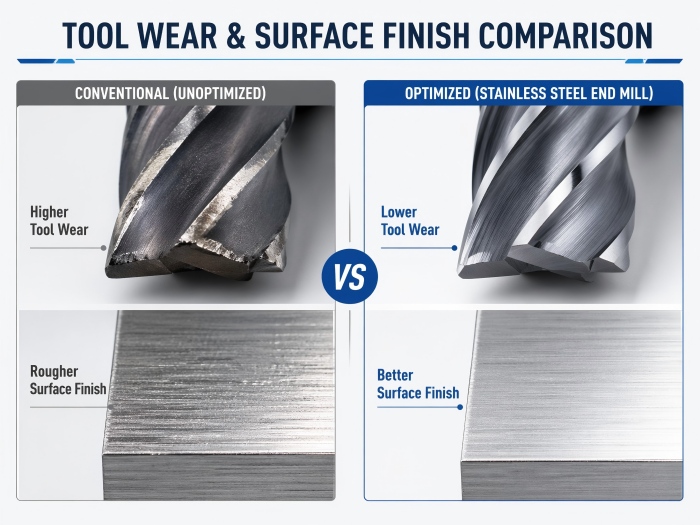
When to Replace an End Mill Instead of Forcing More Life
Trying to force more life from a worn cutter can create bigger problems than replacing it on time. Once the edge begins to lose stability, surface finish may deteriorate, cutting force may rise, and the risk of edge breakage becomes much higher.
A predictable replacement point is often more valuable than pushing a tool too far. In stainless steel, stable production usually matters more than extracting the last possible minute from one cutter.
Practical Checklist to Extend Tool Life
•Choose an end mill geometry designed for stainless steel rather than relying on a fully general-purpose cutter.
•Use a coating and carbide grade suited to higher heat and wear conditions.
•Keep speed, feed, and chip evacuation in balance instead of adjusting only one variable.
•Reduce runout, overhang, and weak clamping wherever possible.
•Evaluate tool life based on wear stability, not just whether the cutter can still cut.
Conclusion
End mills for stainless steel last longer when the full cutting system is working together: tool geometry, coating, carbide grade, speed and feed, chip evacuation, and setup rigidity. Stainless steel puts more pressure on the cutter than many easier materials, so tool life improves most when those factors are treated as one system instead of separate decisions.
In practical machining, longer tool life is usually the result of better matching rather than one secret tip. The right stainless steel end mill, used under stable conditions, will almost always outperform a more generic tool pushed too hard.
A complete end mill for stainless steel range makes that comparison easier, especially when different operations require different cutter geometries and performance priorities.
FAQ
Why do end mills wear faster in stainless steel?
Stainless steel usually creates higher cutting resistance, more heat, and more demanding wear conditions than easier-to-machine materials, so tool life often becomes shorter if geometry, coating, and parameters are not well matched.
How can I make an end mill for stainless steel last longer?
Tool life usually improves when the cutter geometry is better matched to stainless steel, the coating is suitable, chip evacuation stays stable, and the setup is rigid enough to reduce uneven edge wear.
Does coating matter in stainless steel machining?
Yes. Coating has a direct effect on heat resistance and wear behavior, so it plays an important role in extending tool life in stainless steel applications.
How long do end mills last in stainless steel?
There is no single fixed lifespan. Tool life depends on material condition, geometry, coating, speed, feed, chip evacuation, and setup stability.
What is the biggest mistake that shortens end mill life in stainless steel?
One of the most common mistakes is treating the problem as only a speed issue. In reality, tool life is often shortened by a combination of geometry mismatch, poor chip control, unstable setup, and excessive wear concentration on the edge.
Looking for the Right Stainless Steel End Mill?
Explore our End Mill for Stainless Steel range to compare cutter geometries and applications for slotting, roughing, finishing, and general stainless steel machining.
Contact us for product recommendations and custom tool solutions.


