





Hole making is one of the most common operations in CNC machining, but producing an accurate hole often involves more than simply drilling into the workpiece. Depending on the required diameter, depth, tolerance, position accuracy, and surface finish, different hole making tools may be used at different stages of the machining process.
In CNC metalworking, drilling, boring, and reaming are three important hole-making processes. Although all three are used to machine holes, they perform different functions and should not be treated as interchangeable operations.
This guide explains how carbide drill bits, boring cutters, and reamers are used, how they differ, and how to select the appropriate hole making process for different machining requirements.
What Are Hole Making Tools in CNC Machining?
Hole making tools are cutting tools used to create, enlarge, correct, or finish holes in a workpiece. The correct process depends on whether the hole is being created from solid material or whether an existing hole requires additional machining.
In precision CNC machining, hole-making operations commonly involve:
• Creating a new hole in solid material
• Increasing the diameter of an existing hole
• Correcting hole geometry or position
• Improving dimensional accuracy
• Improving the internal surface finish
Drilling, boring, and reaming can be used separately or as part of a combined machining sequence depending on the final hole requirements.
Drilling vs Boring vs Reaming: What Is the Difference?
The main difference between these three hole-making processes is the condition of the hole before machining and the purpose of the operation.
| Process | Main Function | Starting Condition | Typical Goal |
|---|---|---|---|
| Drilling | Create a new hole | Solid material | Produce the initial through hole or blind hole |
| Boring | Enlarge or correct an existing hole | Pre-existing hole | Improve diameter, geometry, position, or concentricity |
| Reaming | Precision finish an existing hole | Pre-drilled or pre-machined hole | Achieve final size and improved surface finish |
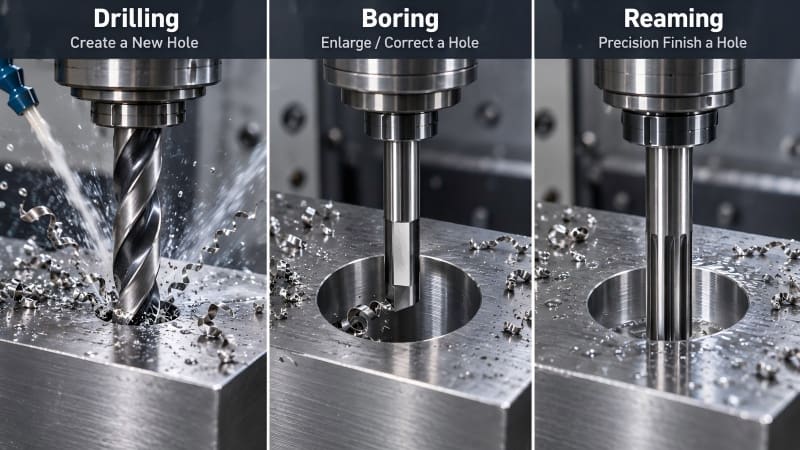
A drilled hole may already meet the required specification in general machining. For tighter dimensional or geometric requirements, boring or reaming may be added as secondary operations.
1. Carbide Drill Bits – Creating the Initial Hole
Drilling is normally the first step in a hole-making process. A drill removes material from a solid workpiece to create a cylindrical hole.
Solid carbide drills are widely used in CNC machining because their rigidity and wear resistance make them suitable for high-speed and precision drilling applications.
Depending on the application, drilling may be used to produce:
• Through holes
• Blind holes
• Shallow holes
• Deep holes
• Pre-holes for boring or reaming
When selecting carbide drill bits, important factors include hole diameter, hole depth, workpiece material, machine rigidity, coolant conditions, and chip evacuation.
Hole Depth and Chip Evacuation
As hole depth increases, chip evacuation becomes more important. Chips that remain inside the flute can increase cutting forces, generate heat, damage the hole surface, and increase the risk of tool breakage.
For deeper holes, flute design, coolant delivery, cutting parameters, and drilling strategy should be selected according to the depth-to-diameter ratio of the hole.
Through Holes and Blind Holes
Through holes allow the drill to exit the workpiece, while blind holes stop at a specified depth. Blind-hole machining requires additional attention to hole depth, chip evacuation, and bottom geometry.
2. Boring Cutters – Enlarging and Correcting Existing Holes
Unlike drilling, boring does not normally create a hole from solid material. Instead, it machines an existing hole to enlarge the diameter or improve its geometry and dimensional control.
Boring can be useful when a drilled hole does not provide sufficient diameter accuracy, alignment, concentricity, or geometric consistency.
Typical boring applications include:
• Increasing an existing hole diameter
• Correcting hole position or alignment
• Improving cylindricity
• Improving concentricity
• Producing a more controlled internal diameter
Selecting suitable boring cutters depends on the hole diameter, required tolerance, machining allowance, tool overhang, machine rigidity, and workpiece material.
Why Use Boring After Drilling?
A drilled hole follows the path created by the drill itself. If the initial hole has position error, diameter variation, or geometric deviation, boring can provide greater control because the boring tool removes material from the existing hole wall.
Boring is therefore often selected when dimensional and geometric requirements are more demanding than drilling alone can reliably achieve.
3. Reamers – Precision Hole Finishing
Reaming is generally used as a finishing operation after a hole has already been drilled or otherwise machined close to its final size.
A reamer removes a relatively small amount of material from the hole wall. Its main purpose is not heavy material removal, but improving final hole size, dimensional consistency, and internal surface finish.
Common applications for precision reamers include holes that require closer dimensional control or improved surface quality after drilling.
When Should a Reamer Be Used?
Reaming is suitable when the existing hole is already reasonably straight and correctly positioned but still requires final sizing or surface improvement.
A reamer is generally not intended to correct a severely misaligned hole or remove a large amount of material. If the hole requires significant diameter correction or geometric adjustment, boring may be a more suitable process before reaming.
How Drilling, Boring, and Reaming Work Together
Drilling, boring, and reaming are not competing processes. In many precision machining applications, they can be used as different stages of the same hole-making sequence.
General-Purpose Hole
If the dimensional and surface requirements are not especially demanding, drilling may be sufficient:
Solid Material → Drilling → Finished Hole
Hole Requiring Diameter or Geometry Correction
If the initial drilled hole requires improved diameter control or geometric correction:
Solid Material → Drilling → Boring → Finished Hole
Precision Finished Hole
For applications requiring closer final sizing and improved internal surface finish, the machining sequence may involve:
Solid Material → Drilling → Boring → Reaming → Finished Hole
However, not every precision hole requires all three processes. The correct machining sequence should be determined by tolerance, surface finish, geometry, production efficiency, and available machining allowance.
How to Choose the Right Hole Making Tool
A simple way to select the machining process is to first identify what needs to be done to the hole.
| Machining Requirement | Recommended Process |
|---|---|
| Create a hole in solid material | Drilling |
| Enlarge an existing hole | Boring |
| Correct hole geometry or alignment | Boring |
| Bring an existing hole to final precision size | Reaming |
| Improve the internal surface finish of an existing hole | Reaming |
In practice, hole-making tool selection should also consider the complete machining environment rather than only the operation type.
Factors to Consider in CNC Hole Making
1. Hole Diameter
Tool diameter must match both the initial machining requirement and the amount of material that will remain for any secondary boring or reaming process.
2. Hole Depth
Deeper holes increase the importance of tool rigidity, flute design, coolant delivery, and chip evacuation. Long tool overhang can also increase deflection and vibration.
3. Dimensional Tolerance
A general drilled hole may not require secondary machining. When tighter tolerances are required, boring or reaming may be used depending on whether the main requirement is geometric correction, dimensional control, or finishing.
4. Surface Finish
Surface finish requirements influence whether drilling alone is sufficient or whether a finishing operation such as reaming is required.
5. Workpiece Material
Steel, stainless steel, aluminum, hardened materials, and other alloys have different cutting characteristics. Tool material, geometry, coating, coolant, and cutting parameters should be selected according to the workpiece.
6. Machine and Setup Rigidity
Machine condition, workholding, spindle stability, and tool overhang all influence hole accuracy. Even a suitable cutting tool may produce inconsistent results if the machining setup lacks sufficient rigidity.
Common Problems in Hole Making
Hole quality problems can result from tool selection, cutting parameters, chip evacuation, machine rigidity, coolant delivery, or workpiece clamping.
Hole Diameter Out of Tolerance
Diameter variation may be related to tool wear, runout, deflection, inappropriate cutting parameters, or an unsuitable machining process. If drilling cannot provide sufficient dimensional control, boring or reaming may be required.
Poor Internal Surface Finish
Poor surface finish can result from worn cutting edges, vibration, poor chip evacuation, incorrect feed, insufficient coolant, or excessive tool overhang.
Chip Evacuation Problems
Chip accumulation is especially important in deeper holes. Recutting chips can increase heat, damage the cutting edge, scratch the hole wall, and reduce process stability.
Tool Deflection
Long tools, deep holes, unstable workholding, or excessive cutting forces can cause deflection and affect hole position, straightness, and diameter accuracy.
Premature Tool Wear or Breakage
Tool wear and breakage should be evaluated together with workpiece material, cutting speed, feed rate, coolant conditions, tool geometry, chip evacuation, and machine rigidity rather than considering only one factor.
DOHRE Hole Making Tools for CNC Machining
DOHRE's current hole-making tool range includes carbide drill bits, boring cutters, and reamers for CNC metalworking applications.
Each tool performs a different function in the hole-making process: drilling creates the initial hole, boring enlarges or corrects an existing hole, and reaming provides final sizing and surface finishing where required.
For a specific hole diameter, depth, workpiece material, tolerance, or machining requirement, you can contact DOHRE to discuss the appropriate cutting tool solution.
Conclusion
Choosing the right hole making tool depends on understanding the purpose of each machining process.
Carbide drills are primarily used to create holes from solid material, boring cutters are used to enlarge or correct existing holes, and reamers are used for precision sizing and surface finishing.
By matching the machining process to hole diameter, depth, tolerance, surface finish, workpiece material, and machine conditions, manufacturers can improve hole quality, machining stability, and overall production efficiency.