


Get In Touch
Do you have a questions or an issues we can help you with?
Let’s talk about your project and how Dohre can help get your tools designed, manufactured and ready for the market.


Reading volume: 318

Release time :2026-06-12
Estimated reading time:
Dimensional accuracy is critical in graphite electrode machining because small errors in the electrode can affect the final EDM result. Tool wear, cutter shape, runout, dust buildup, and unstable finishing conditions can all change the final size of graphite features. A stable process and the right graphite end mill help maintain accuracy from roughing to finishing.
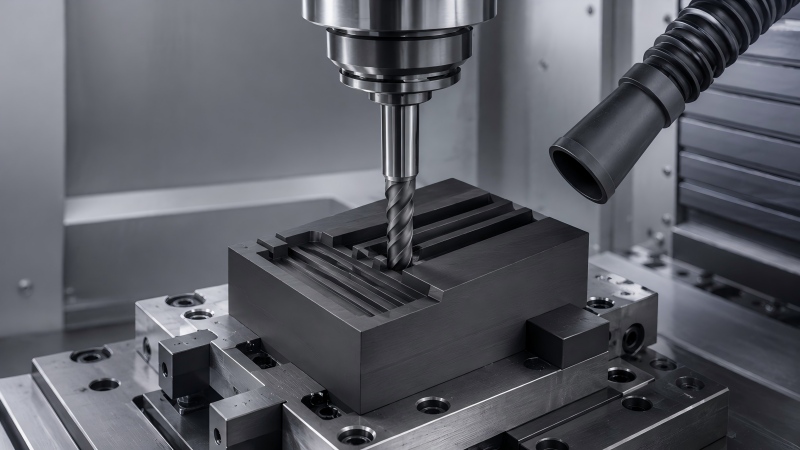
In graphite electrode machining, dimensional accuracy is just as important as surface finish. A graphite electrode may look acceptable on the surface, but if the tool has worn during machining or the setup is not stable, the final size of ribs, pockets, corners, or 3D details may shift from the required tolerance.
Graphite is easy to remove, but it is abrasive to cutting tools. During long machining cycles, even small tool wear can gradually change the cutting size. To maintain electrode accuracy, manufacturers need to control tool wear, cutter shape, runout, dust evacuation, finishing allowance, and toolpath stability.
Graphite electrodes are often used for EDM machining of molds, cavities, ribs, and fine details. If the electrode size is not stable, the final EDM result may be affected. This can lead to extra correction work, longer machining time, or inconsistent mold quality.
Accuracy problems are not always obvious during milling. A small amount of tool wear, runout, or dust buildup may not stop the machining process, but it can still affect the final electrode dimension. This is why graphite electrode machining should be controlled carefully, especially during semi-finishing and finishing.
Dimensional error usually comes from a combination of tool condition, cutting strategy, and setup stability. The most common causes are tool wear, incorrect tool shape, excessive runout, unstable allowance, and poor dust control.
| Cause | How It Affects Accuracy | What to Check |
|---|---|---|
| Tool wear | The actual cutting size changes as the edge becomes worn | Edge rounding, coating wear, corner wear, and tool life |
| Runout | One flute cuts more than the others, causing uneven size and surface marks | Tool holder, spindle, clamping, and tool extension |
| Unsuitable tool shape | The cutter does not match the electrode feature | Flat, corner radius, or ball nose selection |
| Unstable finishing allowance | The final pass removes uneven material and affects size consistency | Roughing allowance, semi-finishing strategy, and toolpath control |
| Dust buildup | Graphite dust affects visibility, cutting stability, and inspection | Dust extraction, cleaning, and machining area condition |
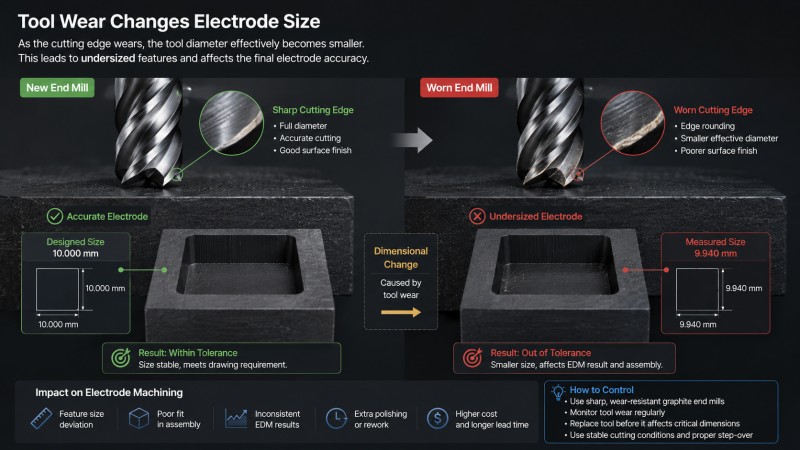
Tool wear is one of the main reasons for dimensional change in graphite electrode machining. As the cutting edge becomes rounded, the tool may no longer cut the same profile as a new tool. This can gradually affect small ribs, narrow slots, pocket corners, and fine electrode details.
In roughing, slight wear may not cause immediate problems. In finishing, however, worn edges can affect both size and surface finish. If a worn tool is used for the final pass, the electrode may lose accuracy even when the toolpath is correct.
This is closely related to tool life control. Our article on tool wear in graphite milling explains how flank wear, edge rounding, coating wear, and corner wear affect graphite machining results.
Different graphite electrode features require different tool shapes. If the cutter shape does not match the feature, the final dimension may be difficult to control, especially around corners, curved surfaces, and narrow details.
| Tool Type | Best Used For | Accuracy Benefit |
|---|---|---|
| Flat end mill | Flat bottoms, sidewalls, and pocket surfaces | Maintains clear flat features and defined edges |
| Corner radius end mill | Corners, semi-finishing, and areas with higher edge load | Reduces corner wear and improves edge stability |
| Ball nose end mill | 3D contours, curved surfaces, and complex electrode shapes | Improves profile consistency on curved features |
Tool shape selection is discussed more fully in our guide on how to choose flat, corner radius, and ball nose end mills for graphite machining.
Runout can have a strong effect on graphite electrode accuracy. When the tool does not rotate concentrically, each flute does not remove the same amount of material. One cutting edge may wear faster, while another may cut less effectively.
This can create uneven tool marks, size variation, and faster local wear. For small graphite electrode features, even minor runout can become visible in the final result. A stable holder, correct clamping, and suitable tool extension are important for maintaining accuracy.
Before finishing, it is useful to check tool runout, holder condition, tool length, and machine stability. A good graphite end mill still needs a stable setup to maintain consistent electrode dimensions.
Finishing accuracy depends heavily on the material left from the previous operation. If the roughing or semi-finishing pass leaves uneven allowance, the final tool may remove different amounts of material across the electrode. This can affect both accuracy and surface finish.
A stable semi-finishing process helps create a more consistent finishing allowance. This is especially important for thin ribs, narrow slots, deep cavities, and 3D electrode surfaces. The final pass should remove a controlled amount of material, not correct large remaining errors from roughing.
| Machining Stage | Main Accuracy Goal | Control Point |
|---|---|---|
| Roughing | Remove material efficiently | Avoid excessive tool wear and leave enough allowance |
| Semi-finishing | Create a stable shape before finishing | Keep allowance consistent across the electrode |
| Finishing | Maintain final size and surface quality | Use a sharp tool, stable path, and controlled step-over |
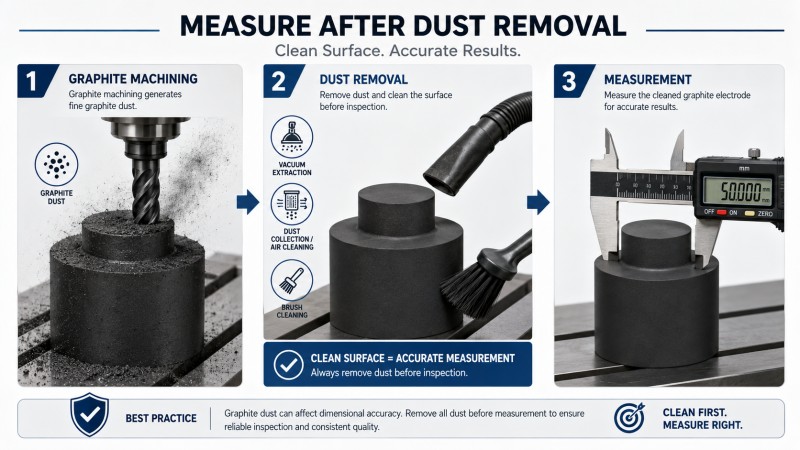
Graphite dust can affect more than surface cleanliness. If dust remains in small pockets, corners, or fine details, it can make inspection less reliable and may interfere with stable cutting. Dust buildup around the tool can also increase abrasive wear.
A clean cutting zone helps maintain better accuracy during long machining cycles. Good dust extraction, regular cleaning, and stable machining conditions can reduce the chance of dust-related inconsistency.
When measuring graphite electrodes, the part should be cleaned properly before inspection. Fine graphite dust may hide small surface defects or affect the measured result on fine features.
Surface finish and dimensional accuracy are closely related in graphite electrode machining. When the tool wears, the surface often becomes rougher and the cutting size may change at the same time. Strong feed marks, uneven texture, or chipped edges may indicate that the process is no longer stable enough for precision finishing.
Improving surface finish can also support better dimensional consistency. Smaller step-over, stable toolpaths, suitable cutter shape, and controlled tool wear all help keep the electrode surface and size more predictable. This topic is discussed in detail in our article on how to improve surface finish in graphite electrode milling.
• Use a graphite-specific end mill instead of a general-purpose cutter for precision electrode machining.
• Choose the tool shape according to the electrode feature: flat, corner radius, or ball nose.
• Use diamond-coated tools to reduce abrasive wear in graphite milling.
• Separate roughing and finishing tools when accuracy is important.
• Check tool wear before the final finishing pass.
• Control runout, tool extension, and clamping stability.
• Leave a consistent allowance for finishing.
• Keep graphite dust under control during machining and before inspection.
• Use stable toolpaths and avoid sudden engagement on fine electrode features.
Dohre's MEX series graphite end mills are designed for graphite electrode machining where tool life, surface consistency, and dimensional accuracy are important.
Why does dimensional error happen in graphite electrode machining?
Dimensional error may come from tool wear, runout, wrong tool shape, unstable finishing allowance, dust buildup, or poor toolpath stability. These factors can gradually change the final electrode size.
How does tool wear affect graphite electrode accuracy?
As the cutting edge wears, the actual cutting profile changes. This can affect small features, corners, ribs, and surface consistency, especially during finishing operations.
Which end mill is better for accurate graphite electrode machining?
It depends on the feature. Flat end mills are suitable for flat areas, corner radius end mills improve corner stability, and ball nose end mills are used for 3D contours and curved electrode surfaces.
Does diamond coating help dimensional accuracy?
Diamond coating helps reduce abrasive wear, so the tool can maintain its cutting shape for a longer time. This supports more stable surface finish and dimensional accuracy in graphite machining.
Should roughing and finishing use the same tool?
For high-accuracy graphite electrodes, it is usually better to separate roughing and finishing tools. A worn roughing tool may still remove material, but it may not maintain the accuracy required for finishing.
Improving dimensional accuracy in graphite electrode machining requires control over the entire process. Tool wear, cutter shape, runout, finishing allowance, dust evacuation, surface finish, and toolpath stability all affect the final electrode size.
A suitable graphite end mill, stable setup, clean machining environment, and controlled finishing strategy can help maintain more consistent graphite electrode quality. For precision electrode work, tool condition should be checked before the final finishing operation.
Dohre provides MEX series graphite end mills for graphite electrode machining and other graphite applications. Contact us for graphite end mill recommendations or custom tool solutions.
Do you have a questions or an issues we can help you with?
Let’s talk about your project and how Dohre can help get your tools designed, manufactured and ready for the market.
By continuing to use the site you agree to our privacy policy Terms and Conditions.