HRC60, HRC65, and HRC68 Hardened Steel: How to Choose the Right End Mill
Introduction
HRC60, HRC65, and HRC68 hardened steel all belong to high-hardness machining, but they do not place the same demand on an end mill. As hardness increases, tool wear, edge chipping, coating stability, and setup rigidity become more critical, especially in hardened mold steel milling.
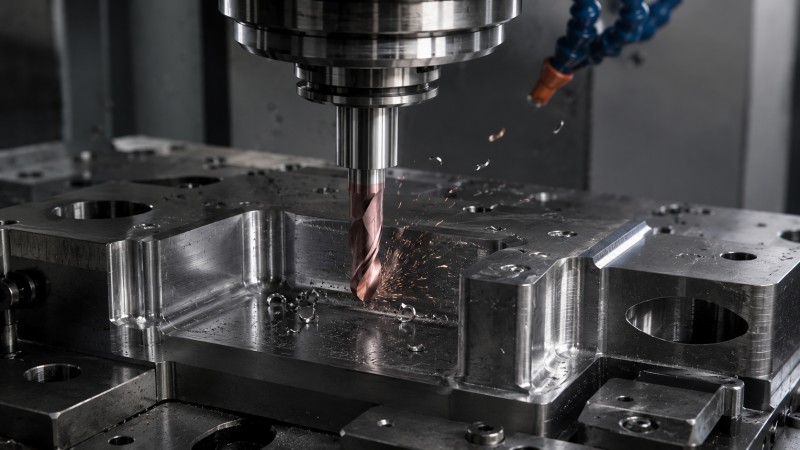
Choosing an end mill for hardened steel should not stop at the word “hardened.” A workpiece at HRC60, HRC65, and HRC68 may all look like hard milling applications, but the cutting pressure, wear speed, edge stability, and tool life requirements can be very different.
For high-hardness mold steel such as H13, NAK80, S136, 718H, and other heat-treated mold materials, the actual hardness range should be one of the first points checked before selecting the cutter. The higher the hardness, the more important it becomes to match the end mill with the machining stage, cutter geometry, tool rigidity, coating performance, and setup stability.
Why Hardness Range Matters in Hardened Steel Milling
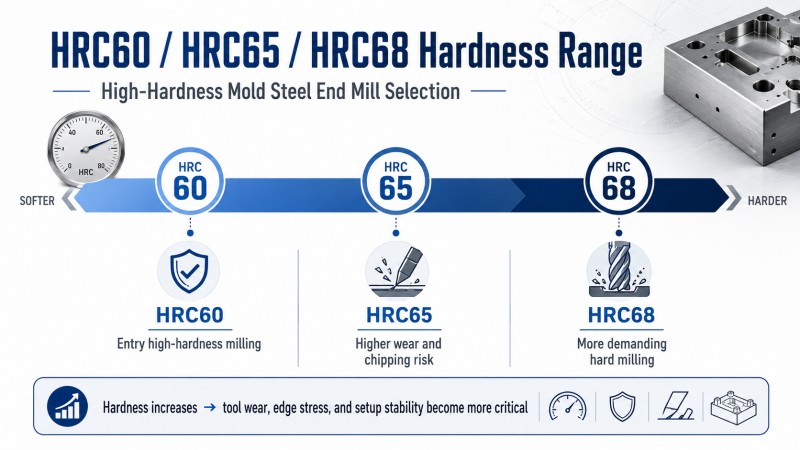
Hardness has a direct effect on how the cutting edge behaves during milling. As the workpiece becomes harder, the edge must resist higher cutting pressure and more severe wear. A tool that performs acceptably at HRC60 may not maintain the same stability at HRC65 or HRC68.
This is why hardened steel milling should be selected by actual hardness rather than material name alone. The same mold steel may require different end mills depending on heat treatment, machining allowance, finishing requirement, and machine rigidity.
| Hardness Range | Machining Difficulty | End Mill Selection Focus |
|---|
| HRC60 | Entry level of high-hardness milling | Wear resistance, stable edge strength, suitable coating |
| HRC62–65 | Higher risk of wear and chipping | Stronger edge support, tool rigidity, stable cutting path |
| HRC66–68 | More demanding hard milling condition | High wear resistance, controlled engagement, finishing stability |
HRC60 Hardened Steel: Entering the High-Hardness Range
HRC60 is already a high-hardness machining condition, but it is usually more forgiving than HRC65 or HRC68. At this level, a properly selected carbide end mill can often perform well if the cutter has good wear resistance, enough edge strength, and a stable coating.
For HRC60 mold steel, the main goal is to avoid treating the material like ordinary steel. Cutting parameters, toolholding, and cutter geometry must still be controlled carefully. Excessive runout, long overhang, or unstable cutting engagement can still cause early wear or edge chipping.
HRC62–65 Hardened Steel: Higher Wear and Chipping Risk
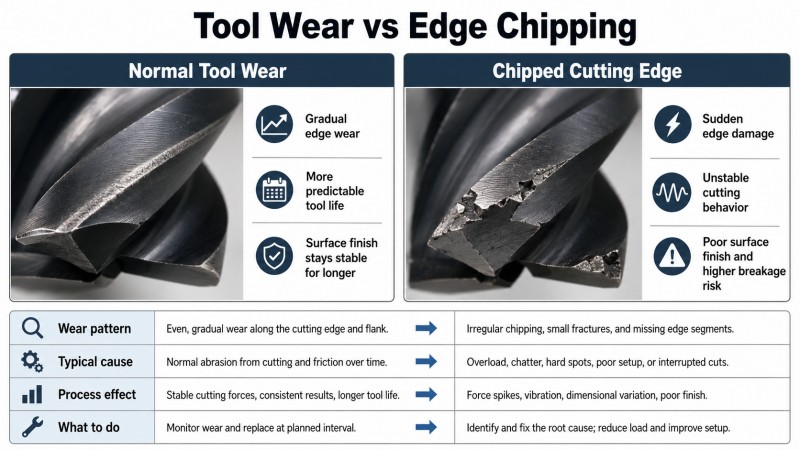
When the hardness reaches HRC62–65, the cutting edge faces higher stress. Tool wear can become faster, surface finish may become less stable, and small edge damage can develop more easily if the cutter is not properly supported.
At this range, edge strength becomes more important. A sharp edge can reduce cutting resistance, but if the edge is too weak, it may chip under high load. A stronger edge can improve durability, but if it is too blunt, it may increase heat and cutting force. The right balance depends on whether the operation is finishing, semi-finishing, side milling, or contour machining.
If chipping appears repeatedly in this hardness range, the issue may not be the hardness alone. Tool selection, runout, engagement, and setup stability should be checked together. The main causes are discussed in more detail in our article on why end mills chip when milling HRC 60–68 hardened steel.
HRC66–68 Hardened Steel: More Demanding Hard Milling Conditions
HRC66–68 hardened steel is a more demanding hard milling condition. At this level, the cutter needs stronger wear resistance, more stable edge support, and a more rigid machining setup. Small problems in toolholding or cutting path can lead to visible changes in tool life and surface quality.
For this hardness range, the machining stage becomes especially important. Finishing and semi-finishing often require controlled engagement, stable toolpath movement, and consistent edge condition. Rough or interrupted cutting may place a stronger impact load on the tool and increase the risk of edge damage.
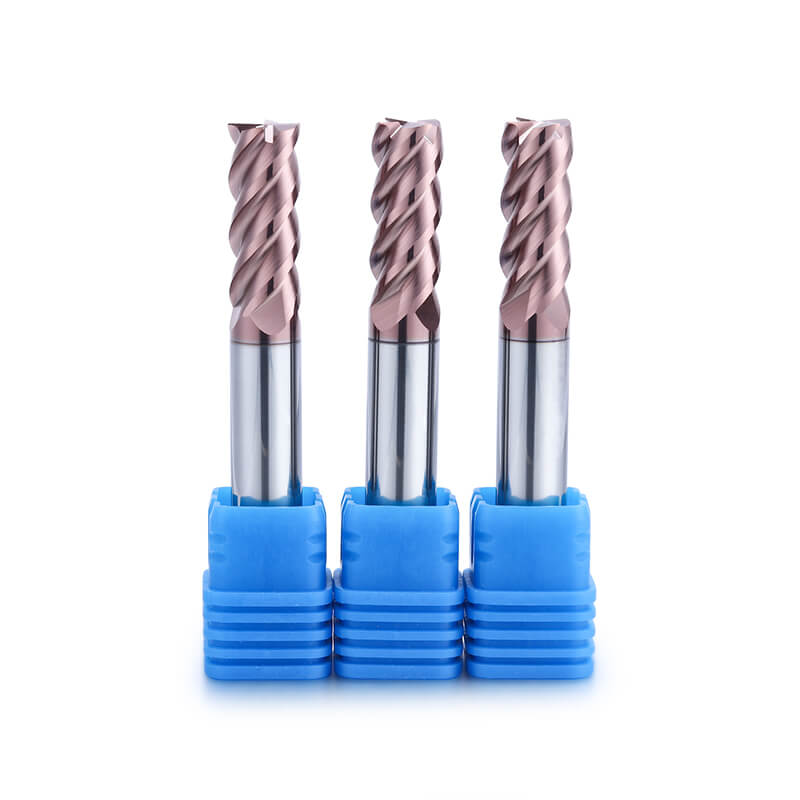
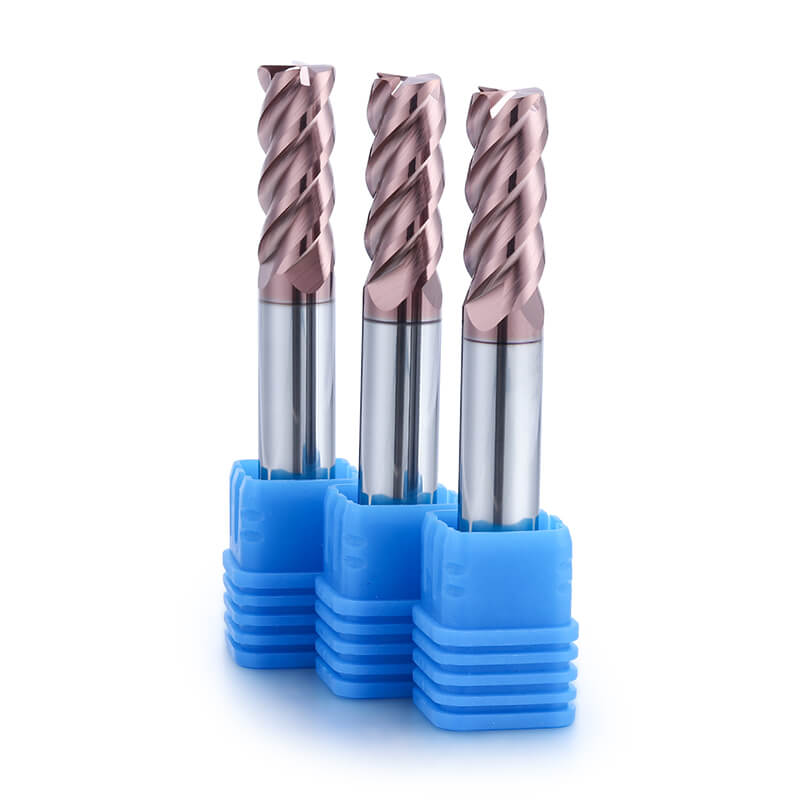
A dedicated end mill for high-hardness steel is usually more suitable than a general cutter designed for materials below HRC60. Dohre's HEX series is a company-defined high-hardness steel end mill series for HRC 60–68 hardened materials, so it should be understood as a product series name paired with its application range, not as a general international tool category.
End Mill Selection Factors for HRC60–68 Materials
For HRC60–68 hardened steel, the right end mill should be selected as a complete system. Hardness is important, but it should be evaluated together with cutter geometry, coating stability, substrate strength, machining stage, and setup rigidity.
| Selection Factor | Why It Matters | What to Check |
|---|
| Actual hardness | Higher hardness increases edge stress and wear speed | Confirm whether the workpiece is HRC60, HRC65, or near HRC68 |
| Cutter geometry | Different geometries distribute cutting load differently | Match flat, ball nose, or corner radius tool to the part feature |
| Edge strength | Weak edges chip easily under high cutting pressure | Balance sharpness and support based on machining stage |
| Coating stability | High-hardness milling creates heat and abrasive wear | Choose coating suitable for high-hardness hardened steel |
| Setup rigidity | Runout and vibration cause uneven edge loading | Reduce overhang, improve clamping, and control engagement |
How Cutter Geometry Changes with Hardness
Cutter geometry should become more carefully matched as hardness increases. In lower-hardness materials, a wider range of tools may still work. In HRC60–68 hardened steel, the wrong geometry can quickly increase cutting stress, edge wear, or chipping risk.
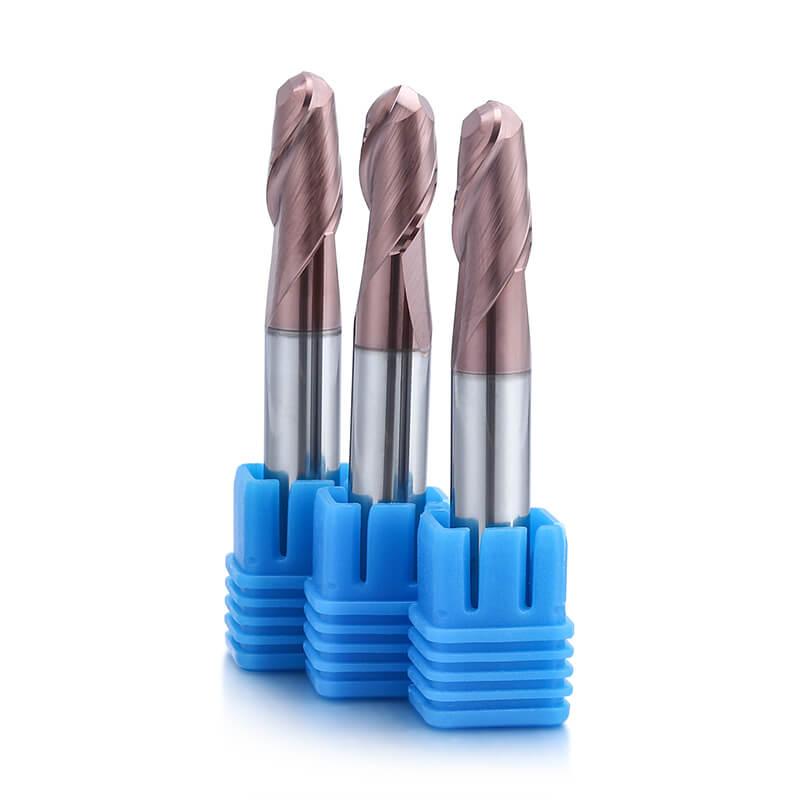
Flat end mills are useful for flat surfaces, side milling, and defined features. Ball nose end mills are more suitable for curved mold surfaces and 3D finishing. Corner radius end mills can reduce stress concentration at the corner and provide stronger edge support in some semi-finishing and finishing operations.
For HRC65 and above, the choice between these cutter types should not be based only on the cutter shape. It should also consider the contact area, toolpath, corner load, and surface finish requirement.
When Carbide May Still Work and When CBN Should Be Considered
A dedicated carbide end mill can still be a practical solution for many HRC60–68 hardened steel applications, especially when the setup is rigid, the cutting path is stable, and the tool is correctly selected for the hardness range.
However, as hardness increases and finishing requirements become more demanding, carbide may reach its practical limit in some applications. If tool wear, dimensional consistency, or surface finish becomes difficult to control even after optimizing the process, CBN may be considered for certain high-hardness finishing work.
The decision should not be made only by hardness number. It should also consider machining stage, required accuracy, tool life expectation, and process stability.
Common Selection Mistakes
• Choosing by material name only, without confirming the actual HRC value.
• Using an end mill designed for materials below HRC60 in a true HRC65 or HRC68 application.
• Selecting a very sharp edge without enough edge support for high-hardness cutting.
• Ignoring setup rigidity, runout, overhang, and machine stability.
• Using the same tool strategy for roughing, semi-finishing, and finishing.
• Assuming coating alone can solve edge chipping or unstable wear.
Practical Checklist for HRC60–68 End Mill Selection
•Confirm whether the workpiece is HRC60, HRC65, or near HRC68.
•Check whether the material is heat-treated mold steel or a lower-hardness mold material.
•Select an end mill designed for high-hardness hardened steel, not only general difficult materials.
•Match cutter geometry to flat surfaces, curved contours, sidewalls, or finishing features.
•Control runout, tool overhang, vibration, and cutting engagement.
•Evaluate tool performance by wear pattern, surface finish, dimensional stability, and edge condition.
FAQ
What end mill should I use for HRC60 hardened steel?
For HRC60 hardened steel, use an end mill designed for high-hardness materials with suitable wear resistance, edge strength, coating stability, and rigid toolholding.
Is HRC65 harder to mill than HRC60?
Yes. HRC65 usually creates higher cutting pressure and faster wear than HRC60, so cutter geometry, edge support, and setup stability become more important.
Can carbide end mills cut HRC68 hardened steel?
A dedicated carbide end mill may be used in some HRC68 applications if the setup is rigid and the cutting condition is stable. For demanding finishing or strict tool life requirements, CBN may also be considered.
Does hardness affect end mill chipping?
Yes. As hardness increases, the cutting edge faces higher stress. If the tool geometry, edge strength, or setup rigidity is not suitable, chipping becomes more likely.
Is HEX an international tool type?
No. HEX is Dohre’s company-defined product series name for high-hardness steel end mills. It should be paired with generic wording such as “end mill for HRC 60–68 hardened steel” so users can clearly understand the application.
Conclusion
HRC60, HRC65, and HRC68 hardened steel all belong to high-hardness machining, but the end mill requirements become more demanding as hardness increases. The tool must provide enough wear resistance, edge strength, coating stability, and rigidity to maintain stable cutting.
For hardened mold steel such as H13, NAK80, S136, 718H, and other heat-treated materials, the best end mill should be selected according to actual hardness, machining stage, part feature, and setup condition. A cutter that works at HRC60 may not always deliver the same result at HRC65 or HRC68.
Dohre's HEX series high-hardness steel end mill for HRC 60–68 hardened materials is designed for this type of hard milling application. Contact us for product recommendations and custom end mill solutions for hardened mold steel machining.