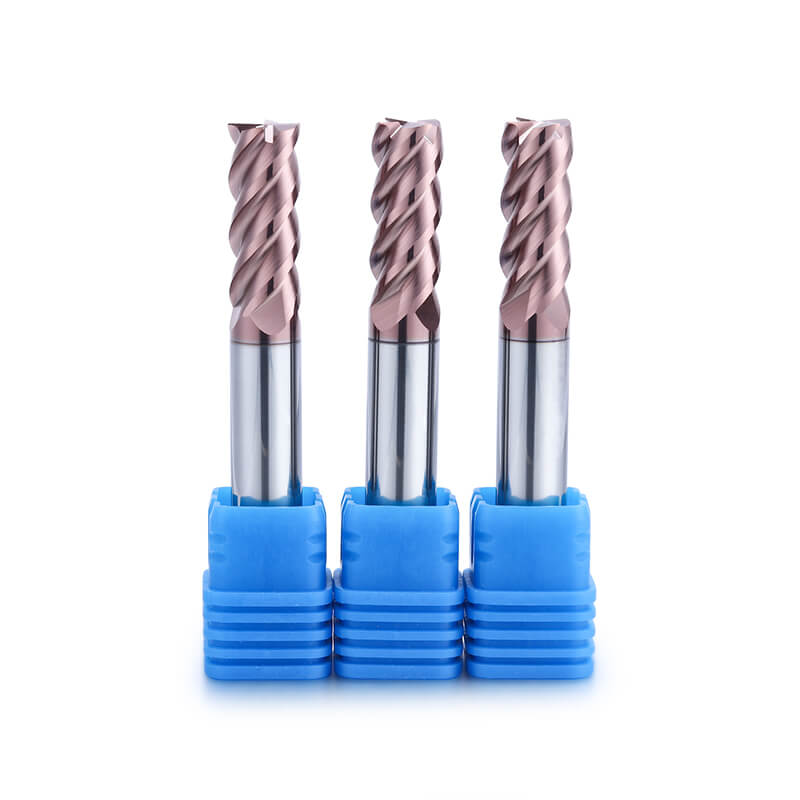
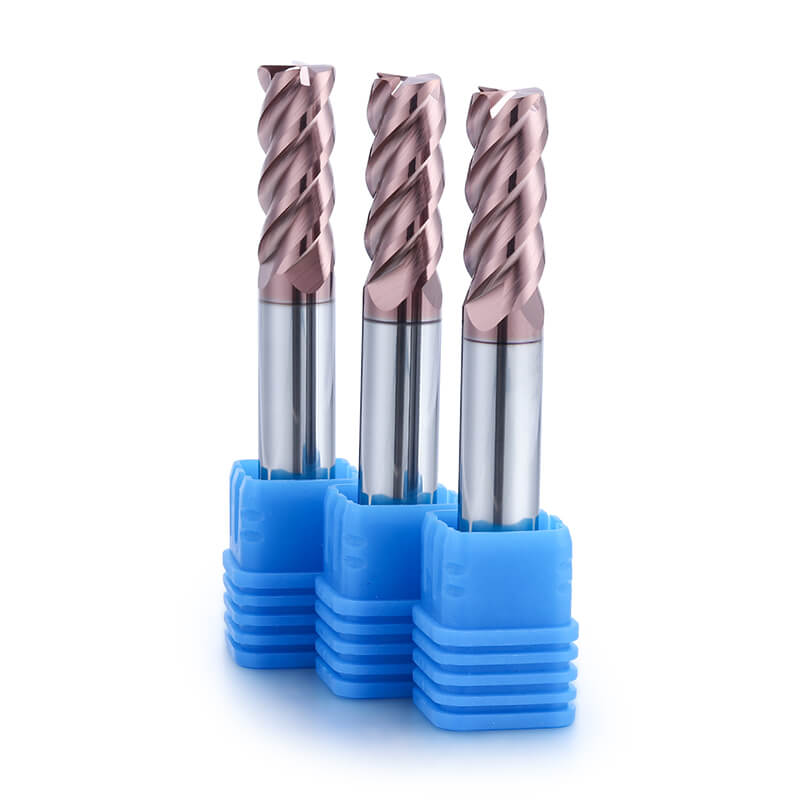
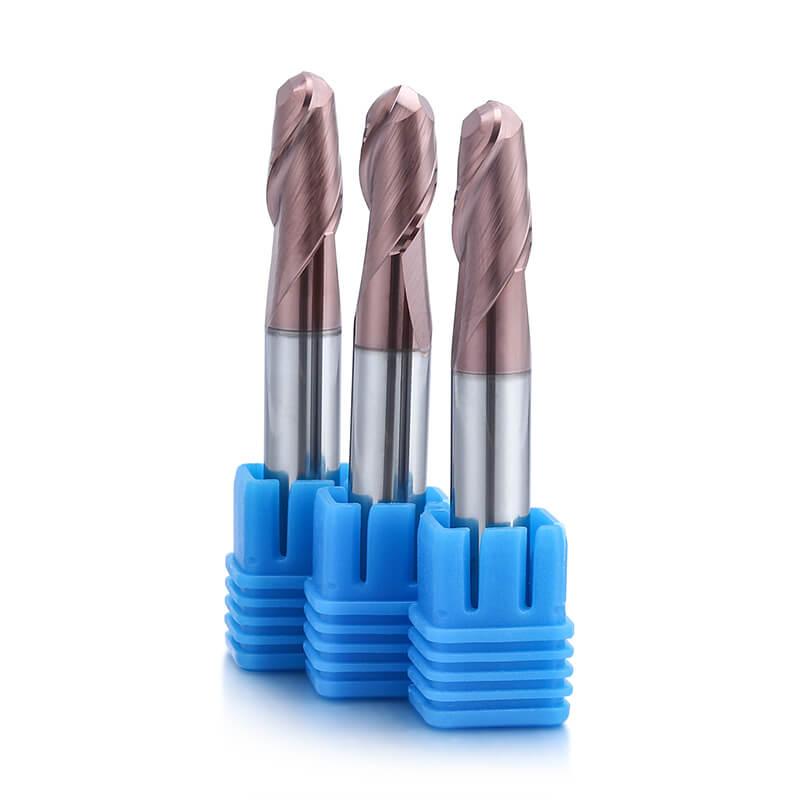
How to Reduce Vibration and Chatter in HRC60–68 Hardened Steel Milling
Introduction
HRC60–68 hardened steel milling is sensitive to vibration because the cutting edge works under high pressure and has little tolerance for unstable engagement. Reducing chatter is not only about changing cutting parameters; it also depends on tool rigidity, cutter geometry, setup stability, and a controlled cutting path.
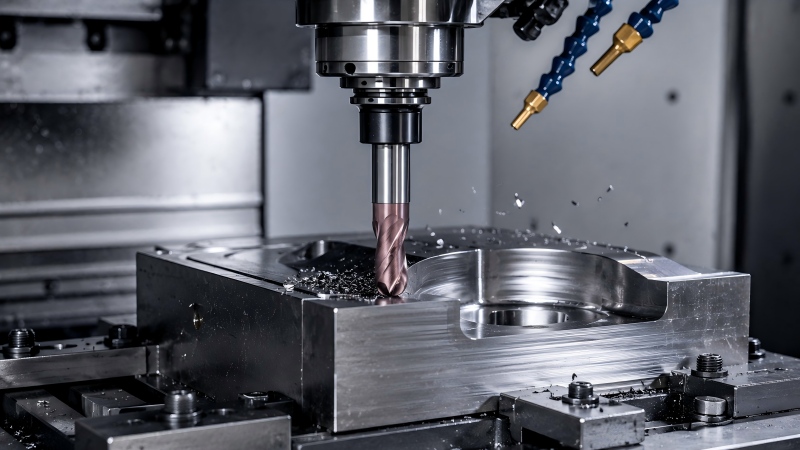
Vibration and chatter are common problems when milling HRC60–68 hardened steel. They often appear first as unstable cutting sound, visible chatter marks, uneven surface finish, or abnormal tool wear. If the problem continues, it may lead to edge chipping, shorter tool life, and poor dimensional consistency.
In hard milling, chatter is rarely caused by one factor alone. It usually comes from a combination of high material hardness, long tool overhang, weak clamping, excessive runout, unsuitable cutter geometry, or sudden cutting load changes. A stable process requires the cutter, holder, machine, toolpath, and cutting conditions to work together.
Why HRC60–68 Hardened Steel Milling Is Sensitive to Vibration
Hardened steel in the HRC60–68 range places high pressure on the cutting edge. Compared with lower-hardness mold steel, the cutter has less tolerance for unstable engagement. A small amount of runout, tool deflection, or vibration can quickly affect both the cutting edge and the machined surface.
This is why a cutter that works in easier materials may not perform the same way in HRC65 or HRC68 steel. As hardness increases, cutting force becomes more concentrated, and any weakness in the setup becomes easier to see through chatter marks, unstable finish, or faster edge wear.
Before solving chatter, it is important to confirm that the cutter is suitable for the actual hardness range. For a broader selection view, our article on how to choose an end mill for HRC60–68 hardened mold steel explains why hardness, geometry, and machining stage should be considered together.
Common Causes of Chatter in Hard Milling
Chatter often starts when the cutting edge cannot maintain stable contact with the workpiece. In HRC60–68 hardened steel, this can happen more easily because cutting resistance is high and the tool edge is under continuous stress.
| Cause | What It Causes | What to Check |
|---|
| Long tool overhang | Tool deflection and unstable cutting sound | Reduce overhang and improve holder rigidity |
| Excessive runout | One flute carries more load than the others | Check tool holder, spindle, and clamping accuracy |
| Unstable engagement | Sudden load changes and chatter marks | Use smoother entry and controlled cutting paths |
| Unsuitable cutter geometry | Poor vibration control and uneven tool wear | Choose geometry designed for hard milling stability |
How Tool Overhang and Runout Affect Milling Stability
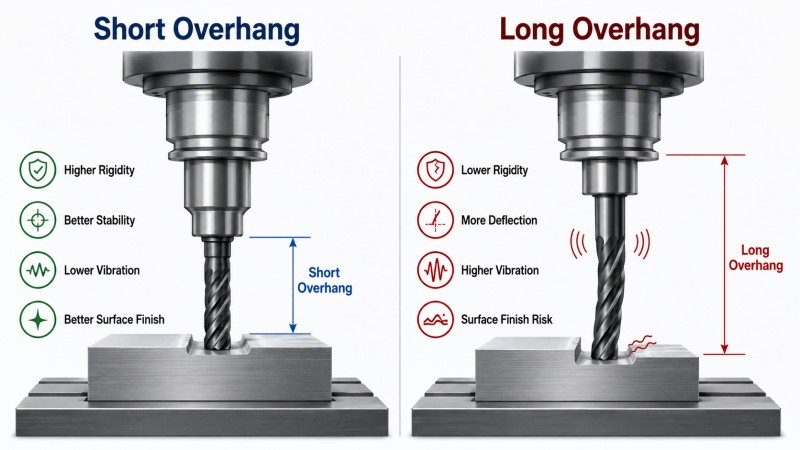
Tool overhang is one of the first things to check when chatter appears. The longer the tool extends from the holder, the easier it is for the cutter to deflect under cutting force. In HRC60–68 hardened steel, even small deflection can affect edge contact and surface finish.
Runout is another common source of vibration. When the tool does not rotate concentrically, each flute does not share the cutting load evenly. One flute may remove more material, wear faster, or chip earlier. This uneven load can create a cycle of vibration, poor surface finish, and faster tool damage.
For hardened steel milling, it is usually better to reduce overhang, use a more rigid holder, and check runout before changing the cutter or cutting data. Many chatter problems are not caused by the tool alone, but by the way the tool is held and loaded.
Why Cutter Geometry Matters for Vibration Control
Cutter geometry has a direct influence on how cutting force is generated. In hardened steel, a cutter must be strong enough to resist edge damage, but it also needs to cut smoothly enough to avoid excessive vibration. If the geometry is too weak, the edge may chip. If the geometry creates too much cutting resistance, chatter may become worse.
Flute design, core strength, helix angle, and edge preparation all affect stability. For hard milling, the cutter should not only be wear-resistant. It should also help reduce uneven cutting force during continuous engagement.
This is especially important in mold finishing, sidewall milling, and cavity machining. These operations often involve changing contact areas, narrow corners, or longer tool reach, all of which can make vibration more likely.
How Unequal Helix and Unequal Pitch Geometry Help Reduce Chatter
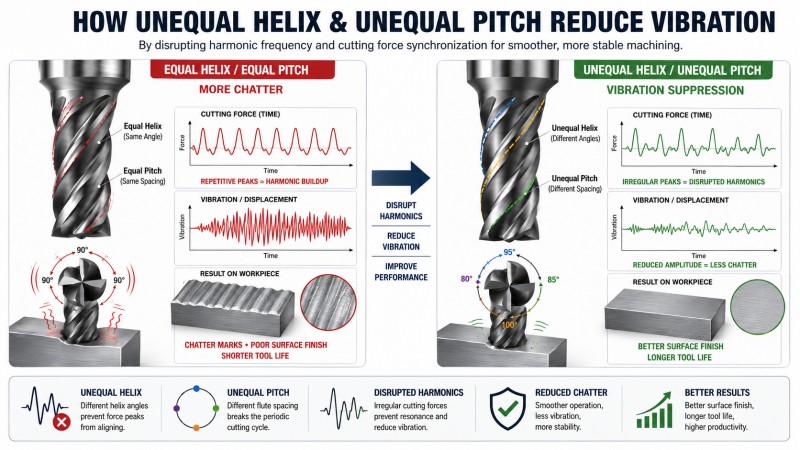
Unequal helix and unequal pitch designs are often used to help reduce vibration. Instead of allowing each cutting edge to hit the material at the same rhythm, the geometry changes the cutting timing between flutes. This helps reduce harmonic vibration and makes the cutting process more stable.
In hardened steel milling, this type of geometry can be useful because the process is sensitive to repeated impact and resonance. A more stable cutting rhythm can help reduce chatter marks, improve surface finish, and make tool wear more predictable.
For HRC60–68 hardened materials, an end mill with anti-vibration geometry and sufficient edge strength is usually more suitable than a general-purpose cutter. This is especially true when the workpiece requires stable finishing, precise sidewalls, or consistent surface quality.
Cutting Parameters That Can Increase or Reduce Chatter
Cutting parameters can either improve stability or make chatter worse. In many cases, chatter appears when radial engagement, axial depth, feed, or spindle speed creates an unstable load on the cutting edge.
| Parameter Issue | Possible Result | Adjustment Direction |
|---|
| Too much radial engagement | Higher cutting force and vibration | Reduce step-over and keep engagement more stable |
| Unstable corner entry | Sudden load increase and chatter marks | Use smoother toolpath transitions |
| Improper spindle speed | Resonance and unstable cutting sound | Adjust speed to avoid the chatter zone |
| Excessive tool load | Edge wear, chipping, and poor finish | Balance feed, depth of cut, and tool rigidity |
Surface Finish Problems Caused by Chatter
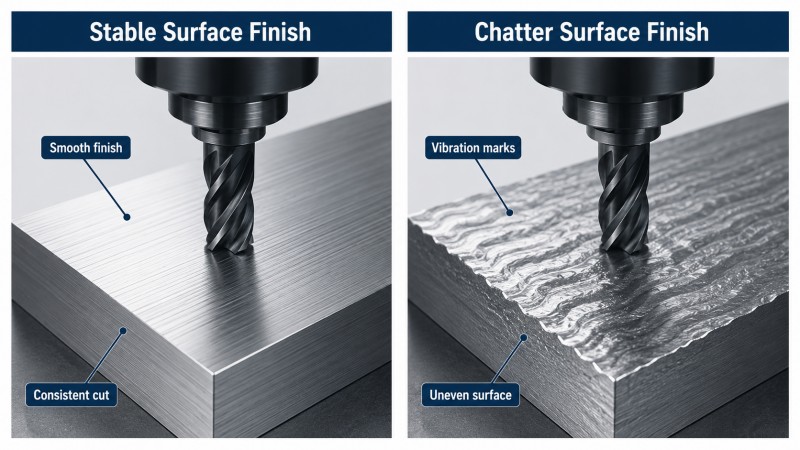
Chatter is often first noticed on the surface. Instead of a smooth and consistent finish, the workpiece may show vibration marks, wavy patterns, uneven sidewalls, or visible tool marks. In mold machining, these defects can increase polishing time and reduce dimensional consistency.
When chatter continues, it can also affect the cutter. The cutting edge may wear unevenly, develop small chips, or lose its ability to maintain a stable finish. This is why vibration control is closely related to both surface quality and tool life.
If chatter has already caused edge damage, the problem may overlap with chipping. Our article on why end mills chip when milling HRC60–68 hardened steel explains how unstable engagement, weak edge support, and runout can lead to cutting edge failure.
Practical Checklist to Improve Stability in Hardened Steel Milling
• Confirm the actual hardness range before selecting the end mill.
• Use a high-hardness steel end mill designed for HRC60–68 hardened materials.
• Reduce tool overhang as much as the part structure allows.
• Check runout, holder accuracy, spindle condition, and clamping rigidity.
• Avoid sudden engagement, sharp corner entry, and unstable toolpath transitions.
• Choose cutter geometry that supports vibration reduction and edge stability.
• Adjust spindle speed, feed, radial engagement, and axial depth together rather than changing only one value.
• Evaluate the result by surface finish, cutting sound, tool wear pattern, and dimensional consistency.
FAQ
Why does chatter happen in hardened steel milling?
Chatter happens when the cutting process becomes unstable. In hardened steel, this can be caused by high cutting force, long overhang, runout, weak clamping, unsuitable cutter geometry, or sudden changes in engagement.
How can I reduce vibration when milling HRC60–68 steel?
Reduce overhang, improve toolholding rigidity, check runout, use stable toolpaths, and choose an end mill designed for high-hardness steel milling. Cutting parameters should also be adjusted to avoid unstable engagement.
Does unequal helix geometry help reduce chatter?
Yes. Unequal helix or unequal pitch geometry can help break up repeated cutting vibration and reduce resonance, which may improve stability and surface finish in hard milling.
Can chatter cause end mill chipping?
Yes. Chatter creates unstable cutting load on the edge. If the vibration continues, the cutter may develop uneven wear, small edge chips, or sudden edge damage.
Why does surface finish become worse during hard milling?
Poor surface finish may come from chatter, tool deflection, runout, unstable engagement, or edge wear. In HRC60–68 hardened steel, these issues become more visible because the cutting condition is less forgiving.
Conclusion
Reducing vibration and chatter in HRC60–68 hardened steel milling requires more than changing one cutting parameter. The cutter, toolholder, machine rigidity, cutting path, and workpiece hardness all affect the stability of the process.
For high-hardness mold steel machining, stable cutting depends on short and rigid toolholding, controlled engagement, suitable cutter geometry, and careful parameter adjustment. Unequal helix or unequal pitch geometry can also help reduce repeated vibration and improve surface finish consistency.
Dohre's HEX series high-hardness steel end mills for HRC60–68 hardened materials are designed for this type of hard milling application. Contact us for product recommendations and custom end mill solutions for hardened steel machining.