


Get In Touch
Do you have a questions or an issues we can help you with?
Let’s talk about your project and how Dohre can help get your tools designed, manufactured and ready for the market.


Reading volume: 2975

Release time :2025-10-16
Estimated reading time:
Stainless steel is difficult to machine because of high cutting resistance, poor heat dissipation, and work hardening. This article explains which end mill types are suitable for stainless steel machining, and how carbide substrate, flute design, and heat-resistant coatings help improve tool life, chip evacuation, and surface finish.
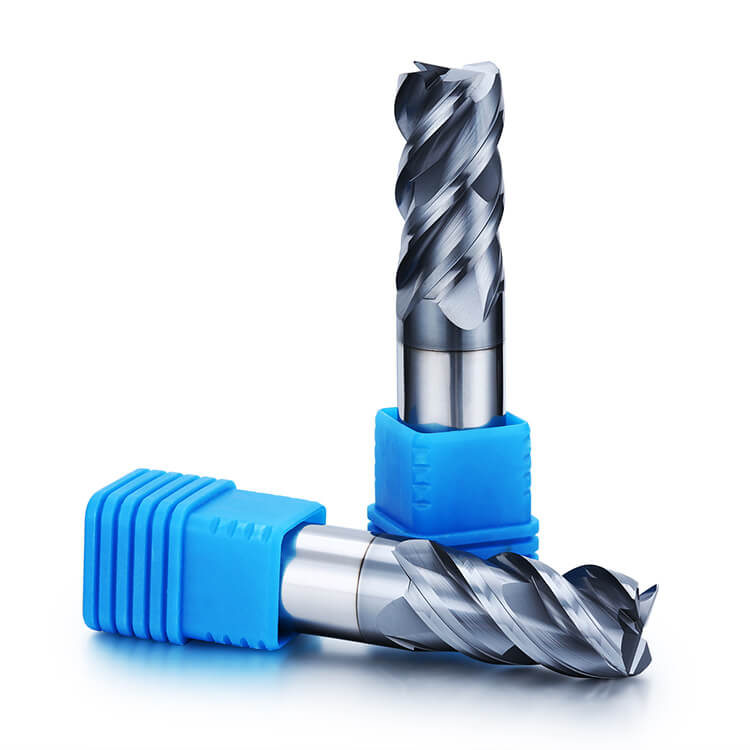
For 304 and 316L stainless steel, solid carbide end mills with suitable heat-resistant coatings, stable cutting geometry, and effective chip evacuation are generally recommended. Three- or four-flute tools are common choices, while five-flute designs may be suitable for selected applications. DOHRE CNC offers TEX Series square, ball nose, and corner radius end mills for stainless steel machining.
Stainless steel machining requires precision, stability, and the right tooling to achieve clean cuts and long tool life. Choosing the right end mills for stainless steel is especially important for common grades such as 304 and 316L, which can present challenges with work hardening, heat generation, and chip control.
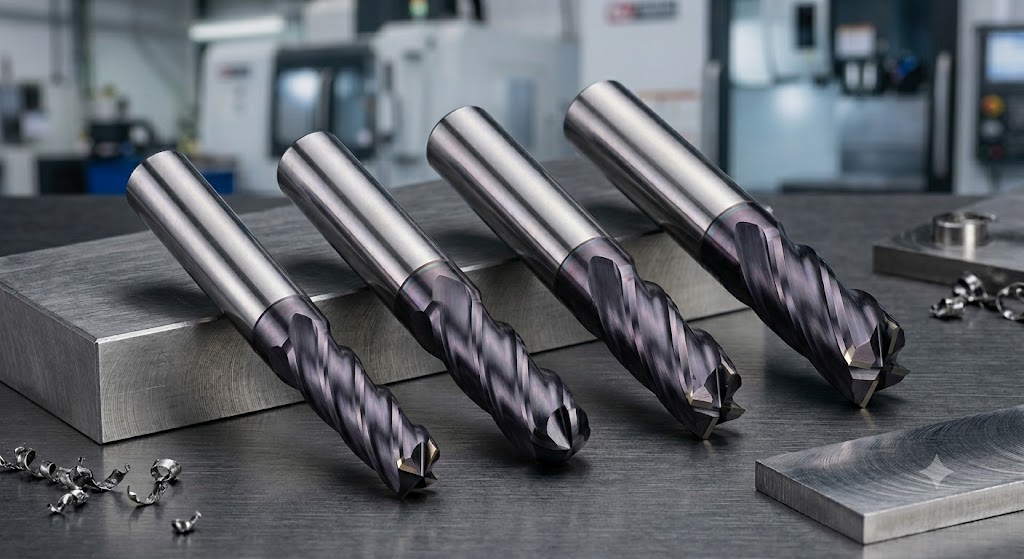
This guide explains how to select carbide grades, flute counts, coatings, tool geometries, and starting cutting conditions for different stainless steel milling operations.
Stainless steel is widely used for its corrosion resistance, strength, and durability. Austenitic grades such as 304 and 316L, however, can be challenging to machine because of their work-hardening behavior, toughness, and relatively low thermal conductivity.
Some stainless steels work harden as they deform under the cutting edge. If the tool rubs instead of cutting effectively, the next pass may encounter a harder surface.
Cutting forces can increase.
Tool wear may accelerate.
Surface finish can deteriorate.
Stainless steel toughness and cutting resistance can place substantial loads on the cutting edges and machine setup.
Accelerated edge wear or chipping
Greater risk of tool deflection
Reduced machining stability
Many stainless steels dissipate heat less effectively than aluminum or plain carbon steel, so heat can concentrate near the cutting zone.
Higher local cutting temperatures
Increased risk of premature tool failure
Greater sensitivity to unsuitable speeds and cooling strategies
A suitable coating, stable cutting parameters, and a consistent cooling strategy can help control these effects.
Stainless steel can adhere to the cutting edge and form built-up edge (BUE), particularly under unsuitable cutting conditions.
Rough or inconsistent surface finish
Unstable cutting performance
Additional edge wear
Alloy composition and microstructure influence stainless steel machinability. Certain grades may cause adhesion, work hardening, or abrasive wear, so the tool substrate, geometry, and coating should be matched to the actual grade and application.
Reliable milling performance depends on matching the tool to the stainless steel grade, cutting engagement, required surface finish, and available machine rigidity.
Fine-grain and ultra-fine-grain carbide grades can provide a useful balance of wear resistance, toughness, and edge integrity. The optimal grade depends on the cutting load and tool geometry; a harder carbide is not automatically the best choice for every setup.
Although 316L can be more difficult to machine in some conditions because of its ductility and work-hardening behavior, it should not simply be described as harder than 304. Select the carbide grade and tool design for the actual material condition and operation.
Flute count influences chip space, rigidity, and achievable feed rate. For stainless steel, three-, four-, and five-flute carbide end mills can be used depending on the operation.
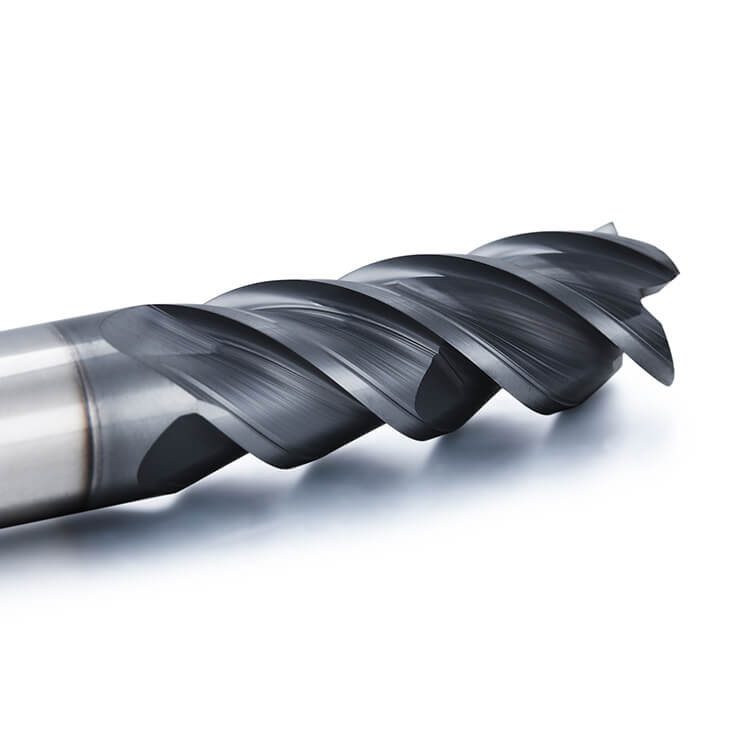
3-flute end mills: Offer more chip space and can be useful for slotting or applications where chip evacuation is a priority.
4-flute end mills: Provide a balance of rigidity, edge engagement, and chip control for many general milling and finishing operations.
5-flute end mills: May be suitable for selected side-milling or finishing operations when cutting engagement and chip evacuation permit.
Choose according to tool diameter, radial engagement, axial depth of cut, chip evacuation, and the actual specifications of the end mill.
Appropriate coatings can improve wear and oxidation resistance when machining stainless steel, particularly at elevated cutting temperatures.
AlCrN-based coatings: Provide thermal stability, oxidation resistance, and wear protection in demanding milling applications.
AlTiN and TiAlN coatings: Are also used on carbide end mills where heat and wear resistance are important.
DOHRE CNC's TEX Series uses an AlCrN-based AP coating designed for stainless steel machining applications. The final coating choice should always be matched to the actual tool model, cutting conditions, and cooling strategy.
Tool geometry affects cutting forces, vibration, and chip evacuation. Depending on the application, important features may include:
Appropriately prepared cutting edges to balance sharpness and edge strength
Variable-helix or variable-pitch geometry to help control chatter
Flute geometry designed for efficient chip removal
Corner-radius designs to strengthen the cutting edge in suitable operations
The best geometry depends on whether the operation involves slotting, roughing, side milling, or finishing.
Flat End MillsSuitable for slotting, side milling, flat-bottom features, and general profile milling. |
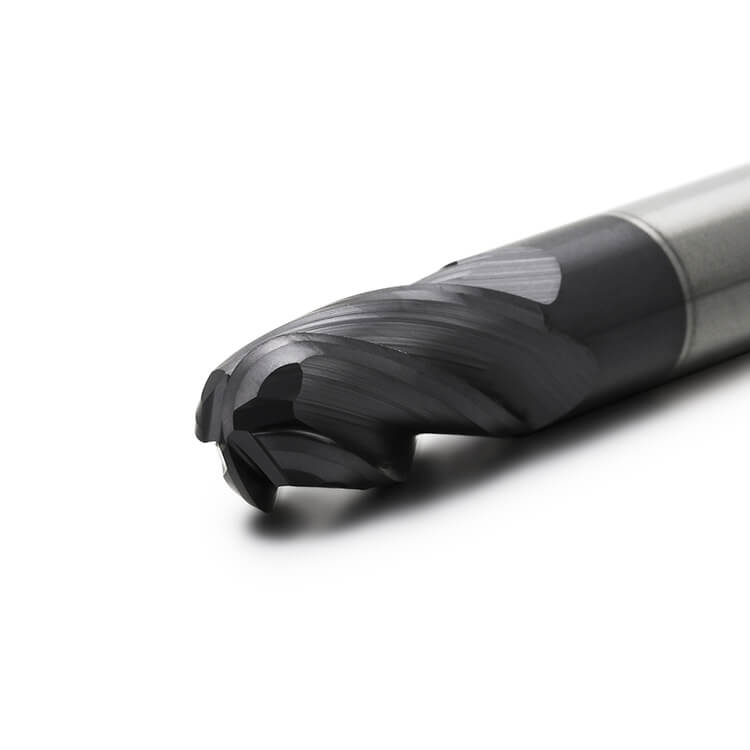
Ball Nose End MillsSuitable for 3D contouring and curved-surface finishing, including mold and die applications. |
Corner Radius End MillsA rounded corner can improve edge strength and reduce the risk of corner chipping during suitable semi-finishing operations. |
Roughing End MillsRoughing-specific geometries, including chip-breaker features where available, can help manage cutting loads during heavier material removal. |
High-Feed End MillsHigh-feed milling requires geometry specifically designed for suitable chip thinning and cutting engagement. |
Coated End MillsAlCrN-based, AlTiN, and TiAlN coating systems can provide wear and heat resistance. Coating selection depends on the material and machining process. |
For stainless steel applications, explore DOHRE CNC's TEX Series end mills, including square, ball nose, and corner radius designs. Specific dimensions, flute counts, and coatings should be confirmed from the corresponding product specifications.
Cutting parameters should be selected according to the stainless steel grade, tool diameter, cutting geometry, machine rigidity, and machining strategy.
The following figures are general reference ranges for selected stainless steel grades. They are not validated cutting parameters for every DOHRE TEX tool configuration.
| Material | Vc (m/min) | fz (mm/tooth) | ap (mm) | Coolant |
|---|---|---|---|---|
| 304 | 80–120 | 0.03–0.08 | 0.5–2.0 | Flood / MQL |
| 316L | 70–110 | 0.02–0.06 | 0.5–1.5 | Flood cooling |
| 17-4PH | 90–130 | 0.03–0.07 | 0.5–2.5 | MQL / Flood |
Reference values only. Actual cutting speed, feed per tooth, and axial depth depend on tool diameter, flute count, radial engagement, cutting strategy, heat-treatment condition (especially for 17-4PH), machine rigidity, and coolant strategy. These values require verification for the selected tool and machining conditions before production use.
Using an unsuitable flute count. Too little chip space can cause chip packing, while insufficient edge support may lead to poor performance under heavy cutting loads. Match flute count to the machining operation rather than choosing by flute number alone.
Overlooking the coating and substrate. Heat resistance is important, but coating selection must be considered together with carbide grade, edge preparation, and the actual stainless steel being machined.
Applying unsuitable cutting parameters. Excessive cutting speed, incorrect chip load, or unstable engagement may cause work hardening, chatter, poor surface finish, and premature tool failure.
Ignoring toolholding and workholding. Excessive tool runout, long overhang, and weak fixturing can reduce performance even when the end mill is properly selected.
DOHRE CNC manufactures solid carbide cutting tools for industrial machining. Its TEX Series includes square, ball nose, and corner radius end mills for stainless steel applications.
DOHRE CNC works with cutting tool distributors, wholesalers, industrial buyers, and CNC machining companies requiring standard or customized tooling. OEM/ODM requirements can be discussed according to tool dimensions, cutting geometry, coating, and machining application.
Explore the TEX Series stainless steel end mills for available product options.
Choosing suitable end mills for stainless steel involves balancing carbide grade, flute count, coating, tool geometry, and cutting conditions. Correct tool selection, stable machining, and effective chip evacuation can improve tool life, productivity, and surface finish.
For 304 and 316L stainless steel, solid carbide end mills with appropriate cutting geometry and heat-resistant coatings provide a practical starting point. The final selection should always be matched to the actual workpiece and machining requirements.
A solid carbide end mill with suitable geometry and a heat-resistant coating is a common choice for stainless steel. The best tool depends on the material grade, tool diameter, cutting operation, and machine setup. For 304 and 316L, effective chip evacuation and stable cutting conditions are particularly important.
Three- and four-flute carbide end mills are commonly used for stainless steel milling. Three-flute tools offer more chip space, while four-flute designs balance rigidity and chip evacuation. Five-flute tools may also be suitable for selected finishing or side-milling operations when cutting engagement allows sufficient chip clearance.
AlCrN-based, AlTiN, and TiAlN coatings are commonly used for their heat and wear resistance. DOHRE CNC's TEX Series uses an AlCrN-based AP coating designed for stainless steel machining. The appropriate coating depends on the tool geometry, cutting conditions, and coolant strategy.
Both 304 and 316L are austenitic stainless steels and can present challenges involving work hardening, adhesion, and heat generation. The addition of molybdenum in 316L improves corrosion resistance, while differences in composition and material condition can affect machining behavior.
Tool selection and cutting parameters should be adjusted according to the actual material condition, machining operation, and observed tool wear rather than assuming that 316L is always harder than 304.
To reduce work hardening, maintain an effective cutting action and avoid unnecessary rubbing or repeated passes over the same surface. Use an appropriate chip load, stable tool engagement, rigid workholding, and a tool geometry suitable for stainless steel.
Consistent chip evacuation and an appropriate cooling strategy can also help control cutting temperature and improve process stability.
Buyers should compare carbide substrate quality, coating suitability, tool geometry, dimensional accuracy, inspection capability, and application support. For industrial procurement, available sizes, customization options, order quantities, and delivery requirements should also be considered.
For demanding stainless steel applications, sample testing under actual machining conditions can provide more useful evidence than relying on brand reputation alone.
Yes. DOHRE CNC supplies carbide end mills for industrial buyers, distributors, wholesalers, and CNC machining companies. Its TEX Series includes square, ball nose, and corner radius end mills for stainless steel applications.
For OEM/ODM or customized tooling requirements, customers can provide the required diameter, flute count, tool length, shank dimensions, coating preferences, and machining application. The DOHRE CNC team can review these details and discuss suitable tooling options.
Do you have a questions or an issues we can help you with?
Let’s talk about your project and how Dohre can help get your tools designed, manufactured and ready for the market.
By continuing to use the site you agree to our privacy policy Terms and Conditions.