Best Practices for Carbide End Mills in Stone Machining with Forced Wet Cutting
Introduction
Carbide end mills can be used in stone machining when forced wet cutting, tight runout control, and conservative toolpaths are properly applied. This article explains practical setup, coolant delivery, CAM strategy, and trial methods for improving edge quality, tool life, and machining stability.
Stone countertop and engraving shops often default to diamond or PCD for durability and edge quality. Yet there are situations where standard carbide end mills can deliver acceptable finish and cycle times—especially for small diameters, quick-turn needs, and budget control—provided you pair them with disciplined programming and truly forced wet cutting. This guide distills field-proven practices into a repeatable setup you can trial on a 5 axis bridge mill without guesswork.
Key takeaways
Standard carbide can be viable for select countertop, edging, drilling, and engraving tasks when combined with forced wet cutting, low radial engagement, and strict runout control.
Safety first: manage respirable crystalline silica with wet methods, extraction, and PPE per the limits described by the U.S. regulator in the 8 hour TWA and the UK regulator’s workplace guidance (links below).
Program for brittle, abrasive media: constant engagement toolpaths, gentle entries/exits, and corner radius or ball nose tools for finishing reduce edge chipping.
Don’t chase a magic number—use a method: start with conservative chip loads, then adjust in ±5–10% steps based on measurable outcomes (edge chip width, Ra, tool wear per meter).
Forced wet success is about coverage and evacuation: aim the nozzles at the contact zone from both sides, maintain adequate flow/pressure, and keep filtration tight to avoid recutting fines.
Carbide end mills stone machining: where it fits and where it doesn’t
Granite, engineered quartz, marble, and sintered ceramics are simultaneously abrasive and brittle. Abrasion chews through cutting edges; brittleness turns any force spike into edge chips. PCD and diamond tooling excel in life and consistency across these conditions. Where, then, does carbide fit? In short:
When lead time, diameter variety, or cost per setup favors off the shelf carbide.
When features are small, access is tight, or geometries benefit from common carbide forms (e.g., small corner radii or ball finishes).
When you can guarantee forced wetting, tight runout, and conservative engagement to protect the edge.
If production proves that life or finish targets can’t be met within your cost�per�part window, upgrade paths to PCD/diamond remain open. This is a trial�first approach, not dogma.
Tooling, holders, and runout discipline
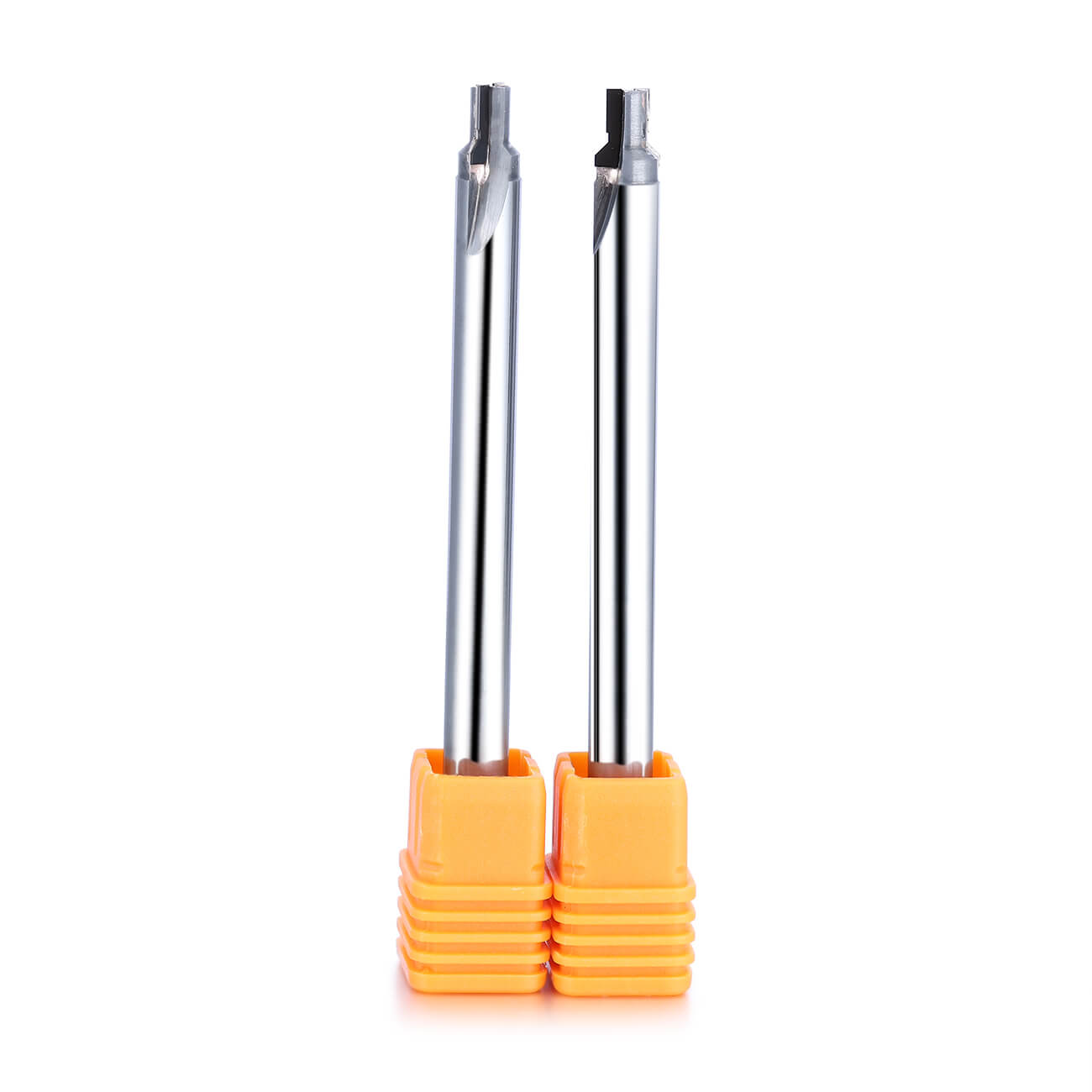
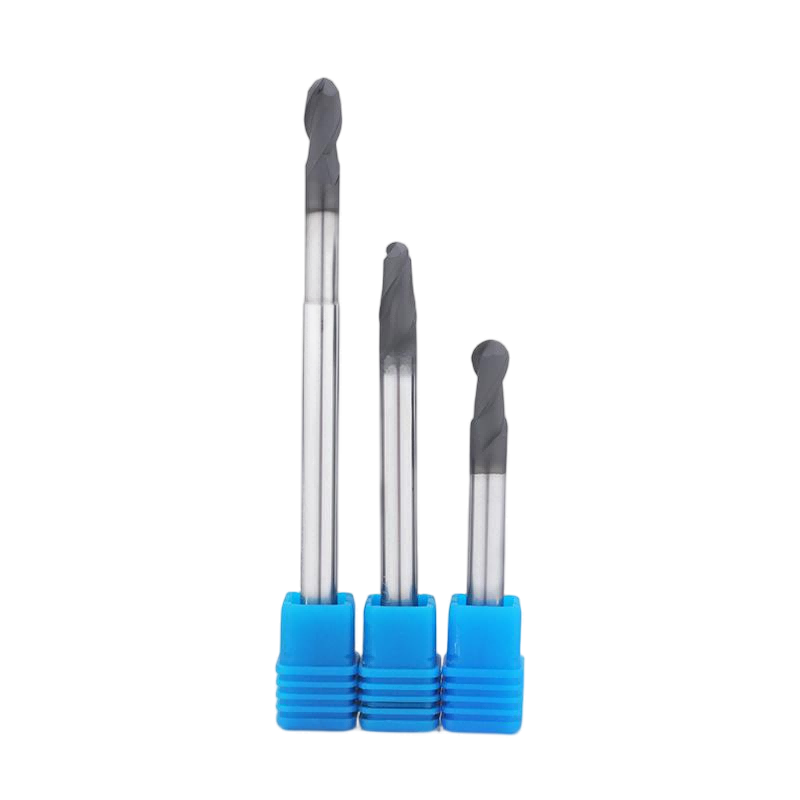
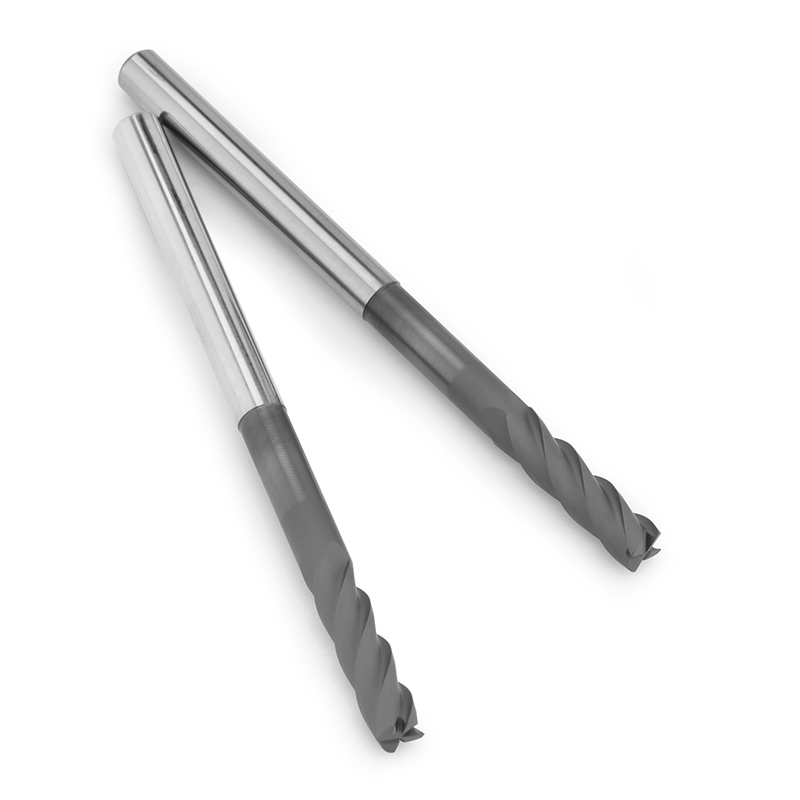
Geometry: For roughing, start with 2–4 flutes and keep radial step�over low. For finishing edges and surfaces that customers will see, favor a small corner�radius or ball�nose carbide to diffuse stress and resist micro�chipping along sharp corners.
Stickout and rigidity: Keep the tool as short as practical. Long reach amplifies vibration and chipping; plan tilt strategies on the 5�axis head to reduce effective stickout.
Runout: Target ≤0.0004 in (≤10 μm) TIR at the tool. Excess runout concentrates wear on one cutting edge and degrades finish quickly.
Holders: Shrink�fit holders typically offer better runout and stiffness than collets for small�diameter carbide. Balance the assembly when speeds climb.
The forced wet�cut playbook
Wet cutting here means more than “there’s water in the enclosure.” It’s about continuous, well�aimed delivery into the contact zone so chips and abrasive fines never linger at the edge.
Coolant type and mix: Water�soluble synthetics designed for diamond/abrasive cutting provide better heat removal and lubrication than plain water. See the guidance from an abrasive�tooling specialist on why and how to select coolant and mix ratios in their overview on diamond tool coolants: Diamond Tool Coolants: Why, How, When & Where to Use (UKAM).
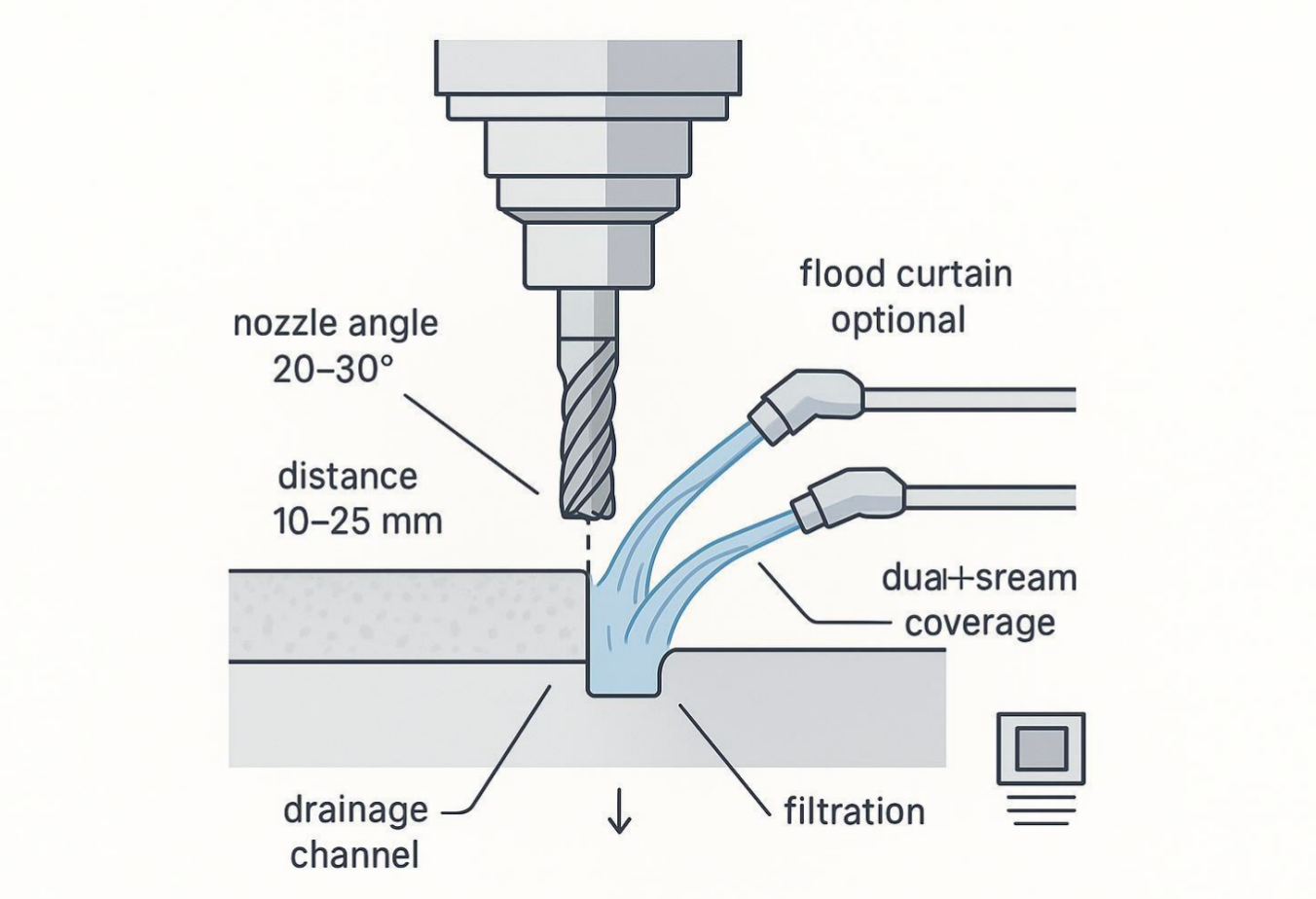
Nozzle placement: Use dual nozzles aimed 20–30° into rotation, 10–25 mm from the contact zone, offset to cover both flanks of the tool. Keep the jet slightly ahead of the cutting edge so fresh fluid meets the chip. For deep or narrow cuts, raise pressure to penetrate the cut zone.
Indicative flow/pressure (shop planning): Some 5�axis stone systems publicize saw�cooling requirements on the order of 4–5 GPM around 35–40 PSI for robust flooding. While blade cooling is not identical to end milling, these numbers are a practical reference for water�supply capacity on stone machines; see the manufacturer’s overview for examples: Guide to BACA’s Waterjets (BACA Systems).
Filtration and slurry: Maintain filtration so abrasive fines don’t recirculate. Slurry left in the cut accelerates wear; plan drainage and cleaning between passes when necessary.
CAM strategies that protect brittle edges
Constant engagement: Adaptive/trochoidal milling keeps chip thickness stable and avoids torque spikes that chip edges. For background on constant�engagement benefits in high�efficiency milling, see this machining trade publication’s explainer: How to reduce cycle times with HEM while improving tool life (Modern Machine Shop).
Radial step�over: Keep it low (often ≤15–25% of diameter) in roughing to limit peak forces and heat. Maintain axial engagement consistent with your holder rigidity and coolant coverage.
Entries and exits: Use smooth lead�ins/lead�outs; avoid slotting at full width. Where possible, leave a light skin and take a final shallow radial pass to clean up.
Near�edge holes and cutouts: Use micro�peck cycles and maintain wet coverage at entry/exit. Program a deburr or micro�chamfer pass to remove fragile edges before the final finish.
A parameter framework and a trial protocol you can trust
Published, stone�specific carbide feeds/speeds under wet cutting are limited. Rather than assert universal numbers, use this framework and a controlled trial to converge on safe, repeatable parameters for carbide end mills stone machining.
Core formulas:
RPM = (SFM × 3.82) ÷ Diameter(in)
IPM = IPT × flutes × RPM
Starting stance: Choose conservative chip loads and low radial engagement; increase in small steps if edge integrity holds and wear is stable.
Tuning ladder: Adjust one variable at a time in ±5–10% increments. Record cycle time, edge�chip width (near edges and internal corners), and tool wear per linear meter.
Inspection metrics: Define a maximum visible�edge chip width (e.g., 0.2–0.3 mm for customer�facing edges), and track Ra where feasible. Replace the tool before wear reaches your reject thresholds.
Because you’ll likely run multiple diameters, treat SFM and IPT as the “portable” starting points and calculate RPM/IPM from your tool diameter using the formulas above. The rows below show conservative starter targets for engineered quartz under forced wet cutting.
Trial matrix template (example fields; fill with your starting values and results):
Pass | Operation | SFM target | IPT (in/tooth) | Radial step-over (%) | Axial DOC (mm) | Edge-chip max (mm) | Notes |
1 | Roughing (adaptive/trochoidal) | 120–200 | 0.0003–0.0006 | 10–20% | 1–3 | ≤0.30 | Start at the low end if runout is high or stickout is long; keep forced wet coverage continuous. |
2 | Finishing (final pass / edge) | 100–160 | 0.0001–0.0003 | 3–8% | 0.3–1.0 | ≤0.25 | Use corner-radius or ball-nose for visible edges; take a shallow radial “clean-up” pass. |
3 | Hole-making (helix / plunge with clearing) | 80–140 | 0.0001–0.0003 | — | — | ≤0.25 | Prefer helical interpolation where possible; if drilling, use micro-pecks and keep the entry fully wetted. |
Troubleshooting checklist
Edge chipping: Decrease radial step�over; add or increase corner�radius/ball finishing pass; verify runout; improve nozzle aim and flow; reduce entry shock with a trochoidal lead�in.
Rapid flank wear: Reduce surface speed and/or chip load; confirm coolant concentration and filtration; avoid recutting slurry.
Vibration or chatter: Shorten stickout; switch to shrink�fit; balance the assembly; lower WOC and keep engagement constant.
Safety and regulatory notes you should not skip
Wet methods materially reduce airborne silica but are not, by themselves, a guarantee of compliance. Review the U.S. regulator’s countertop fabrication fact sheet for controls and the 50 µg/m³ 8�hr TWA limit in the construction and general industry standards: Worker Exposure to Silica during Countertop Fabrication (OSHA, 2015). In the UK, see the regulator’s advice specific to stone worktops for water suppression, on�tool extraction, and RPE to keep exposures at or below the 0.1 mg/m³ WEL: Installing stone worktops: control dust exposure (HSE). Build your program around these controls, document them, and train operators.
Practical micro�example: quartz sink cutout and edging on a 5�axis bridge mill
A shop receives a rush order for a quartz countertop with a standard sink opening and a visible eased edge. PCD tools are tied up on another job, so the team decides to trial standard carbide with forced wet cutting.
Tooling choice and rationale: For roughing the cutout, they program adaptive passes with a small square�end carbide at low radial step�over. For final edge integrity, they switch to a corner�radius carbide finisher to diffuse stress at the profile. A tool comparable to the DOHRE HEX Corner Radius End Mills series is selected for the last pass to minimize micro�chips along the edge. For a light face�finish inside the cutout, a fine�pitch carbide finisher comparable to the DOHRE PEX Solid Tungsten Carbide Finishing End Mill is used.
Wet�cut implementation: Dual nozzles are mounted on the spindle head and aimed 20–30° into rotation, 15 mm from the contact zone, with a secondary flood curtain to keep slurry flushing toward the drain. Flow is verified visually at the cut; the operator confirms continuous, fresh fluid at the interface.
Programming details: The CAM uses constant�engagement roughing, avoids full�width slotting, and leaves a thin stock layer for a final shallow�radial finish. Near the edge, holes are micro�pecked and then lightly chamfered to avoid breakout.
Results tracking: The team fills a trial matrix, increasing chip load in 5–10% steps while inspecting a coupon from the same quartz batch. They set a go/no�go edge�chip limit of 0.25 mm for the visible edge. Once stable, they run the production part and log tool wear against linear meters cut to determine the replacement interval.
Outcome: The finish meets the shop’s visible�edge criteria with controlled tool wear across the order size. The team retains carbide for similar small�feature rush jobs and keeps PCD in reserve for long runs or highly brittle stones.
Next steps
If you need small�diameter flexibility or quick�turn options for stone work, trial standard carbide with the wet�cut and parameter framework above. For custom geometries and application support, DOHRE can be a neutral supplier to evaluate alongside your current vendors.