


Get In Touch
Do you have a questions or an issues we can help you with?
Let’s talk about your project and how Dohre can help get your tools designed, manufactured and ready for the market.


Reading volume: 51

Release time :2026-10-08
Estimated reading time:
Compare dry and wet machining for hardened mold steel, including cutting heat, tool wear, coolant, chip evacuation, and end mill selection.
Choosing between dry and wet machining for hardened mold steel depends on workpiece hardness, machining stage, tooling, machine rigidity, and chip evacuation.
This guide compares both approaches and explains how to choose the right machining strategy for hardened mold steel.
Hardened mold steel generates substantial heat during milling because its high hardness increases cutting resistance. Cutting temperature varies with cutting speed, feed rate, radial engagement, axial engagement, tool geometry, and machine conditions.
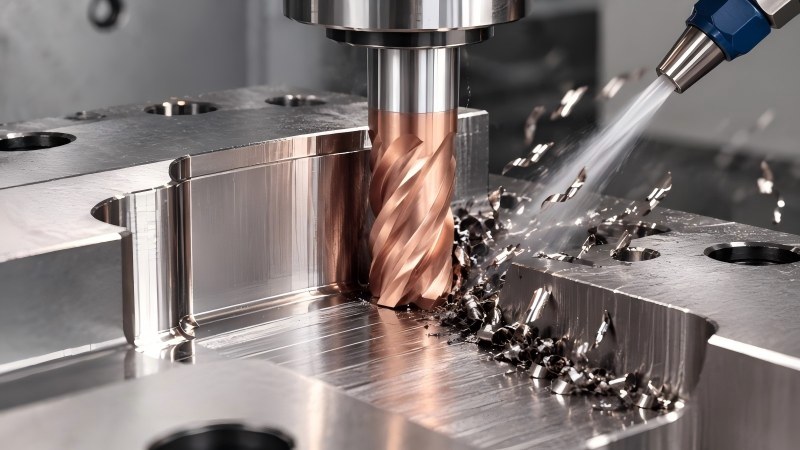
During dry machining, much of the heat leaves with the chips, while compressed air helps clear the cutting zone. Wet machining uses coolant to remove heat and control workpiece temperature when thermal management is required.
Rapid temperature changes can create thermal stress at the cutting edge, increasing the risk of micro chipping and premature wear. Dry machining avoids direct contact between hot cutting edges and liquid coolant, making it suitable for selected hardened steel operations.
For HRC60 to HRC68 materials, specialized end mills for hardened steel are designed for applications requiring wear resistance and cutting stability. Dohre's HEX Series includes square, ball nose, and corner radius end mills for this hardness range.
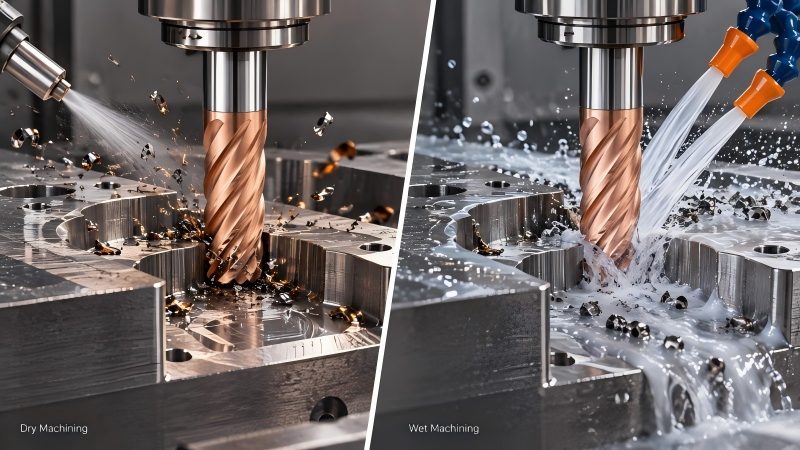
| Machining Factor | Dry Machining | Wet Machining |
|---|---|---|
| Heat removal | Heat mainly leaves with chips and air | Coolant removes heat from the cutting zone |
| Thermal cycling | No direct liquid cooling at the cutting edge | Repeated coolant contact can create thermal changes |
| Chip evacuation | Depends on effective air assistance | Coolant can help transport chips |
| Workpiece temperature | Requires process control | Coolant provides additional temperature control |
| Fluid management | No cutting fluid management | Requires coolant maintenance and disposal |
| Application suitability | Suitable for selected hard milling operations | Useful when cooling or chip removal is required |
Mold steel covers a range of hardness conditions, so tooling should be selected according to the actual material state rather than the material name alone.
For mold steel up to HRC60, carbide tooling designed for mold applications can be suitable for semi finishing and finishing when the cutting conditions are properly controlled.
Dohre's UEX Series is designed for mold steel machining up to HRC60 and covers common materials such as P20, H13, S136, and SKD61. The series uses ultra fine carbide, TiAlSiN coating, and unequal geometry for mold steel applications.
Once the workpiece reaches HRC60 or higher, wear resistance and edge stability become more important. The higher hardness also places greater demands on machine rigidity, tool holding, and cutting parameters.
Dohre's HEX Series is specifically designed for hardened steel from HRC60 to HRC68. Its square, ball nose, and corner radius end mills cover flat surfaces, 3D contours, side walls, shoulders, and mold cavity finishing.
Tool substrate and coating should match the material hardness and machining stage.
For mold steel within the carbide tooling range, ultra fine carbide and suitable coatings can improve wear resistance and cutting stability. For harder materials, CBN can be considered when the workpiece hardness, finishing allowance, machine rigidity, and toolpath are suitable.
Dry machining can be effective for stable finishing operations when the cutting tool can tolerate the generated heat and the machine setup provides sufficient rigidity.
For HRC60+ hardened steel, CBN can be considered when high wear resistance and thermal stability are required. Dohre's CBN end mills for hardened steel are designed for finishing HRC60+ hardened steel, quenched steel, hardened mold steel, and high hardness die steel.
CBN should not be treated as a universal replacement for carbide. Its suitability depends on workpiece hardness, finishing allowance, machine rigidity, tool holding, cutting path, and required surface finish.
Chip evacuation becomes especially important during dry machining. Chips trapped inside a mold cavity can be recut by the tool, increasing cutting forces and accelerating edge wear.
Compressed air can help clear chips without introducing liquid coolant. Nozzle position and airflow should be adjusted according to cavity depth, tool diameter, and chip volume.
Dry machining is sensitive to vibration and tool deflection. Excessive tool overhang, runout, weak clamping, or unstable cutting engagement can increase edge wear and reduce surface quality.
Keeping the tool as short and rigid as the application allows helps maintain stable cutting conditions.
Wet machining can be useful when chip removal is the main concern. Deep holes, enclosed features, and operations with significant chip accumulation may benefit from coolant based chip evacuation.
The decision should therefore be based on the actual operation rather than treating dry machining as a universal replacement for coolant.
Some mold components have tight dimensional requirements where workpiece temperature needs closer control. In these cases, coolant can help manage thermal expansion during machining.
However, the effect of liquid coolant on a hot cutting edge should also be considered when machining hardened steel at high cutting temperatures.
Roughing generates more chips and can produce significant cutting heat. Depending on the machine, tool geometry, material hardness, and cutting parameters, wet machining may provide useful heat and chip management.
For finishing operations, dry machining may be more practical when the tooling and machine conditions support stable cutting.
Start by identifying the actual hardness after heat treatment.
For mold steel up to HRC60, carbide end mills designed for mold steel can be suitable. For HRC60 to HRC68 hardened steel, dedicated hardened steel end mills are more appropriate. CBN can be considered for selected HRC60+ finishing applications.
Tool geometry should match the feature being machined.
Square end mills are suitable for flat surfaces, slots, shoulders, and side walls. Ball nose end mills are suited to 3D contours and curved mold surfaces. Corner radius end mills provide stronger edge support for shoulders, steps, and side wall finishing.
Long tool overhang increases deflection and vibration. Excessive runout can also create uneven loading across the cutting edges.
Keeping the tool short and maintaining accurate tool holding can improve stability when machining hardened mold steel.
Cutting speed and feed should not be selected from hardness alone. Tool diameter, flute count, radial engagement, axial engagement, machine rigidity, tool overhang, and workpiece geometry also affect the appropriate parameters.
Manufacturer recommended cutting data should be treated as a starting point and adjusted according to the actual machining setup.
Not in every situation. Dry machining can work well for selected hardened steel finishing operations because it avoids direct liquid cooling at a hot cutting edge. Wet machining remains useful when cooling, chip evacuation, or workpiece temperature control is important.
Yes. Carbide end mills designed for hardened steel can be used within their recommended hardness and cutting conditions. Dohre's HEX Series is designed for hardened steel from HRC60 to HRC68.
CBN can be considered for suitable finishing applications involving HRC60+ hardened steel, particularly when wear resistance and thermal stability are important. Machine rigidity, finishing allowance, tool holding, and cutting conditions should also be evaluated.
Not every dry machining operation requires compressed air, but effective chip evacuation is important. Air assistance can help remove chips from mold cavities and reduce chip recutting during hardened steel milling.
Dry and wet machining can both be suitable for hardened mold steel. The better choice depends on material hardness, machining stage, tooling, machine rigidity, and chip evacuation requirements.
For HRC60 to HRC68 hardened steel, dedicated tooling and stable cutting conditions are essential. If you need help selecting a suitable end mill for your application, Contact Dohre for product recommendations and custom tooling support.
Do you have a questions or an issues we can help you with?
Let’s talk about your project and how Dohre can help get your tools designed, manufactured and ready for the market.
By continuing to use the site you agree to our privacy policy Terms and Conditions.