How to Choose the Right End Mill for Mold Steel Machining
Introduction
This guide provides a systematic decision-making framework to help you precisely match end mill specifications to various mold steel hardness levels and specific machining requirements. By understanding the interaction between material properties and cutting strategies, you will be able to minimize tool wear, optimize cycle times, and maximize overall manufacturing efficiency in complex mold production.
Selecting the right end mill is critical for achieving high precision, superior surface finish, and extended tool life when machining mold steel. Given the challenging nature of mold steels—characterized by high hardness, toughness, and abrasive properties—it is essential to carefully evaluate factors such as substrate material, advanced coating technologies, and precise geometric parameters like helix angles and flute counts to withstand extreme cutting conditions.
This guide provides a systematic decision-making framework to help you precisely match end mill specifications to various mold steel hardness levels and specific machining requirements. By understanding the interaction between material properties and cutting strategies, you will be able to minimize tool wear, optimize cycle times, and maximize overall manufacturing efficiency in complex mold production.
Why Mold Steel Requires Specialized End Mills
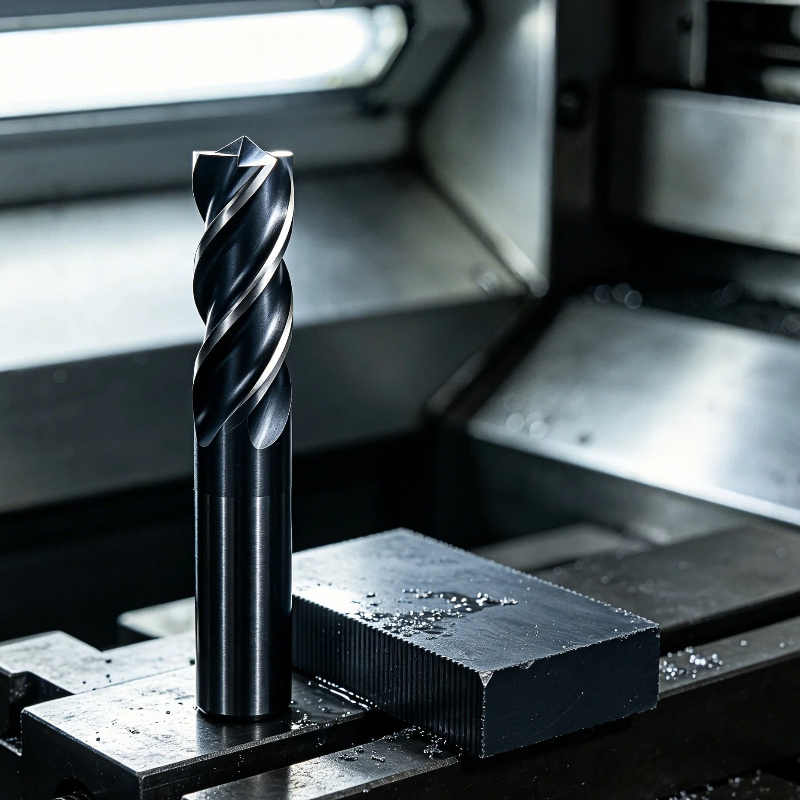
Standard end mills struggle with mold steel’s high hardness, heat resistance, and toughness. Specialized tools are engineered to overcome these challenges through four key advantages:
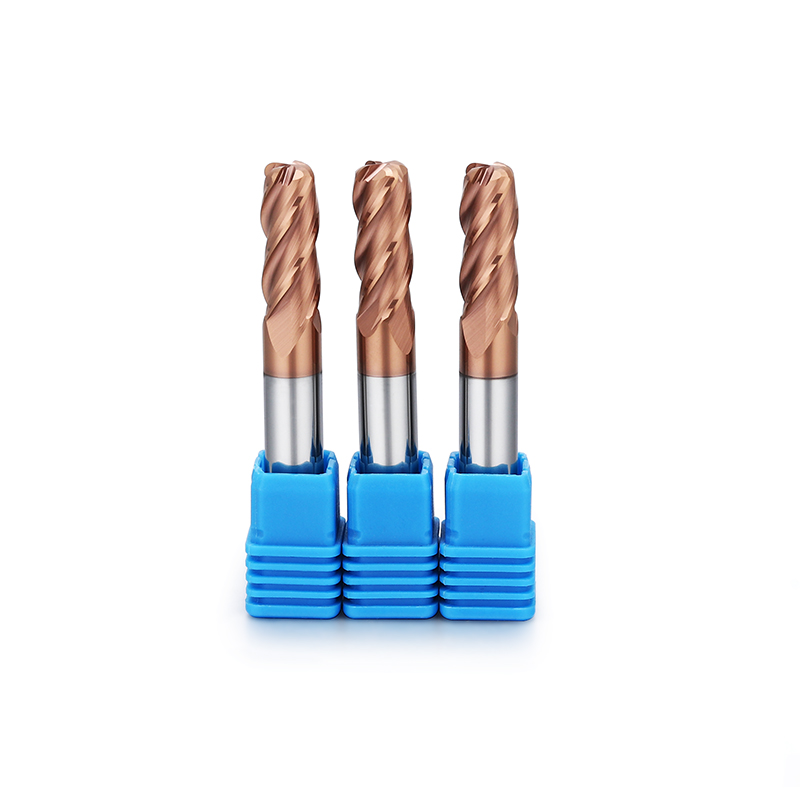
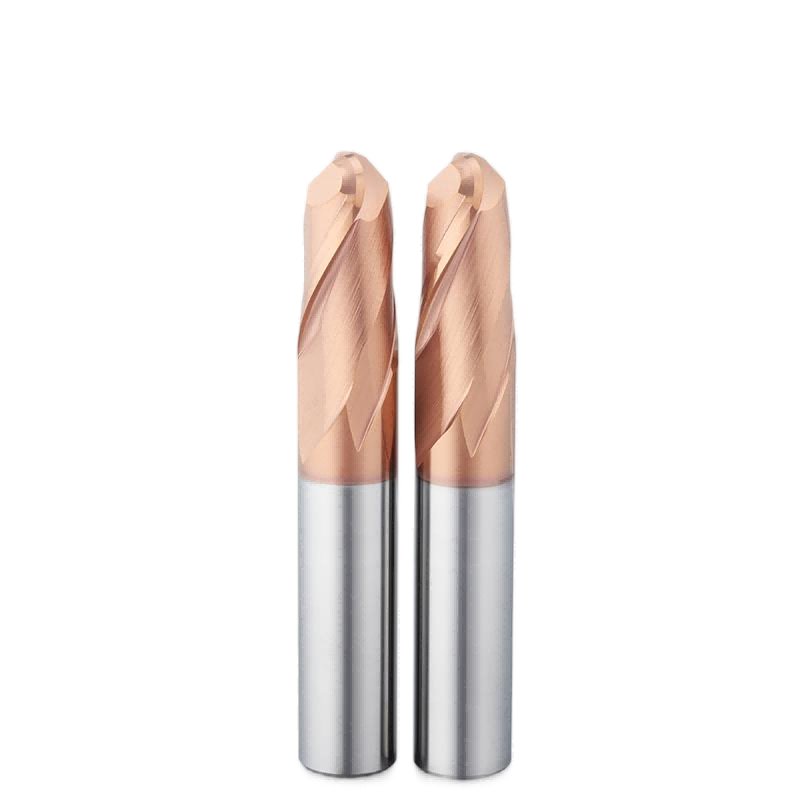
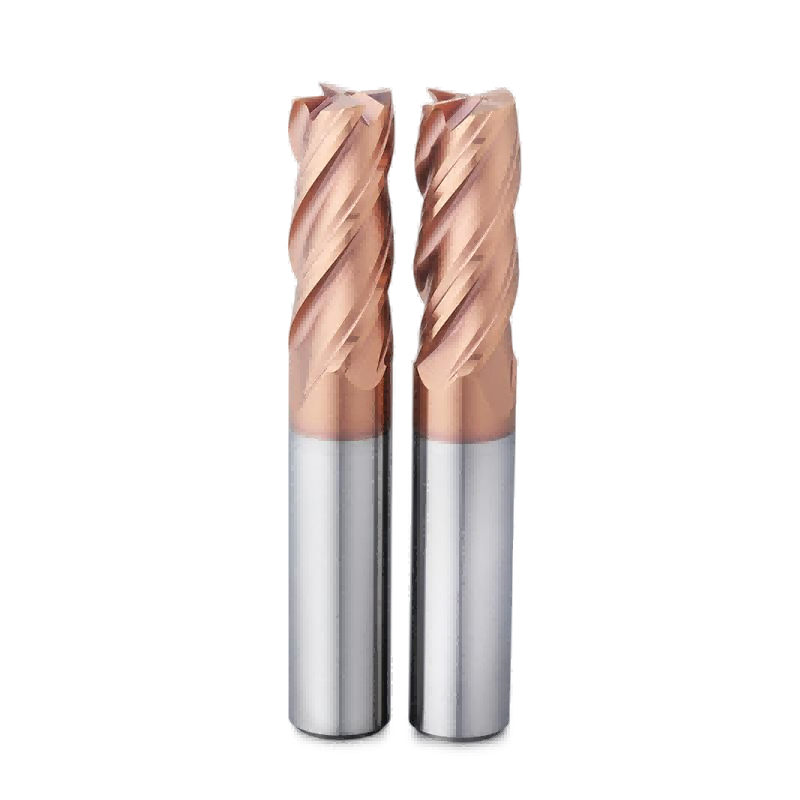
Advanced Metallurgy & Coatings: Specialized end mills use hardened carbide substrates and high-performance coatings (e.g., AlTiN) that maintain edge integrity and resist abrasive wear at extreme temperatures.
Effective Heat Management: Mold steels have low thermal conductivity. Specialized geometries promote rapid chip evacuation, preventing heat buildup that would otherwise soften the tool and cause failure.
Vibration Control: To achieve mirror-like surface finishes, these tools feature variable helix angles and unequal flute spacing. These designs break up harmonic vibrations, preventing chatter even in deep cavities.
Optimized Productivity: While costlier, specialized tools allow for higher speeds and feeds. This reduces cycle times and machine downtime, ultimately lowering the total cost-per-part in high-precision mold making.
How to Select the Right End Mill Based on Mold Steel Grade
Selecting the correct end mill depends heavily on the specific grade and hardness of the mold steel. Matching the tool’s substrate, coating, and geometry to the material’s properties is critical for performance.
1. Pre-Hardened Steels (e.g., P20, 718, NAK80)
These steels are typically machined in the 30–40 HRC range.
Tool Choice: Use General-purpose carbide end mills with AlTiN or TiAlN coatings.
Key Focus: Prioritize tool life and material removal rates. A 4-flute configuration is often ideal for balancing rigidity with chip evacuation.
2. Hot-Work Tool Steels (e.g., H13)
Known for high thermal resistance and toughness, H13 is notoriously difficult to machine when hardened.
Tool Choice: High-performance carbide end mills featuring specialized coatings like AlTiSiN (Silicon-based) to handle high friction and heat.
Key Focus: Thermal management. The coating must resist oxidation at high cutting temperatures to prevent crater wear.
3. Hardened Tool Steels (e.g., D2, Stainless Steels, 50–60+ HRC)
Machining in the hardened state requires extreme precision and wear resistance.
Tool Choice: Micro-grain carbide tools with advanced ceramic or PVD coatings designed for hard milling.
Key Focus: Rigidity and geometry. Use tools with specialized cutting geometries (e.g., negative rake angles or reinforced core diameters) to withstand the intense pressure and prevent chipping.
Selection Quick Reference Table
Pro Tip: Always prioritize tool rigidity over flute count when machining high-hardness steels. A larger core diameter reduces deflection, even if it slightly limits chip clearance.
Carbide, Coating, and Geometry: What Matters Most
Achieving optimal performance in mold steel requires balancing three fundamental pillars of tool design. Neglecting any one of these can lead to premature failure, even with the highest-quality machine.
1. Carbide Substrate: The Foundation
The substrate determines the tool's toughness and ability to hold an edge.
Ultrafine/Nano-Grain Carbide: These are the industry standard for mold work. They provide the perfect balance between hardness (to resist wear) and transverse rupture strength (to prevent chipping).
Why it matters: In mold steel, the cutting edge is subjected to intense pressure. A high-quality, fine-grain substrate ensures the edge stays sharp longer, preventing the "rubbing" effect that leads to work hardening and heat buildup.
2. Coating: The Thermal Barrier
Coatings are not just for show; they act as a sacrificial shield and a lubricant.
Advanced PVD Coatings: Materials like AlTiN (Aluminum Titanium Nitride) or AlTiSiN (Silicon-doped) create a hard, ceramic-like layer that remains stable at high temperatures.
Why it matters: Mold steel is a poor conductor of heat. Coatings effectively prevent this heat from migrating into the carbide substrate, which would otherwise soften the steel and cause the tool to deform or "mushroom."
3. Geometry: The Cutting Mechanism
Geometry dictates how the tool interacts with the material, controls chip flow, and manages vibration.
Variable Helix & Flute Geometry: Unequal helix angles disrupt harmonic vibrations, which is vital for achieving the high-quality surface finish required for mold cavities.
Core Diameter & Rake Angle: A reinforced core provides the structural rigidity to minimize deflection during deep-cavity milling, while the rake angle dictates the cutting action (shear vs. ploughing).
Why it matters: Geometry is the primary factor in stability. Even a premium coated tool will fail if the geometry allows the tool to deflect or vibrate, as this destroys the cutting edge through micro-chipping.
Which Matters Most?
For Roughing: Substrate and Geometry. You need toughness to survive impact and high-volume chip evacuation to handle heavy loads.
For Finishing: Geometry and Coating. You need precise, vibration-free movement (geometry) and a low-friction surface (coating) to achieve a mirror-like finish.
The Verdict: While the substrate provides the strength and the coating provides the heat resistance, geometry is the deciding factor for precision. If your tool vibrates, no amount of advanced coating can save it from premature failure.
Recommended End Mills for P20, H13, NAK80, and S136 Steel
Selecting the right tool for common mold steels requires matching the end mill to the material’s specific thermal and mechanical characteristics. Below is a guide to optimizing your tool selection for these industry-standard grades.
1. P20 (Pre-hardened Mold Steel)
P20 is the workhorse of the mold industry. It is relatively easy to machine but prone to work hardening if the tool is too dull.
Recommendation: 4-Flute Carbide End Mills with AlTiN coating.
Why: A 4-flute design offers the best balance of rigidity and chip clearance. The AlTiN coating provides excellent heat resistance, allowing for higher cutting speeds without shortening tool life.
2. H13 (Hot-Work Tool Steel)
H13 is notoriously difficult due to its high toughness and thermal resistance. It requires tools that can handle high heat at the cutting zone.
Recommendation: High-Performance Solid Carbide End Mills with Si-based (Silicon) coatings (like AlTiSiN).
Why: Silicon-based coatings offer superior oxidation resistance at the high temperatures H13 generates, preventing crater wear and maintaining edge sharpness.
3. NAK80 (Pre-hardened Mirror-Finish Steel)
NAK80 is known for its excellent weldability and high mirror-finish potential. However, it can be "sticky," often leading to Built-Up Edge (BUE) on the tool.
Recommendation: Polished Carbide End Mills (high-polish flutes) with TiAlN or specialized multi-layer coatings.
Why: A highly polished flute prevents chips from welding to the tool, ensuring a superior surface finish. Choose a tool with a high rake angle to shear the material cleanly rather than pushing it.
4. S136 (Stainless Mold Steel)
S136 is highly corrosion-resistant but extremely abrasive, which quickly wears down standard cutters.
Recommendation: Micro-grain Carbide End Mills with Hard PVD Coatings (such as TiAlN or AlCrN).
Why: S136 acts like a "tough" stainless steel. You need a substrate with high abrasive wear resistance and a coating that stays bonded to the tool even when under high pressure.
Common Tool Wear Issues and How to Prevent Them
Tool wear is common in mold steel machining and mainly includes flank wear, edge chipping, built-up edge, and thermal cracking.
Flank wear happens due to continuous friction; using carbide end mills with wear-resistant coatings helps reduce it. Edge chipping usually comes from unstable cutting conditions, so stronger tool geometry and stable setup are important. Built-up edge affects surface finish and can be reduced by optimizing cutting parameters and using proper coatings. Thermal cracking is caused by excessive heat, and it can be controlled with heat-resistant coatings and stable cooling.
Choosing the right end mill and machining parameters is key to improving tool life and performance.
FAQ
Q: Can I use one end mill for both roughing and finishing?
A: Not recommended. Roughing requires high-volume chip removal, while finishing demands sharp edges and high-polish flutes for surface quality. Using a worn roughing tool for finishing usually results in poor surface finish and dimensional errors.
Q: Does "more flutes" always mean a better surface finish?
A: Not always. More flutes allow higher feed rates, but they reduce chip clearance. If chips get trapped, they will cause scratches or tool breakage. Always balance flute count with your specific depth of cut and cavity size.
Q: When should I choose air blast over flood coolant?
A: Use air blast for hardened steels (50+ HRC) to prevent thermal shock (cracking). Use flood coolant for "sticky" materials like NAK80 to flush chips and prevent welding.
Q: How do I know if my end mill is worn out?
A: Watch for three signs: increased noise (squealing/chatter), visible burrs on the part, or a noticeable increase in spindle load (machine power usage).