


Get In Touch
Do you have a questions or an issues we can help you with?
Let’s talk about your project and how Dohre can help get your tools designed, manufactured and ready for the market.


Reading volume: 143

Release time :2026-08-24
Estimated reading time:
Master 304 & 316 stainless steel machining with the TEX Series solid carbide end mills. Engineered with AlCrN heat-resistant coatings, sub-micron carbide substrates, and anti-vibration geometries to eliminate work hardening, suppress chatter, and dramatically extend tool life in tough alloys. Contact DOHRE for a custom quote today!
Machining 304 and 316 austenitic stainless steels presents severe challenges for high precision CNC operations. Known for exceptional corrosion resistance, these alloys suffer from low thermal conductivity, extreme work hardening, and a high tendency to weld to cutting edges.
This severe thermal accumulation accelerates flank wear, triggers edge chipping, and drives up tool replacement costs in high volume production environments.
Selecting a cutting tool engineered specifically for high heat and high deformation resistance resolves these operational hurdles. By combining specialized tool geometry with an advanced coating, the TEX Series offers machine shops a reliable way to boost metal removal rates while preserving consistent part dimensions.
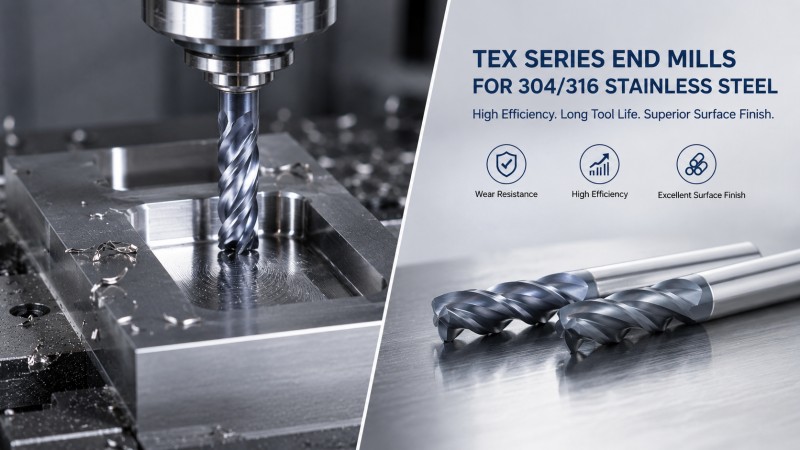
Understanding why standard cutters fail on stainless steel requires examining the mechanics of chip formation. Both 304 and 316 grades generate intense heat during shearing, rapidly hardening the unworked material ahead of the cutting edge.
Because austenitic stainless steels exhibit poor thermal conductivity, nearly 80 percent of generated heat remains trapped in the cutting zone. If a cutter rubs instead of slicing, the material hardens instantly, forcing subsequent flutes to cut through a far tougher surface layer. This heat accumulation degrades standard carbide substrates and accelerates notch wear at the depth of cut line.
While 304 is the baseline stainless grade, 316 contains molybdenum to boost pitting resistance. This addition increases hot hardness and toughness, making 316 significantly harder to process.
| Material Property | 304 Stainless Steel | 316 Stainless Steel |
|---|---|---|
| Machinability Rating | Approximately 45 percent | Approximately 36 percent |
| Alloying Content | 18 percent Chromium / 8 percent Nickel | 16 percent Chromium / 10 percent Nickel / 2 percent Molybdenum |
| Primary Wear Mode | Built up edge and flank wear | Severe notch wear and thermal cracking |
| Recommended Application | General industrial parts | Marine and medical components |
Having identified the material challenges that degrade cutting edges, let us examine how dedicated engineering solves these persistent failure modes.
Addressing premature tool breakdown requires a tool design optimized for vibration control, edge toughness, and high thermal resistance under continuous loads.
Harmonic chatter causes micro chipping on cutting edges. The TEX Series incorporates unequal flute indexing combined with a variable helix angle. By continually varying the pitch angle during rotation, the cutter disrupts resonance buildup, stabilizes the tool during heavy side milling, and produces smoother surface finishes.
Tool integrity depends entirely on raw carbide quality. Manufactured by an experienced carbide end mill manufacturer, TEX cutters utilize ultra fine micro grain carbide paired with a 12 percent cobalt binder to deliver distinct advantages:
Pure virgin tungsten carbide structure free of recycled impurities
Sub micron grain size for maximum flank wear resistance
High cobalt content to absorb heavy mechanical shock during roughing
To protect the tool face against localized heat, TEX tools utilize an AlCrN based AP coating. This layer withstands temperatures up to 1200 degrees Celsius while maintaining low friction:
Prevents sticky stainless steel chips from welding to flutes
Resists oxidation during dry cutting or high speed operations
Retains edge sharpness across extended production cycles
With the structural advantages of the tool established, proper cutting strategies must be applied to maximize overall efficiency on the factory floor.
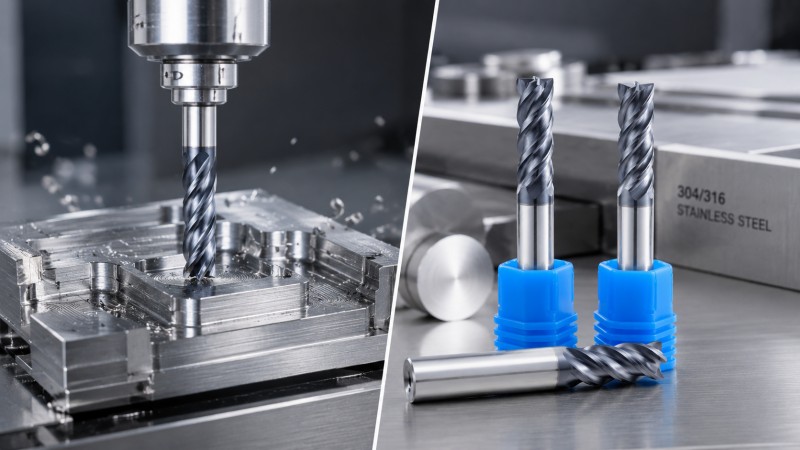
Applying optimal feeds, speeds, and tool paths ensures that cutting forces remain stable while heat escapes primarily through the chip.
Setting the feed per tooth high enough prevents flutes from sliding across work hardened surfaces. Maintaining an axial depth of cut between 1.0 and 1.5 times the tool diameter distributes wear evenly across the entire flute length rather than concentrating stress solely at the corner tip.
Trochoidal milling paths maintain a low radial engagement angle, typically between 8 percent and 15 percent of the cutter diameter. This strategy reduces contact time per revolution, lowers heat transfer into the tool body, and allows operators to increase table feeds without risking catastrophic breakage.
Beyond path optimization, controlling thermal fatigue caused by improper fluid application is equally critical to edge survival.
Thermal shock represents a major cause of sudden tool failure, often confused with standard mechanical wear during heavy stainless processing.
Applying low pressure flood coolant to a tool running at high speeds creates rapid thermal cycling. Flutes heat up to 900 degrees Celsius inside the cut, then rapidly cool upon exiting. This constant expansion and contraction forms micro cracks perpendicular to the cutting edge, eventually causing large sections of carbide to break away.
Selecting the correct cooling method depends on the milling application:
High pressure air blast works best for trochoidal milling by blowing hot chips clear without thermal shock
Through spindle liquid coolant operating at 50 bar or higher effectively flushes chips during deep slotting using specialized End mills for stainless steel
To help you make the best decision for your specific setup, here are answers to common practical questions that often come up during tool selection and shop management.
Pricing depends on raw carbide grade quality, batch volume, complex custom geometries, and specialized coating applications. For accurate pricing based on your specific machining requirements, contact the engineering team at DOHRE directly.
Selecting TiAlN or general titan nitride coatings instead of AlCrN based formulas is a frequent error. Standard coatings lack sufficient oxidation resistance at extreme temperatures, allowing sticky stainless chips to weld to the tool flutes.
Tool life should be tracked by counting completed parts or measuring flank wear under magnification rather than relying on audible operator cues. On 316 stainless steel, flank wear exceeding 0.2 mm indicates the cutter should be swapped to prevent workpiece damage.
Standard modifications typically ship within 7 to 10 working days. Fully custom tool profiles requiring unique grinding programs and specialized coatings generally require 2 to 3 weeks for delivery.
Machining 304 and 316 stainless steel efficiently requires cutting tools that resist work hardening, high thermal stress, and chatter. By combining sub micron virgin carbide, vibration dampening variable geometries, and heat resistant AlCrN coatings, dedicated tools help machine shops achieve consistent tool life and superior surface quality across demanding operations.
As an experienced manufacturer of high performance milling cutters, DOHRE provides complete technical support, application analysis, and custom tool designs tailored to your production equipment. Contact our engineering team today to review your machining requirements and discover how our cutting solutions can optimize your shop productivity.
Do you have a questions or an issues we can help you with?
Let’s talk about your project and how Dohre can help get your tools designed, manufactured and ready for the market.
By continuing to use the site you agree to our privacy policy Terms and Conditions.