


Get In Touch
Do you have a questions or an issues we can help you with?
Let’s talk about your project and how Dohre can help get your tools designed, manufactured and ready for the market.


Reading volume: 46

Release time :2026-10-15
Estimated reading time:
Learn how to select coolant for titanium machining, including coolant types, delivery methods, tool geometry, and production maintenance.
Choosing the right coolant is an important part of titanium machining.
The suitable coolant and delivery method depend on the machining operation, tooling, and machine setup.
This guide covers the main coolant options, delivery methods, and tooling considerations for titanium machining.
Titanium alloys tend to retain more cutting heat near the tool edge than materials that conduct heat away from the cutting area more easily.
This increases the thermal load on the cutting edge and can accelerate coating wear and edge damage.
Coolant can help remove heat and reduce friction during cutting.
However, it should support suitable cutting parameters and tool design rather than compensate for an unsuitable machining setup.
Titanium can adhere to the cutting edge under unstable cutting conditions. Built up edge may interfere with cutting performance and contribute to edge damage when adhered material breaks away.
Coolant can help reduce friction around the cutting edge, while tool coating and edge preparation influence resistance to heat, wear, and material adhesion.
Poor chip evacuation can leave chips near the cutting edge, increasing friction and heat accumulation.
Coolant flow should therefore be considered together with flute geometry and chip space. A suitable titanium alloy end mill can help move chips away from the cutting area while coolant supports heat removal.
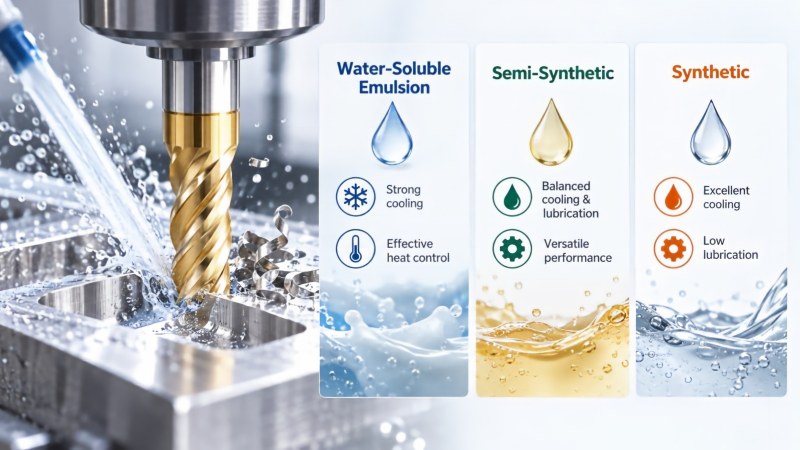
Water soluble emulsion provides both cooling and lubrication and can be considered for general titanium milling applications.
The water content supports heat removal, while the oil component provides lubrication at the tool and workpiece interface. The concentration should follow the coolant manufacturer's specifications and the requirements of the machining operation.
Consistent delivery is also important because poor coolant access can reduce its effectiveness.
Semi synthetic coolant provides a balance between cooling and lubrication. It can be considered when the machining process requires both temperature control and lubrication.
The appropriate formulation depends on the cutting operation, machine system, tool geometry, and workpiece material. Tool wear and cutting performance should be monitored during coolant evaluation.
Synthetic coolant can be considered when heat removal is a major requirement.
However, cooling capacity should not be the only selection criterion. Titanium machining can also involve material adhesion and chip control issues, so the required level of lubrication should be considered when selecting the coolant.
| Coolant Type | Cooling | Lubrication | Typical Consideration |
|---|---|---|---|
| Water soluble emulsion | High | High | General titanium milling |
| Semi synthetic | High | Moderate to high | Balanced cooling and lubrication |
| Synthetic | Very high | Moderate | Applications focused on heat control |
| MQL | Limited | High at the contact point | Selected operations with suitable parameters |
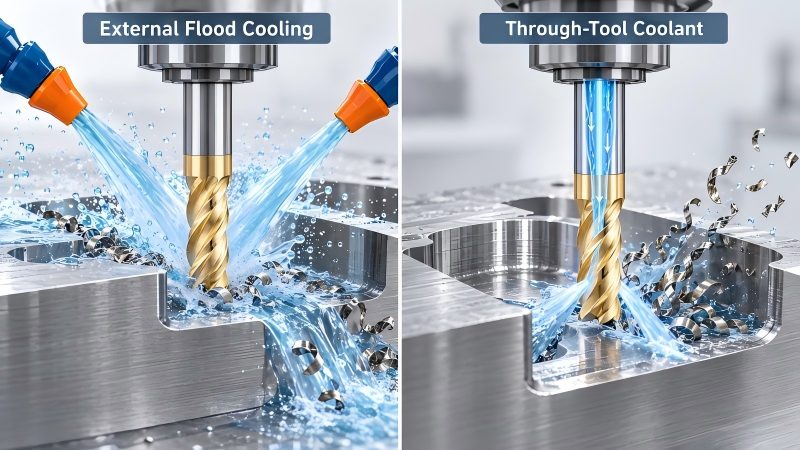
External flood cooling can work effectively when the nozzle has a clear path to the cutting area.
The coolant stream should be directed toward the active cutting area rather than simply toward the outside of the tool. Correct positioning helps the fluid reach the cutting edge and assists with chip removal.
Deep pockets and enclosed features can reduce the effectiveness of external delivery when the workpiece blocks the coolant stream.
Through tool coolant delivers fluid through internal channels in the cutting tool and can improve access to deep slots and cavities.
This method is particularly useful when external nozzles cannot maintain a direct path to the cutting edge. The DEX Corner Radius End Mill for Titanium Alloy is specified with both Internal and External coolant options.
The coolant method should still match the tool, machine capability, cutting depth, and workpiece geometry.
Coolant pressure alone does not guarantee effective delivery. The direction and position of the coolant stream also affect how well it reaches the cutting area.
For external systems, the nozzle should provide a clear path to the cutting edge without interfering with the tool, workpiece, or chip flow.
Coolant performs more effectively when chips can leave the cutting area without excessive recutting.
The DEX Flat End Mill for Titanium Alloy uses a 43 degree helix angle and unequal helix U shaped flutes with 87 degree and 93 degree flute angles. It also includes a chip breaker groove for roughing applications.
This combination of coolant delivery and chip evacuation is important because increased coolant flow cannot fully compensate for poor flute design or restricted chip space.
Tool coating influences performance under titanium cutting conditions.
The DEX Flat End Mill uses HSR118 coating and an 8 degree positive rake angle with an ultra fine micro grain carbide substrate. The coating is designed to provide heat resistance and anti sticking performance for titanium alloy machining.
Coolant and coating therefore address different parts of the cutting process. Coolant manages heat and lubrication, while the tool coating supports the cutting edge under thermal and wear loads.
Coolant requirements can vary with the machining operation.
Slotting, side milling, shoulder machining, roughing, and finishing create different chip evacuation conditions. Tool geometry should therefore match the workpiece feature and cutting strategy.
For a broader range of titanium milling tool configurations, see the Titanium Alloy End Mills from Dohre.
A machining test listed on the DEX Corner Radius End Mill product page used TC4 + A6013 and emulsion cooling. The reported cutting conditions were 113 m/min cutting speed, 0.042 mm/z feed rate, 0.5 mm cutting depth, and 2.1 mm cutting width. After 200 minutes of processing, the reported wear surface width was 0.08 mm.
The test provides a practical example of evaluating coolant together with tool geometry and cutting parameters. It represents a specific test condition rather than a universal coolant recommendation for every titanium alloy application.
A coolant trial should evaluate overall machining performance rather than temperature alone. Monitor tool edge wear, built up edge, chip formation, surface finish, spindle load, vibration, and coolant condition during the test. These results can help determine whether the selected coolant and delivery method are suitable for the application.
Water based coolant should be maintained within the concentration range recommended by the coolant manufacturer.
Insufficient concentration can reduce lubrication and corrosion protection, while excessive concentration may affect fluid performance and operating cost.
Regular concentration checks provide a more reliable basis for coolant maintenance than adding fluid based only on sump level.
Tramp oil, chips, fines, and other contaminants can gradually affect coolant performance.
Suitable filtration and routine fluid maintenance can help maintain a cleaner coolant system. The maintenance method should match the machine, coolant formulation, and production environment.
A sudden change in tool life does not necessarily mean that the coolant itself is unsuitable.
Tool runout, vibration, tool overhang, cutting parameters, chip evacuation, coating condition, and coolant delivery can all affect tool wear. Monitoring these factors together can help identify the cause of process changes.
There is no single coolant suitable for every titanium machining application. Water soluble emulsions, semi synthetic fluids, and synthetic coolants can all be considered according to the required balance between cooling and lubrication.
Through tool coolant can improve access to the cutting area when external coolant has difficulty reaching deep slots or cavities. Its effectiveness depends on tool design, machine capability, cutting conditions, and coolant flow.
Consistent coolant delivery can help control heat and friction during cutting. Tool life also depends on coating, flute geometry, cutting parameters, tool overhang, runout, and overall machining conditions.
Poor chip evacuation can leave chips near the cutting edge and increase friction and heat. Suitable flute geometry combined with effective coolant delivery helps maintain a clearer cutting area.
Coolant selection for titanium machining should match the machining operation, delivery method, and cutting tool. Proper coordination of these factors can help maintain consistent cutting conditions.
For titanium milling tools and application specific recommendations, contact Dohre to discuss suitable cutting tool solutions with the manufacturer.
Do you have a questions or an issues we can help you with?
Let’s talk about your project and how Dohre can help get your tools designed, manufactured and ready for the market.
By continuing to use the site you agree to our privacy policy Terms and Conditions.