


2 flute and 3 flute end mills are both common in aluminum machining, but they suit different cutting conditions. This guide compares their main differences and practical applications.


Reading volume: 1555

Release time :2026-03-26
Estimated reading time:
2 flute and 3 flute end mills are both common in aluminum machining, but they suit different cutting conditions. This guide compares their main differences and practical applications.
When machining aluminum, one of the most common questions is whether to use a 2 flute or 3 flute end mill. Both are widely used in CNC machining, and both can perform well in aluminum, but they are not exactly the same.
In practice, the difference is not just the number of flutes. It also affects chip evacuation, cutting stability, machining efficiency, and surface finish. If the wrong option is selected for the application, problems such as chip packing, burr formation, poor finish, or unstable cutting may appear.
If you are comparing different types of end mill for aluminum, understanding how 2 flute and 3 flute tools behave in actual machining is a good place to start.

Aluminum usually produces larger and more continuous chips than many harder materials. Because of this, flute space becomes an important part of tool performance.
The flute count affects:
• chip evacuation
• cutting edge engagement
• tool rigidity
• material removal efficiency
• finish quality
In aluminum machining, tool selection is often a balance between smooth chip evacuation and efficient cutting performance. That is why both 2 flute and 3 flute cutters are common options.
A 2 flute end mill has two cutting edges and larger flute valleys. This larger space allows chips to evacuate more easily during machining.
For aluminum, 2 flute tools are often chosen when chip evacuation is the main priority. They are especially common in slotting and roughing operations, where a large amount of material is removed and chip flow must remain smooth.
Because there is more space between the flutes, chips can leave the cutting zone more easily. This helps reduce chip packing.
A 2 flute tool often cuts more freely in aluminum, especially when the setup requires clean chip removal and lower cutting load.
When cutting full slots, chip evacuation is often one of the biggest concerns. A 2 flute tool is usually a safer option in this type of operation.
• slotting
• roughing
• deeper cuts
• operations with high chip volume
• general aluminum milling where evacuation is critical
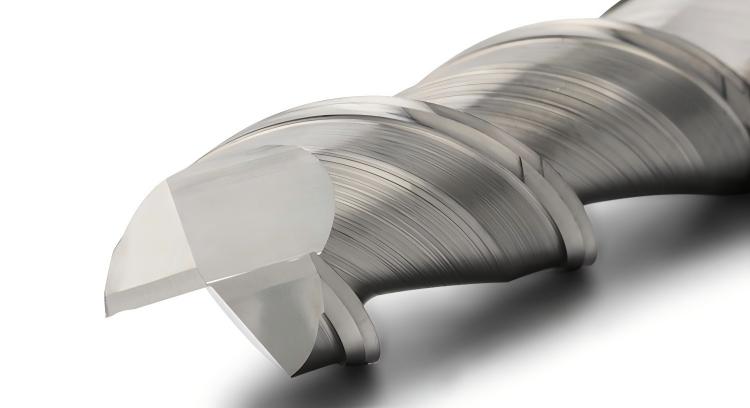
A 3 flute end mill adds one more cutting edge while still keeping relatively good flute space. This makes it a practical middle point between chip evacuation and cutting efficiency.
In many aluminum machining applications, 3 flute tools are used when users want a balance between productivity and smooth cutting performance.
With one more cutting edge, a 3 flute cutter can often remove material more efficiently than a 2 flute tool under stable machining conditions.
Many users choose 3 flute tools because they can provide both good productivity and a cleaner surface finish.
For many side milling and profile machining tasks, 3 flute tools are a strong all-around option.
• side milling
• profile milling
• semi-finishing
• finishing
• general CNC machining of aluminum parts
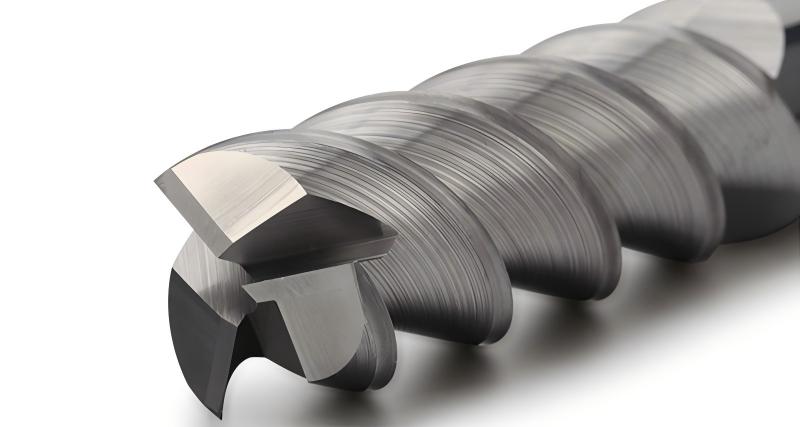
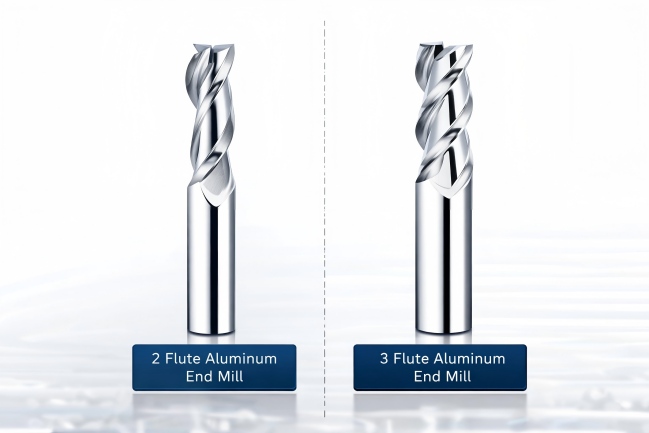
The biggest difference is how the tool balances chip space and cutting engagement.
A 2 flute end mill gives more room for chip evacuation, which is especially helpful in operations that generate a large amount of chips.
A 3 flute end mill adds cutting efficiency and can provide a better balance between machining speed and finish quality when chip evacuation is still under control.
So the choice is usually not about which one is always better, but which one is more suitable for the cutting condition.
A 2 flute end mill is often the better option in the following situations:
When the cutter is engaged in a full-width slot, chip evacuation becomes more difficult. The larger flute space of a 2 flute tool helps reduce chip packing.
If the goal is to remove material quickly while keeping chip flow smooth, a 2 flute cutter is often a practical choice.
In deeper cutting conditions, chip evacuation becomes even more important, so fewer flutes can be an advantage.
If the machine condition or setup is not ideal, a 2 flute tool may help reduce cutting load and improve stability.
A 3 flute end mill is often the better option in these cases:
For general side cutting, a 3 flute tool often provides a good combination of productivity and smooth cutting.
When compared with a 2 flute cutter, a 3 flute tool can sometimes produce a better finish under stable conditions because of the additional cutting edge.
If the machine setup is stable and chip evacuation is still acceptable, 3 flute tools can improve overall cutting efficiency.
For many shops, 3 flute cutters are a practical everyday choice for common aluminum parts.
Not necessarily.
In aluminum machining, more flutes do not automatically mean better results. If chip evacuation becomes poor, the extra cutting edge may actually create more problems. Chips may be recut, cutting heat may increase, and finish quality may become unstable.
That is why aluminum tools are often designed with flute counts that still leave enough room for chip flow. In many applications, 2 flute and 3 flute are the most practical choices.
If chip buildup and material adhesion are part of your machining problem, you can also read our article on why aluminum sticks to an end mill.
Flute count is important, but it is not the only factor.
A sharp edge helps cut aluminum cleanly and reduces burr formation.
A polished flute surface can improve chip flow and reduce adhesion.
A suitable helix angle can improve cutting smoothness and chip evacuation.
The tool should be designed for non-ferrous materials, not just general-purpose cutting.
Slotting, roughing, contouring, and finishing may each require a different tool preference.
For this reason, many aluminum cutter series offer different flute options within the same product family, allowing users to choose according to their machining task.
Flute count is only one part of tool selection. If you also want to compare cutter tip shapes, read our article on square end mills vs ball nose end mills for aluminum.
Both 2 flute and 3 flute options can appear in several aluminum cutter types.
A square end mill for aluminum is widely used for slotting, side milling, and profile machining.
A ball nose end mill for aluminum is often used for contours, cavity work, and curved surfaces.
A high polished end mill for aluminum is commonly preferred when chip flow and clean cutting are especially important.
Depending on the product series, flute options may vary according to cutter type and intended application.
If you are deciding between 2 flute and 3 flute for aluminum, a simple rule is:
• choose 2 flute when chip evacuation is the main concern
• choose 3 flute when you want a better balance between efficiency and finish
In many real machining situations:
• slotting and roughing often lean toward 2 flute
• side milling and profile work often lean toward 3 flute
• stable high-speed machining may benefit from 3 flute
• heavier chip evacuation conditions may benefit from 2 flute
The final choice still depends on material condition, machine rigidity, spindle speed, cutting depth, and surface finish requirement.
Both 2 flute and 3 flute end mills can work very well in aluminum machining. The difference is mainly in how they balance chip evacuation and cutting efficiency.
A 2 flute cutter is often more suitable for slotting, roughing, and high chip-load conditions where smooth chip evacuation is the priority. A 3 flute cutter is often more suitable for side milling, profile machining, and applications where a better balance between efficiency and surface finish is needed.
Instead of treating one option as universally better, it is more useful to match the flute count to the actual cutting task. If you are comparing different tooling options, exploring a complete End Mill for Aluminum range can help you choose the right cutter type for your machining process.
Is 2 flute or 3 flute better for aluminum?
Both can be suitable. A 2 flute end mill is often better for chip evacuation, while a 3 flute end mill is often better for balancing cutting efficiency and finish quality.
Why is 2 flute common in aluminum machining?
Because it provides larger flute space, which helps chips evacuate more easily during slotting and roughing operations.
When should I choose a 3 flute end mill for aluminum?
A 3 flute cutter is often a good choice for side milling, profile machining, semi-finishing, and general aluminum CNC applications.
Is 3 flute always faster than 2 flute?
Not always. A 3 flute tool may improve efficiency in stable conditions, but if chip evacuation becomes poor, performance may suffer.
What other factors matter besides flute count?
Edge sharpness, flute finish, helix angle, cutter geometry, and the actual machining application are all important.
Looking for the right cutter for aluminum machining? Explore our End Mill for Aluminum range to compare square end mills, ball nose end mills, and high polished tools for different CNC applications.
Contact us for product recommendations and custom tool solutions.
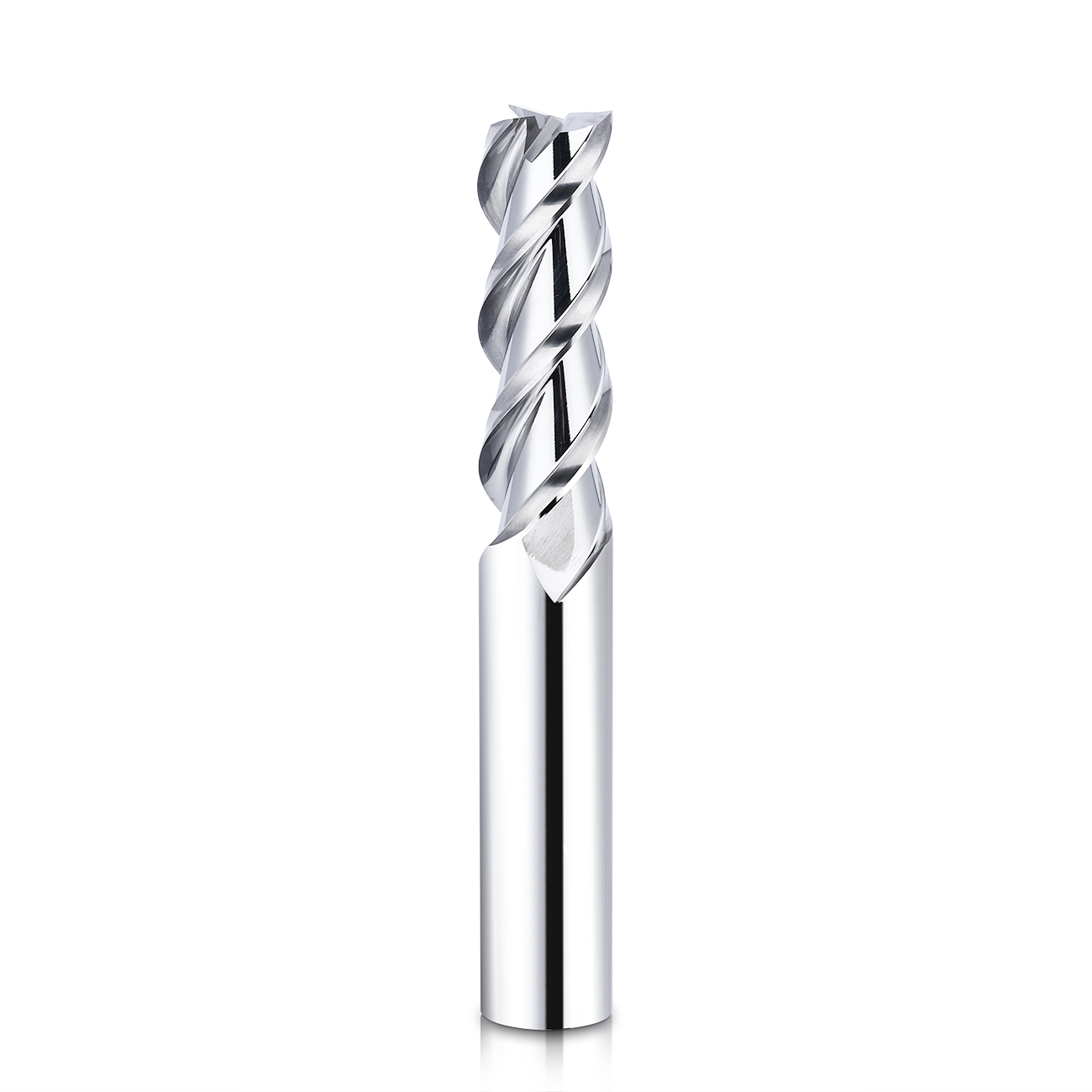
• Designed for high gloss aluminum finishing and mirror-like surface quality • Suitable for aluminum appearance parts, precision components, and finishing operations • Polished flute design supports smoother chip evacuation • Sharp cutting edge helps reduce burrs and visible tool marks • Helps reduce built-up edge during aluminum finishing • Suitable for aluminum alloy, copper alloy, magnesium alloy, and aluminum-silicon alloy • Uncoated or DLC coating options available according to machining needs
Learn More>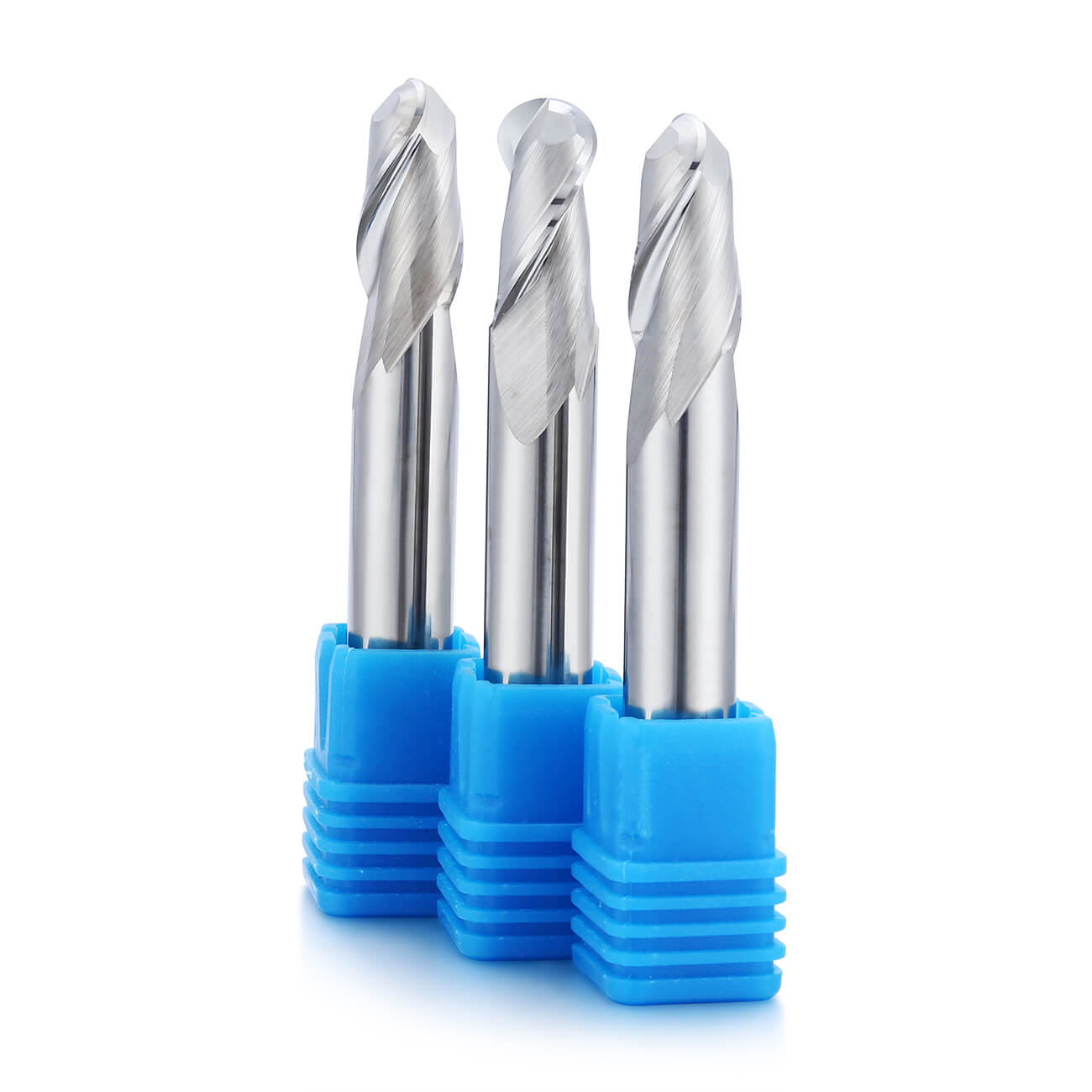
• 0.8 μm carbide with 10% cobalt • Uncoated or DLC coating for aluminum machining • 45° helix angle for smooth chip evacuation • Positive rake angle for lower cutting resistance • Designed for 3D contouring and surface finishing of aluminum
Learn More>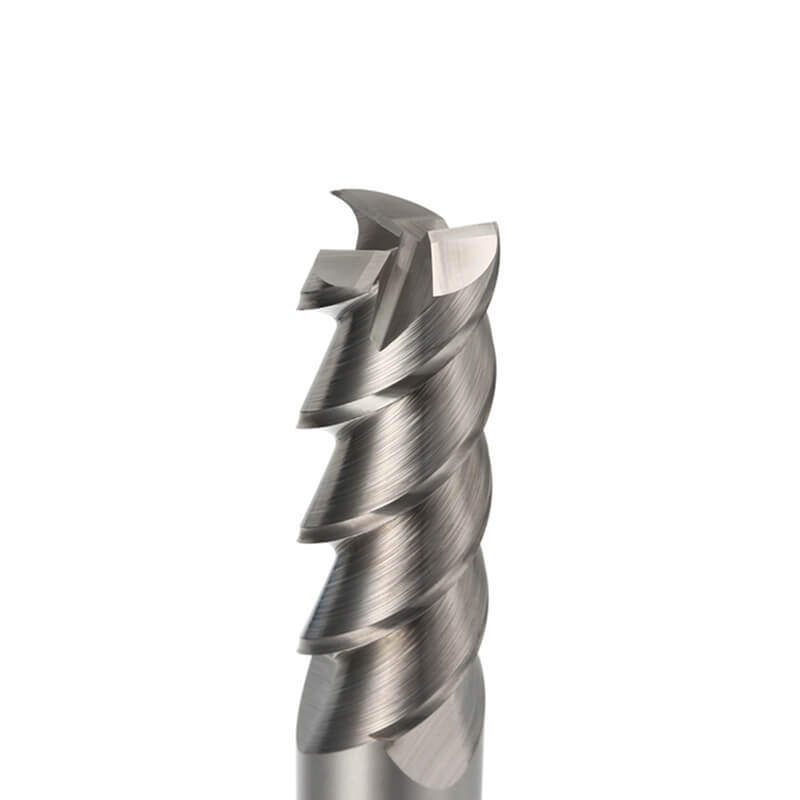
• Designed for aluminum slotting, side milling, pocket machining, and flat surface milling • Imported carbide rod with 0.8 μm grain size and 10% cobalt content • Uncoated or DLC Rainbow coating available • 6° end rake angle and 12° side rake angle for sharp aluminum cutting • 1200-grit precision-ground cutting edge for smaller burrs and smoother finish • 55% small-core design and 45° helix angle for smooth chip evacuation
Learn More>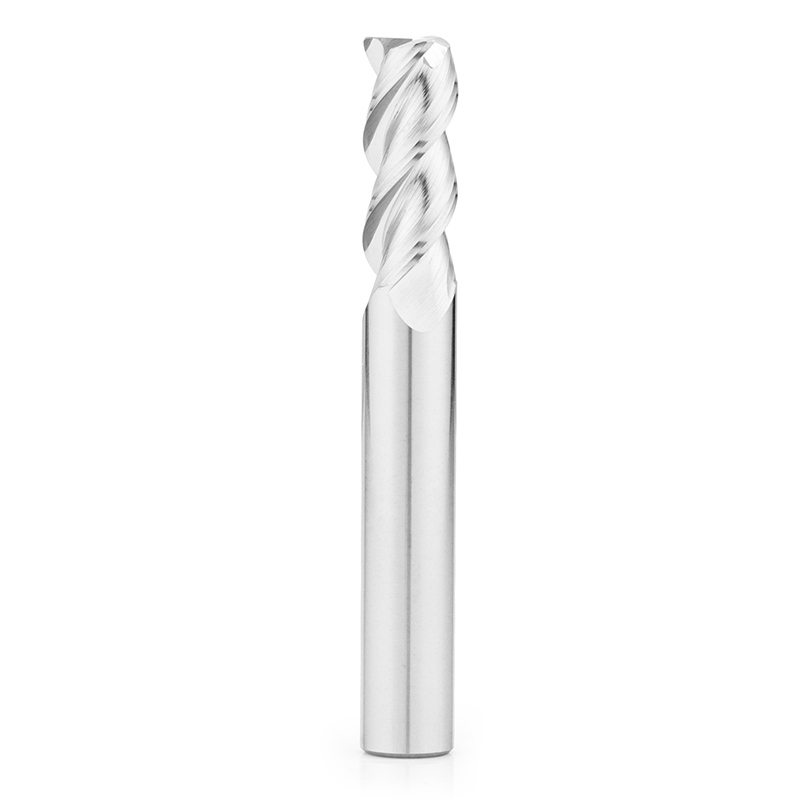
• Designed for aluminum shoulder milling, side-wall finishing, pocket machining, and dynamic milling • Corner radius design helps reduce edge chipping and improve tool life • Imported carbide rod with 0.8 μm grain size and 10% cobalt content • Uncoated or DLC Rainbow coating available • 55% small-core design and 45° helix angle for smooth chip evacuation • 6° end rake angle and 12° side rake angle for sharp aluminum cutting
Learn More>By continuing to use the site you agree to our privacy policy Terms and Conditions.