End Mill for H13 Hardened Steel After Heat Treatment: How to Choose the Right Cutter
Introduction
H13 steel becomes much more difficult to mill after heat treatment because hardness, cutting resistance, and edge load increase significantly. Choosing the right end mill for hardened H13 requires more than checking the material name; the actual hardness, machining stage, cutter geometry, setup rigidity, and surface finish requirement should all be considered.
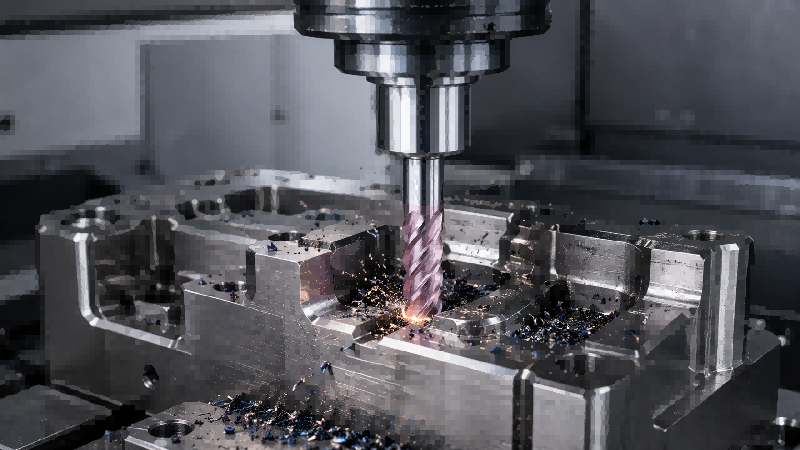
H13 steel is widely used in mold and die applications, but its machining behavior changes a lot after heat treatment. In a lower-hardness or annealed condition, it may be machined with a general mold steel end mill. After hardening, however, the cutting edge must handle higher cutting resistance, more concentrated heat, and a greater risk of wear or chipping.
This is why choosing an end mill for H13 should not be based only on the material name. The actual hardness after heat treatment, the machining stage, the part shape, and the required surface finish all affect the tool choice. A cutter that works well in pre-hardened H13 may not be stable enough for harder finishing conditions.
Why H13 Steel Becomes Difficult to Mill After Heat Treatment
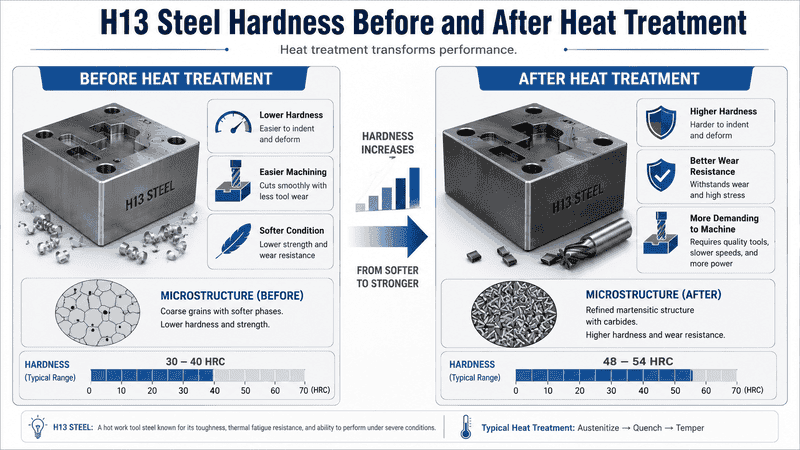
H13 is a hot-work mold steel, often used for die casting molds, extrusion dies, forging dies, and other tooling parts that need strength and heat resistance. Before heat treatment, the material is easier to cut. After heat treatment, the surface becomes harder, and the cutter has to work under a much heavier load.
The main challenge is not only hardness. Hardened H13 can also create higher cutting temperature, stronger edge pressure, and more obvious vibration during finishing. If the tool geometry or setup is not stable, the result may be rapid wear, edge chipping, poor surface finish, or dimensional variation.
For this reason, H13 after heat treatment should be treated as a hard milling application, especially when the part requires accurate sidewalls, fine surface finish, or long tool life in mold finishing.
Check the Actual Hardness Before Choosing the End Mill
The same H13 material can have different machining requirements depending on its heat treatment condition. This is one of the most important points in tool selection. If the actual hardness is not confirmed, it is easy to choose a cutter that is either too weak for the application or too specialized for the job.
| H13 Condition | Machining Requirement | End Mill Selection Direction |
|---|
| Annealed or lower hardness | General mold steel machining | A mold steel end mill may be suitable, depending on the cutting condition |
| Pre-hardened condition | Higher wear resistance and stable cutting are needed | Choose stronger edge geometry and suitable coating |
| Hardened H13 | Hard milling, finishing, and stable tool life | Use a high-hardness steel end mill matched to the actual HRC range |
| Very high hardness finishing | Surface finish, accuracy, and edge stability become critical | Use a rigid setup, stable finishing strategy, and a cutter designed for hard milling |
If the hardness is around HRC60 or higher, tool selection should be closer to high-hardness steel machining rather than general mold steel machining. The hardness difference between HRC60, HRC65, and HRC68 can also change the risk of wear, chipping, and surface finish problems. This topic is discussed in more detail in our guide on HRC60, HRC65, and HRC68 hardened steel end mill selection.
Common Problems When Milling Hardened H13 Steel
After heat treatment, H13 is less forgiving during milling. Small problems in toolholding, cutting load, or tool geometry may show up quickly on the cutter or on the workpiece surface.
| Problem | Possible Reason | What to Improve |
|---|
| Fast flank wear | High hardness, heat, or unsuitable coating | Use a wear-resistant coating and stable cutting parameters |
| Edge chipping | Weak edge support, runout, vibration, or sudden engagement | Improve rigidity, reduce impact load, and choose stronger geometry |
| Chatter marks | Long overhang, unstable toolpath, or insufficient setup rigidity | Shorten overhang, check holder accuracy, and control engagement |
| Poor surface finish | Tool wear, runout, large step-over, or unstable cutting | Use finishing geometry, reduce step-over, and monitor edge condition |
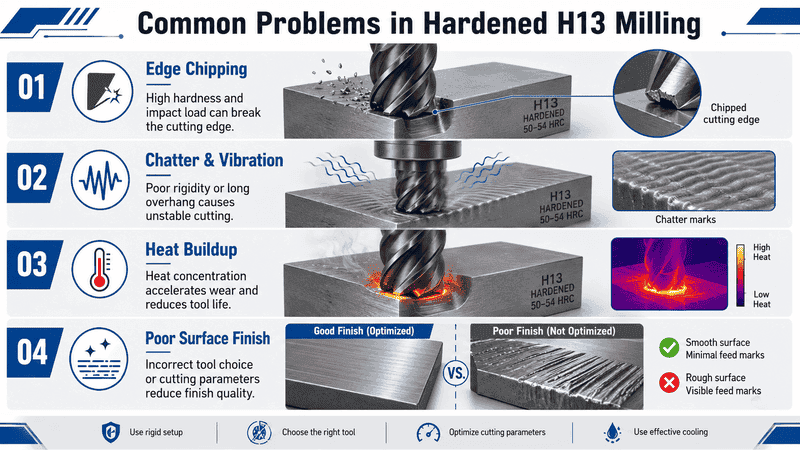
Among these problems, chipping is often the most sudden. It may happen when the cutting edge is overloaded or when vibration creates repeated impact on the edge. The causes are similar to other HRC60–68 materials, which we explained in our article on why end mills chip when milling HRC60–68 hardened steel.
What Cutter Geometry Works Better for Hardened H13
For hardened H13, cutter geometry should support both edge strength and stable cutting. A tool with a very weak cutting edge may feel sharp at the beginning, but it can chip quickly under high hardness. A tool with too much cutting resistance may increase heat and vibration, especially during finishing or side milling.
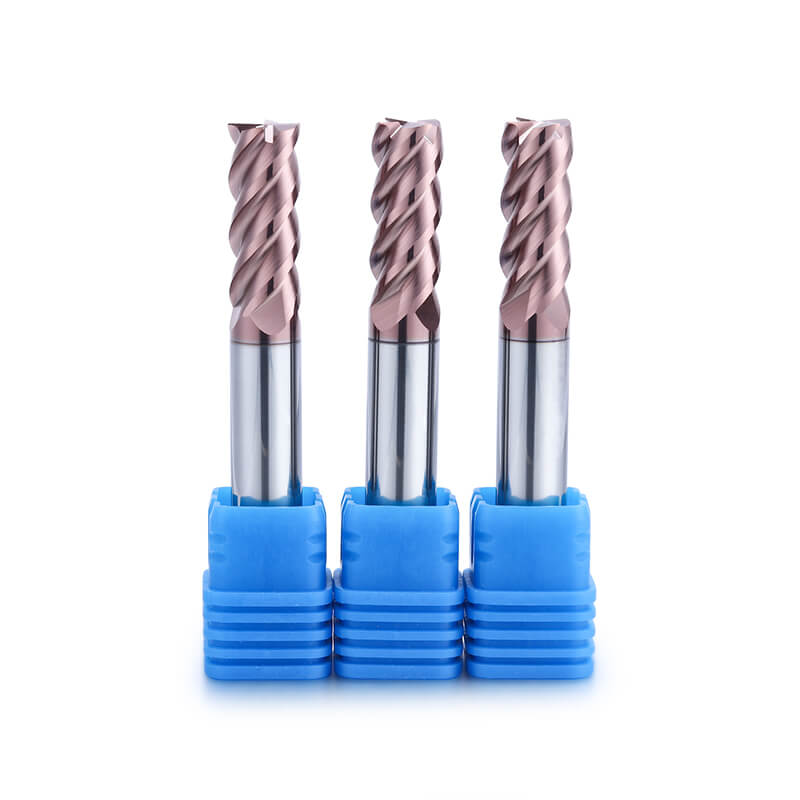
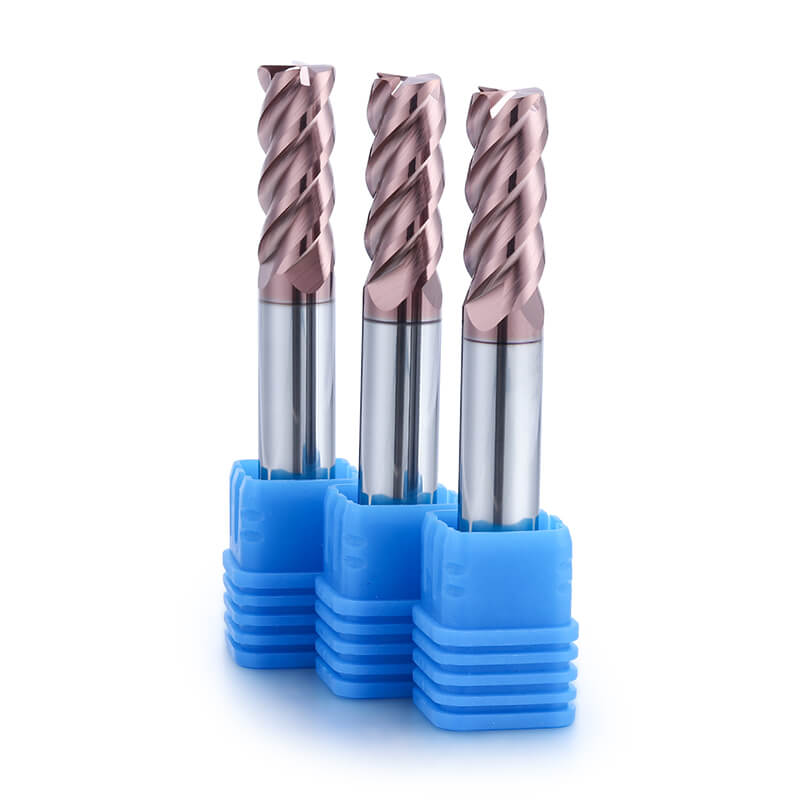
A suitable end mill for hardened H13 usually needs a strong cutting edge, stable flute design, good core rigidity, and a geometry that helps reduce vibration. Unequal helix or unequal pitch designs can also help break up repeated cutting vibration, which is useful when machining hard mold cavities or sidewalls.
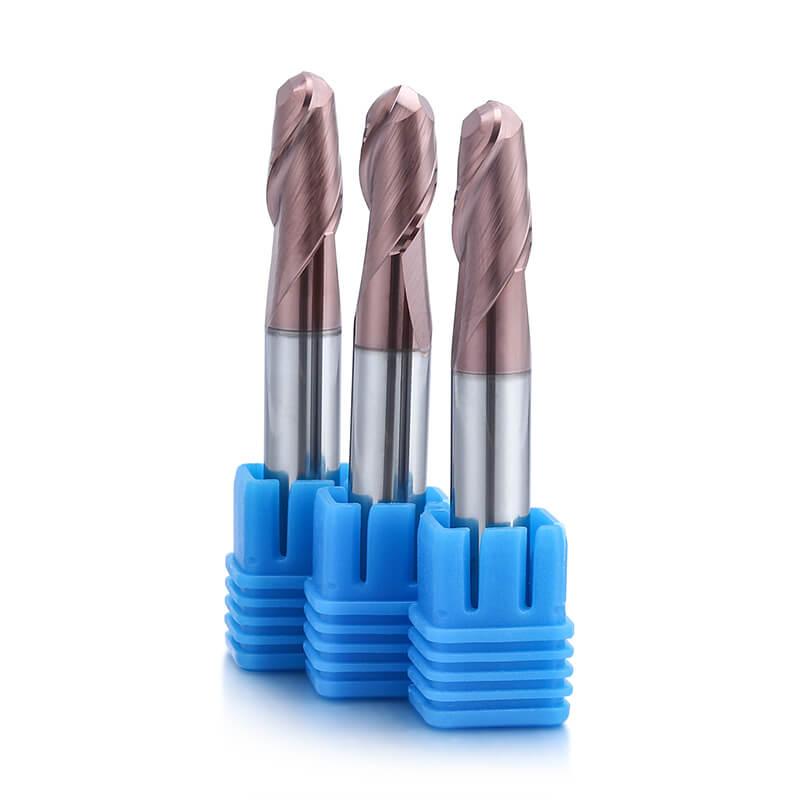
The cutter shape should match the part feature. A flat end mill is often used for flat surfaces and side milling. A corner radius end mill can provide stronger corner support when edge strength is important. A ball nose end mill is more suitable for 3D contour finishing and curved mold surfaces.
Coating, Carbide Substrate, and Edge Strength
Hardened H13 milling generates concentrated heat near the cutting edge. If the coating cannot handle the heat and wear, the edge may lose stability quickly. A suitable coating should help reduce wear, protect the cutting edge, and maintain performance during longer machining time.
The carbide substrate is also important. Hard milling requires a balance between hardness and toughness. If the substrate is not strong enough, the edge may chip. If the edge preparation is not suitable, the tool may either wear too fast or create too much cutting resistance.
For H13 after heat treatment, the goal is not simply to choose the hardest cutter. The better choice is usually a cutter that can keep the edge stable under high hardness, heat, and repeated cutting load.
Roughing, Semi-Finishing, and Finishing Considerations
Hardened H13 should not be approached the same way at every machining stage. Roughing, semi-finishing, and finishing each place different demands on the end mill.
| Machining Stage | Main Focus | Tool Selection Point |
|---|
| Roughing | Control cutting load and avoid sudden edge impact | Use a rigid cutter and stable toolpath strategy |
| Semi-finishing | Leave consistent allowance for finishing | Reduce vibration and maintain predictable tool wear |
| Finishing | Surface finish, accuracy, and edge stability | Use finishing geometry, lower engagement, and short overhang when possible |
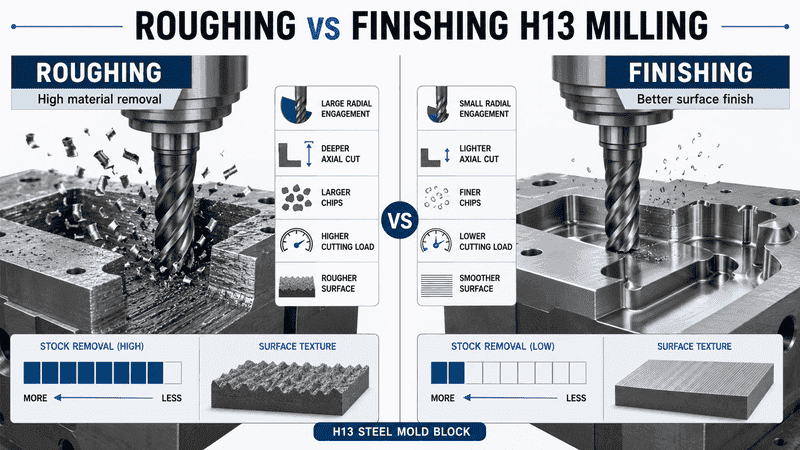
For finishing hardened H13, a stable allowance is very important. If too much material is left for the final pass, cutting load may increase and surface quality may become unstable. If the allowance is too small or uneven, the tool may rub instead of cutting cleanly.
Toolholding, Runout, and Machining Stability
A good end mill still needs a stable setup. In hardened H13 milling, long tool overhang, weak clamping, or excessive runout can make the cutting process unstable even when the cutter itself is suitable.
Runout is especially important in finishing. If one flute cuts more heavily than the others, the surface may show uneven marks and the tool may wear faster on one side. This can reduce both tool life and surface finish consistency.
When machining hardened H13 cavities or deep features, vibration control becomes even more important. Shorter overhang, better holder accuracy, and smoother toolpath transitions can all help reduce chatter. For more details, see our article on how to reduce vibration and chatter in HRC60–68 hardened steel milling.
Practical Checklist for Hardened H13 Milling
• Confirm the actual hardness after heat treatment before choosing the end mill.
• Do not select the cutter based only on the material name “H13.”
• Use a high-hardness steel end mill when the hardness enters the hard milling range.
• Choose cutter geometry according to the machining stage and part feature.
• Use stronger edge support when chipping or corner damage is likely.
• Keep tool overhang short and check runout before finishing.
• Avoid sudden engagement, sharp corner entry, and unstable cutting paths.
• Monitor tool wear before it affects surface finish or dimensional accuracy.
• Adjust feed, speed, step-over, and depth of cut together instead of changing only one parameter.
FAQ
What end mill is suitable for H13 hardened steel?
The right end mill depends on the actual hardness after heat treatment. For hardened H13, a high-hardness steel end mill with strong edge support, suitable coating, and stable geometry is usually recommended.
Can carbide end mills machine H13 after heat treatment?
Yes, carbide end mills can machine hardened H13 when the cutter geometry, coating, toolholding, and cutting parameters are suitable. The process must be stable because hardened H13 is more sensitive to wear, chipping, and vibration.
Why does the end mill chip when milling hardened H13?
Chipping may be caused by high hardness, weak edge support, excessive runout, chatter, sudden engagement, or too much cutting load. Checking both tool selection and setup stability is important.
Is H13 the same to machine before and after heat treatment?
No. H13 is much easier to machine before heat treatment. After hardening, cutting resistance, tool wear, and the risk of edge damage increase, so the end mill and cutting strategy should be adjusted.
Which cutter shape is better for hardened H13 finishing?
It depends on the part feature. Flat end mills are suitable for flat surfaces and side milling, corner radius end mills provide stronger corner support, and ball nose end mills are often used for 3D contour finishing.
Conclusion
Choosing an end mill for H13 hardened steel after heat treatment starts with understanding the actual hardness and machining requirement. The material name alone is not enough. Tool geometry, edge strength, coating, runout, toolholding rigidity, and cutting stability all affect the final result.
For hardened H13 mold steel, a stable high-hardness steel end mill can help reduce wear, chipping, vibration, and surface finish problems. The best result usually comes from matching the cutter with the hardness range, machining stage, part geometry, and setup condition.
Dohre's HEX series high-hardness steel end mills for HRC60–68 hardened materials are designed for hard milling applications where edge strength, wear resistance, and machining stability are important. Contact us for hardened H13 end mill recommendations or custom tool solutions.