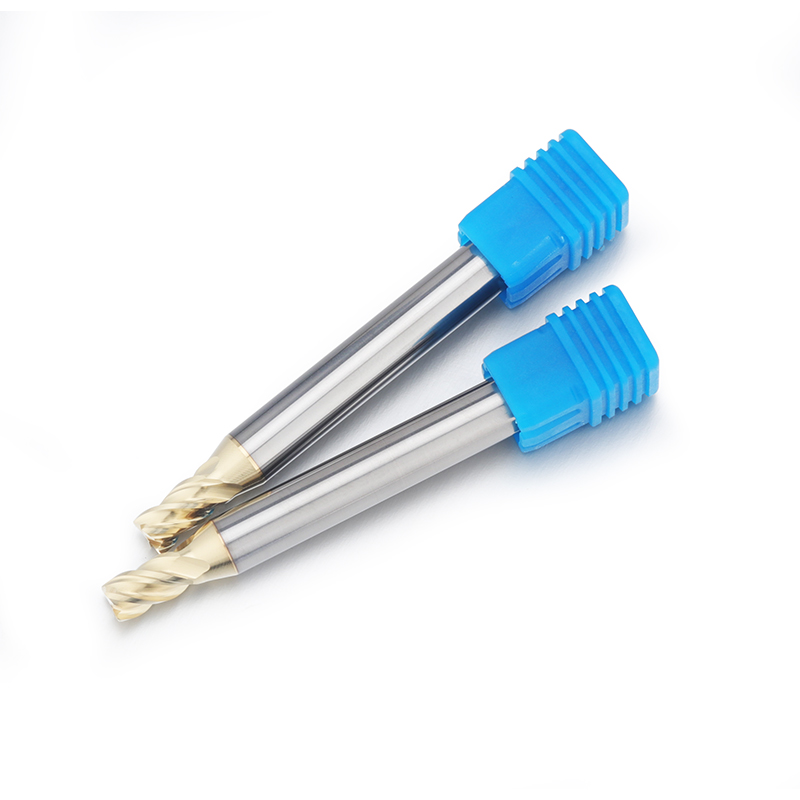
Flat End Mill vs Ball Nose vs Corner Radius End Mill for Titanium Alloy
Introduction
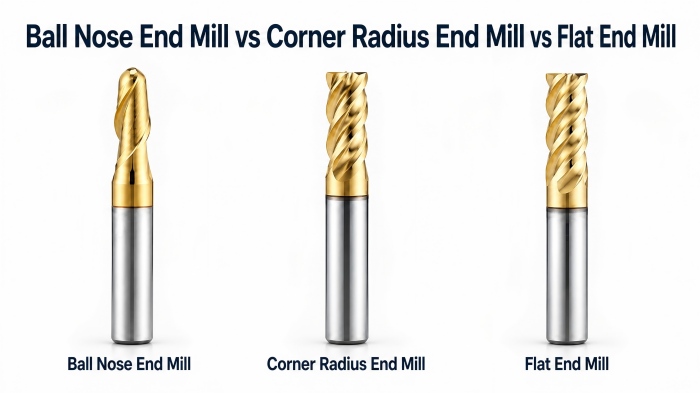
Cutter shape plays an important role in titanium alloy milling because flat surfaces, curved contours, and stronger edge support require different tool designs. This guide compares flat, ball nose, and corner radius end mills to help choose the right cutter type for different titanium alloy machining tasks.
Flat end mills, ball nose end mills, and corner radius end mills are all used in titanium alloy machining, but they are designed for different cutting tasks. This guide compares the three cutter types and explains how to choose the right end mill for flat surfaces, contours, cavities, side milling, and stable finishing in titanium alloy applications.
Titanium alloy machining is not only affected by tool material and coating. Cutter shape also changes how the edge contacts the workpiece, how cutting force is distributed, and how stable the tool remains during milling. That is why flat, ball nose, and corner radius tools should be selected according to the actual part feature rather than treated as interchangeable options.
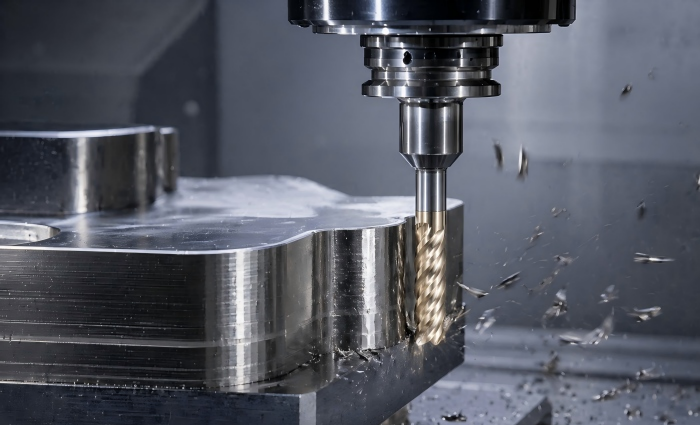
Why Cutter Shape Matters in Titanium Alloy Machining
Titanium alloy is more demanding than many general machining materials because cutting heat can stay near the edge, chip evacuation can become unstable, and tool wear may develop quickly under poor cutting conditions. In this environment, the cutter shape directly affects cutting stability and tool life.
A flat end mill may be efficient for straight walls and flat features, but it is not the best choice for curved surfaces. A ball nose end mill follows contours more naturally, but it is not ideal for sharp flat-bottom features. A corner radius end mill often gives better edge support than a sharp-cornered flat tool, which can help in more stable finishing or semi-finishing work.
Quick Comparison: Flat, Ball Nose, and Corner Radius End Mills
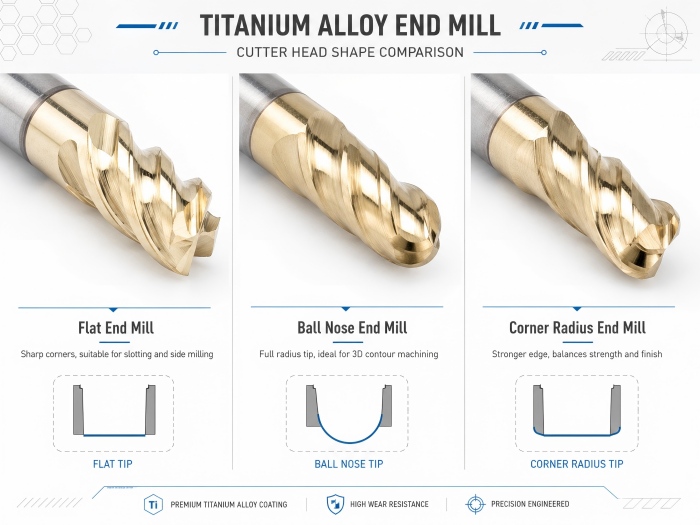
| Tool Type | Best For | Main Advantage | Typical Limitation |
|---|
| Flat End Mill | Flat surfaces, side milling, shoulder milling, straight walls | Good for defined edges and flat-bottom features | Less suitable for curved surfaces and smooth 3D contours |
| Ball Nose End Mill | Contours, cavities, curved surfaces, 3D finishing | Better for smooth surface transitions | Not ideal for flat-bottom cuts or sharp internal corners |
| Corner Radius End Mill | Semi-finishing, finishing, sidewall work, stronger edge support | Balances edge strength and machining stability | Less suitable than ball nose for complex 3D surface finishing |
Flat End Mill for Titanium Alloy: Best for Side Milling and Defined Features
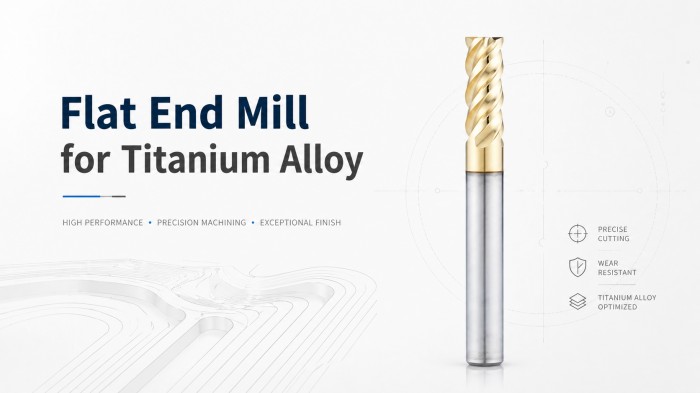
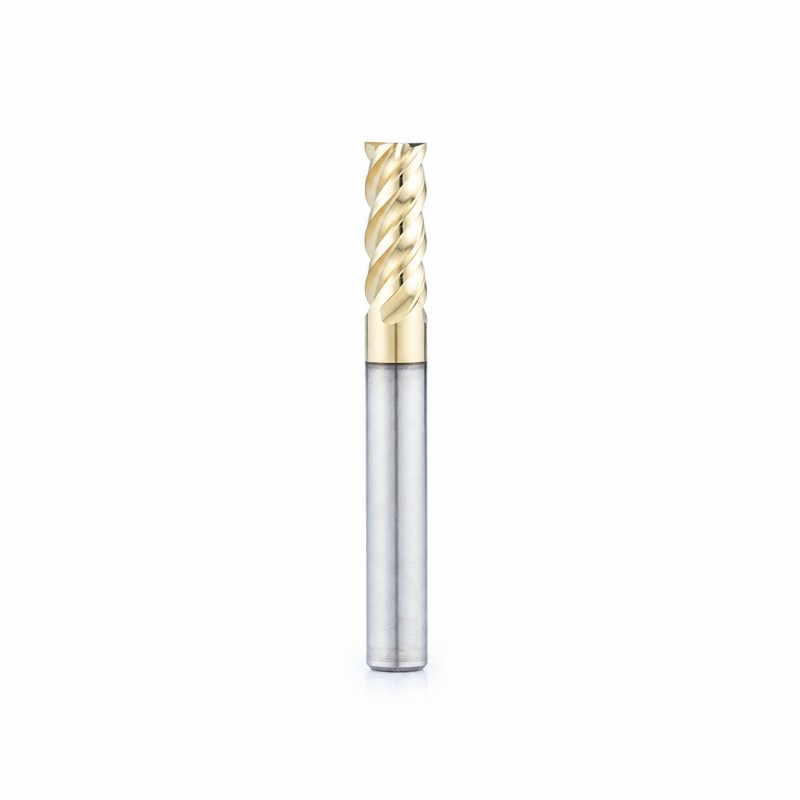
A flat end mill is usually the more direct choice when the titanium alloy part requires flat surfaces, straight sidewalls, or clearly defined profile features. It can be used for side milling, shoulder milling, and flat-bottom features where the cutting shape needs to remain sharp and controlled.
In titanium alloy machining, the flat tool still needs enough edge strength, coating stability, and chip evacuation support. A sharp but weak cutting edge may wear or chip too early, while a tool with poor flute design may trap heat near the cutting area. A DEX flat end mill for titanium alloy is more suitable when the part geometry requires defined surfaces and stable side cutting.
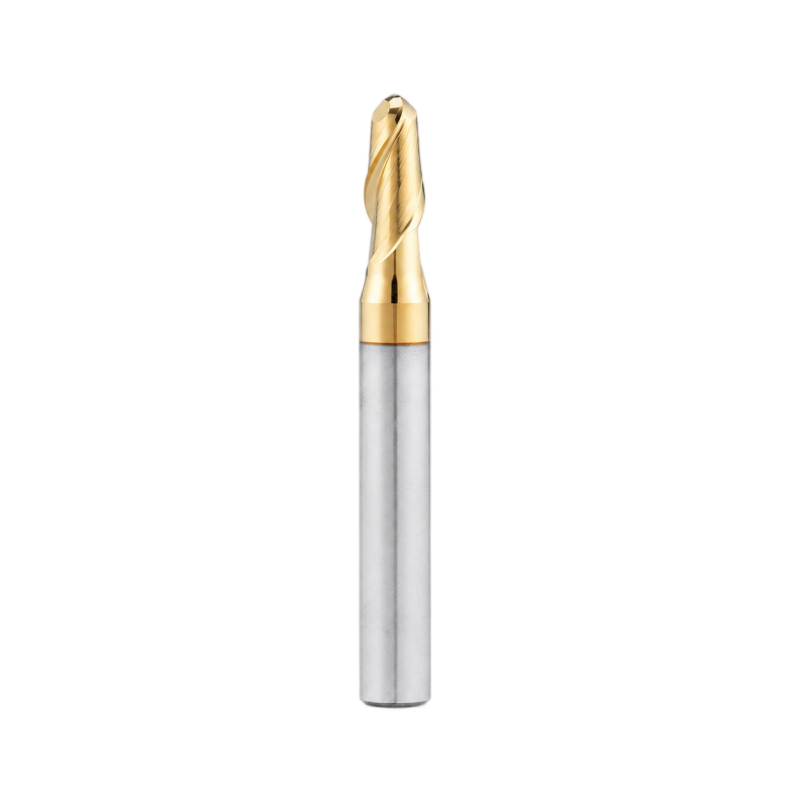
Ball Nose End Mill for Titanium Alloy: Best for Contours and Curved Surfaces
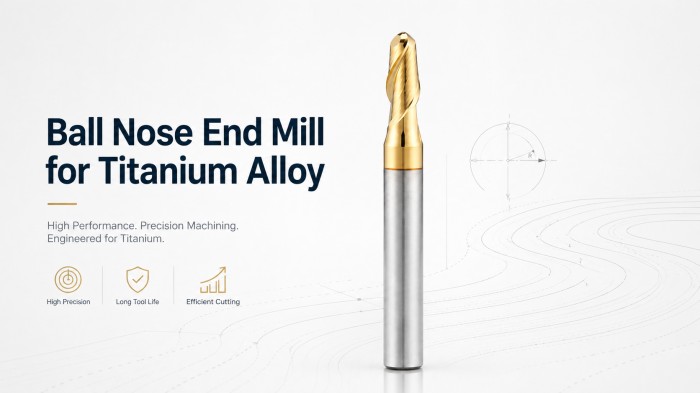
A ball nose end mill is more suitable for curved surfaces, 3D contours, cavities, and mold-style finishing paths. The rounded cutting end helps the tool follow complex surfaces more smoothly, which makes it useful when the titanium alloy part has curved geometry rather than flat features.
The main advantage of a ball nose tool is surface transition. It can help reduce sharp tool marks on curved paths and is often used when contour quality matters. A DEX ball nose end mill for titanium alloy fits applications where the toolpath needs to follow curved features more naturally.
Corner Radius End Mill for Titanium Alloy: Best for Edge Strength and Stable Finishing
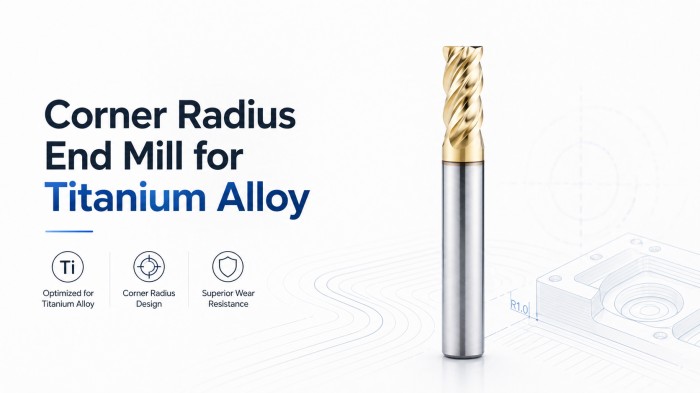
A corner radius end mill is often selected when users want stronger edge support than a sharp-cornered flat tool can provide. The small radius at the cutting corner helps reduce stress concentration, which can be useful in titanium alloy machining where edge chipping and unstable wear are common concerns.
This tool type is especially practical for semi-finishing, finishing, and sidewall applications where stability matters more than a perfectly sharp corner. A DEX corner radius end mill for titanium alloy is usually a strong option when the process needs a balance of edge strength, finish stability, and tool life.
How Cutter Shape Affects Tool Life in Titanium Alloy
Tool life in titanium alloy is closely related to heat control, edge loading, and chip evacuation. Cutter shape affects all three. A flat end mill may create strong cutting action on defined features, but the corner can become a weak point under unstable loading. A ball nose tool distributes contact differently along curved paths, while a corner radius tool can reduce stress at the tool corner.
This is why choosing the best end mill for titanium alloy is not only about selecting a coating or carbide grade. The tool shape must also match the actual cutting path. The broader selection logic is covered in our guide to choosing the best end mill for titanium alloy.
How to Choose Between the Three Cutter Types
A practical way to choose the right titanium alloy end mill is to begin with the part feature and machining stage.
• For flat surfaces, straight walls, and defined edges, a flat end mill is usually the more direct choice.
• For contours, curved surfaces, cavities, and 3D finishing paths, a ball nose end mill is usually more suitable.
• For stronger edge support, more stable finishing, and better corner durability, a corner radius end mill is often more practical.
• For titanium alloy, coating, chip evacuation, and cutting stability still need to be considered together with cutter shape.
Common Selection Mistakes
• Using a flat end mill for complex contour finishing where a ball nose tool would match the surface better.
• Using a ball nose tool for flat-bottom features where a flat end mill would produce a more defined result.
• Ignoring corner strength in titanium alloy side milling and finishing applications.
• Choosing only by cutter shape while ignoring heat resistance, chip evacuation, and coating suitability.
Conclusion
Flat end mills, ball nose end mills, and corner radius end mills all have a place in titanium alloy machining. A flat end mill is better for flat surfaces and defined profiles, a ball nose end mill is better for contours and curved surfaces, and a corner radius end mill is often better when stronger edge support and stable finishing are needed.
The best choice depends on the part feature, the machining stage, and the stability required during cutting. A complete end mill for titanium alloy range makes it easier to compare flat, ball nose, and corner radius cutters for different titanium milling applications.
FAQ
What is the difference between a flat end mill, ball nose end mill, and corner radius end mill?
A flat end mill is better for flat surfaces and defined edges, a ball nose end mill is better for contours and curved surfaces, and a corner radius end mill offers stronger corner support for stable finishing.
Which end mill is best for titanium alloy side milling?
A flat end mill or corner radius end mill is usually more suitable for titanium alloy side milling, depending on whether the process needs sharper edge definition or stronger corner durability.
When should I use a ball nose end mill for titanium alloy?
A ball nose end mill is usually better for curved surfaces, cavities, contours, and 3D finishing paths in titanium alloy machining.
Why use a corner radius end mill for titanium alloy?
A corner radius end mill can provide better corner strength and more stable finishing than a sharp-cornered flat end mill, which is useful in demanding titanium alloy applications.
Does cutter shape affect tool life in titanium alloy?
Yes. Cutter shape affects edge loading, cutting contact, chip evacuation, and stability, all of which can influence tool life in titanium alloy milling.
Looking for the Right Titanium Alloy End Mill?
Explore our End Mill for Titanium Alloy range to compare DEX flat, ball nose, and corner radius end mills for different titanium milling applications.
Contact us for product recommendations and custom tool solutions.