Long-Neck vs Long-Flute Micro End Mills: Which Should You Use for Deep Features?
Introduction
Long-neck and long-flute micro end mills can both reach deep slots, cavities, mold ribs, and restricted features, but they serve different purposes. A long-flute tool provides a longer active cutting edge for machining deep walls, while a long-neck tool uses a reduced-diameter clearance section to reach recessed areas with a shorter cutting edge. This guide explains how to choose between them based on active cutting depth, required clearance, rigidity, chip evacuation, and tool overhang.
Deep slots, narrow cavities, mold ribs, connector openings, recessed corners, and other restricted features often require a micro end mill with more reach than a standard tool can provide. However, additional reach can be created in different ways.
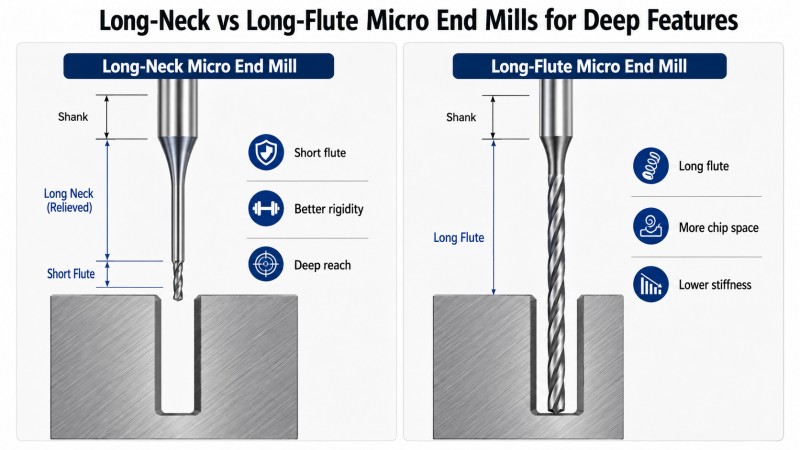
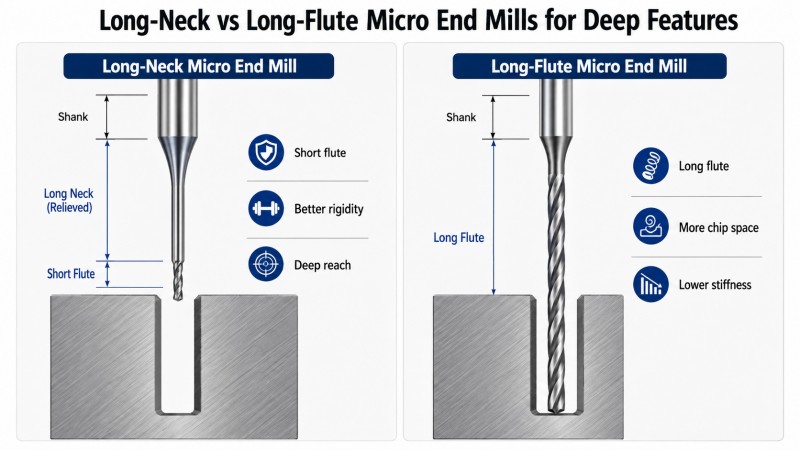
A long-flute micro end mill uses a longer active cutting edge. A long-neck or reduced-neck micro end mill normally uses a shorter cutting edge followed by a smaller-diameter clearance section. Although both tools may reach a deep feature, they do not perform the same function.
The correct choice depends mainly on how much of the deep feature must actually be cut. If the complete sidewall requires axial cutting, a longer flute may be necessary. If only the bottom, corner, or local profile requires cutting, a shorter flute with an appropriate reduced neck may provide a more suitable structure.
For a broader explanation of cutter diameter, flute length, neck length, overhang, and runout, see our guide on how to choose a micro end mill.
Why Long-Neck and Long-Flute Tools Are Often Confused
Customers often describe both tools as “long micro end mills” because each one can access a feature below the top surface of the workpiece. The important difference is not the overall tool length. It is the relationship between the active cutting section and the non-cutting clearance section.
• Flute length determines how much of the tool can actively cut along the axial direction.
• Neck length provides clearance behind the cutting edge so the tool can reach below a wall, rib, shoulder, or cavity opening.
•Working reach describes how far the cutting edge can access the feature without the larger shank contacting the workpiece.
•Tool overhang is the unsupported distance from the holder to the cutting tip after the tool is installed.
•Overall length does not by itself show how much flute length, neck clearance, or usable reach the cutter provides.
Two micro end mills can have the same overall length but very different cutting lengths, neck lengths, neck diameters, and usable reach. The complete dimensional drawing should therefore be reviewed before selecting the tool.
What Is a Long-Flute Micro End Mill?
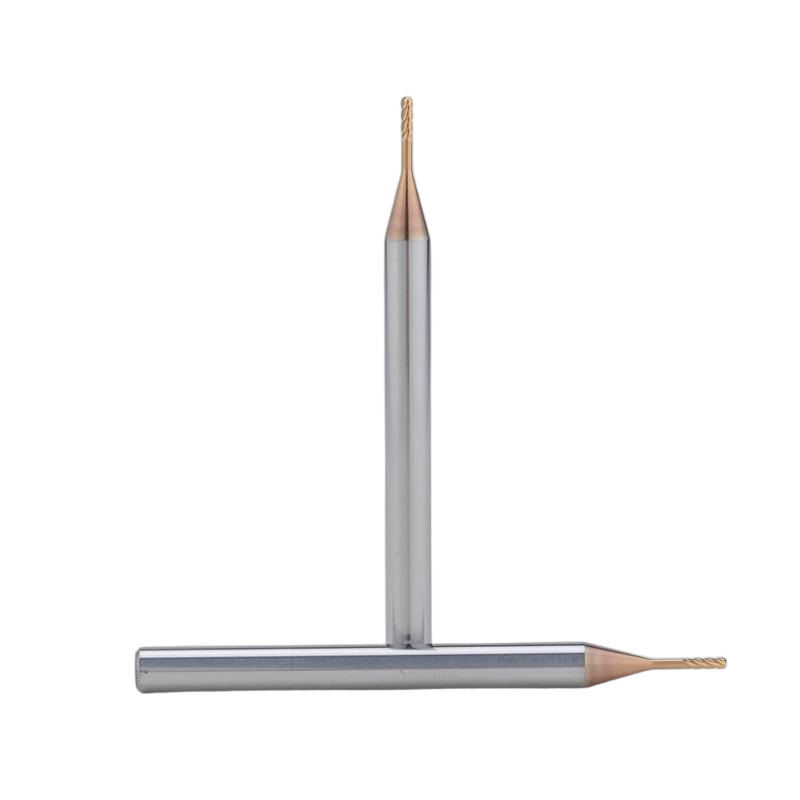
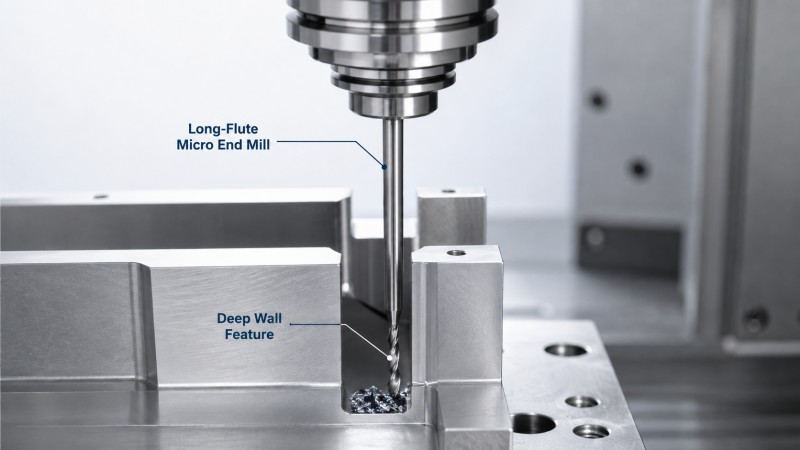
A long-flute micro end mill has an extended cutting edge along a greater portion of the tool. The longer flute allows the cutter to machine a deeper axial section of a slot, wall, pocket, or profile.
This structure may be required when:
•The complete depth of a tall sidewall must be machined.
•A deep slot requires cutting along most of its wall height.
•A profile contains a long axial contact area.
•The non-cutting section would otherwise rub against the workpiece.
•The machining process requires progressive axial passes over a deep surface.
The advantage is that a greater section of the tool can actively remove material. The disadvantage is that extending the flute also increases the flexible cutting section and reduces the amount of solid carbide supporting the tool core.
Possible problems associated with an unnecessarily long flute include:
•Greater tool deflection.
•Sidewall taper or dimensional error.
•Higher vibration sensitivity.
•More flute contact with the workpiece.
•More difficult chip evacuation in deep slots.
•Higher risk of micro-chipping or cutter breakage.
A long-flute tool should therefore be selected because the cutting edge is actually required, not simply because the cavity is deep.
What Is a Long-Neck Micro End Mill?
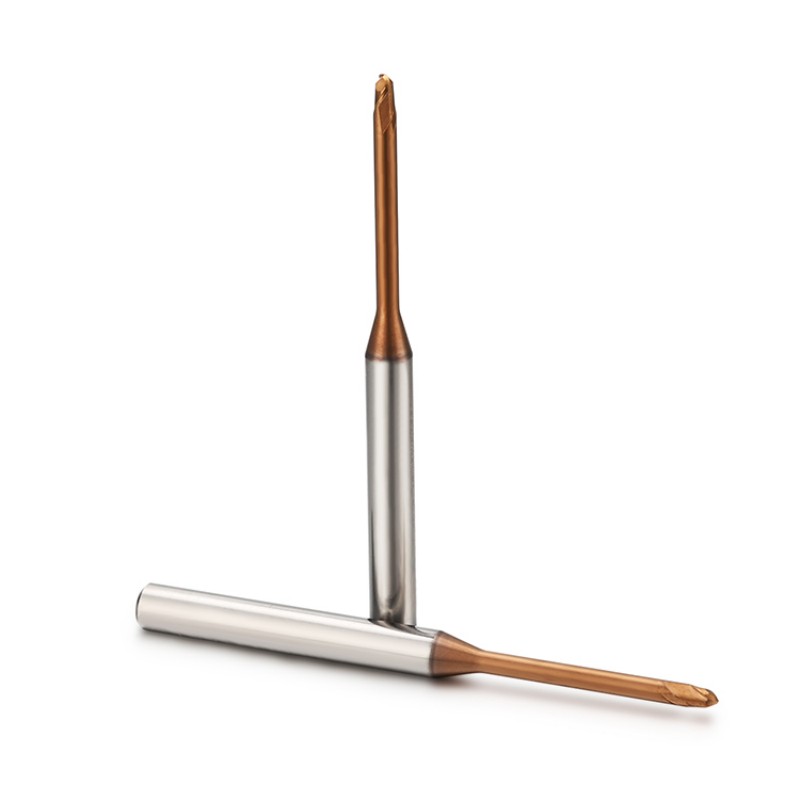
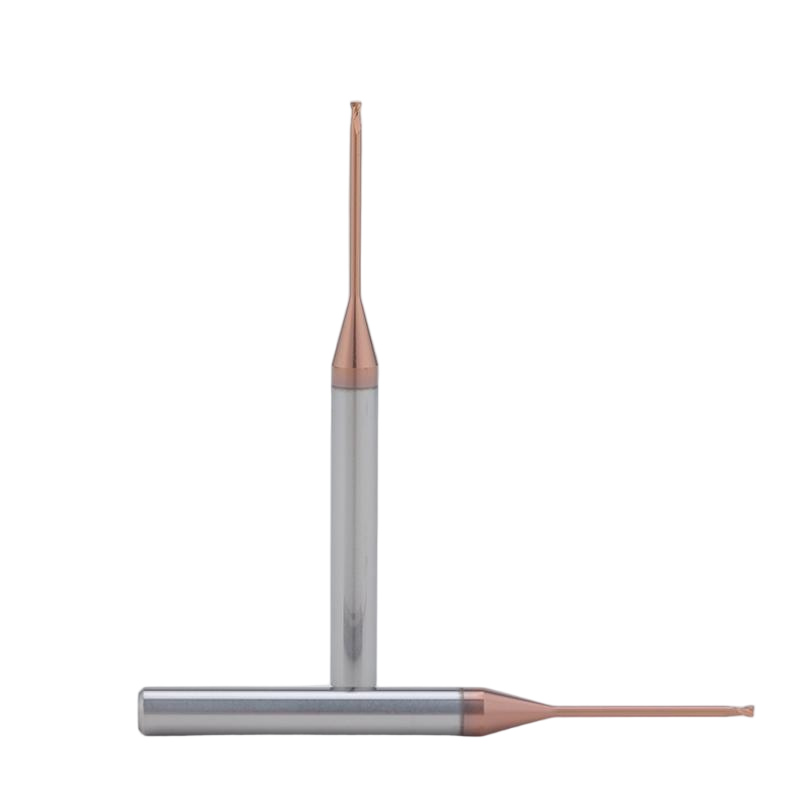
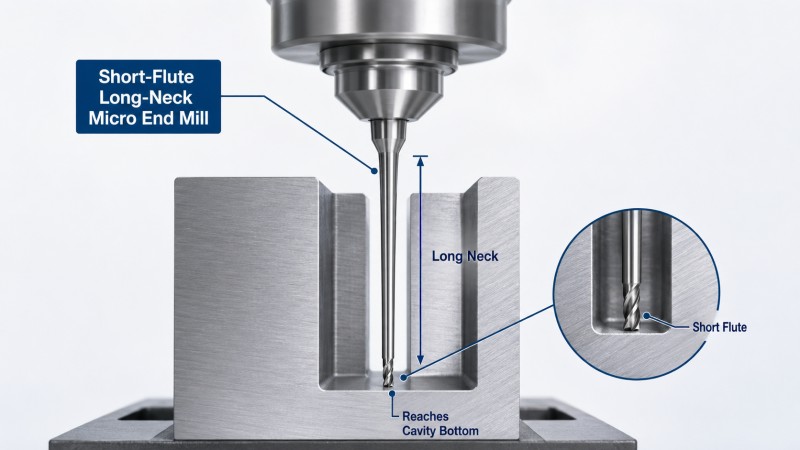
A long-neck micro end mill normally combines a relatively short cutting edge with a reduced-diameter section behind the flute. The neck provides clearance so the cutting edge can reach below a surrounding wall, rib, shoulder, or restricted cavity opening.
The reduced neck is generally not intended to replace the active cutting edge. Its main purpose is to prevent the larger shank from rubbing against the workpiece while the cutting tip machines a deeper area.
A long-neck tool may be useful for:
•Finishing the bottom of a deep cavity.
•Machining a small radius below a tall wall.
•Reaching narrow mold ribs and recessed details.
•Finishing connector openings or internal housing features.
•Machining a local profile located behind a shoulder.
•Avoiding interference between the shank and the workpiece.
The neck should still be only as long and as thin as the application requires. An excessively long or small-diameter neck increases the flexible section of the tool and can reduce cutting stability.
Long-Neck vs Long-Flute Micro End Mills
| Selection Factor | Long-Flute Micro End Mill | Long-Neck Micro End Mill |
|---|
| Active cutting section | Extended along a greater axial length | Usually concentrated near the tool tip |
| Main purpose | Cut a deeper wall, slot, or profile | Reach a deep or restricted feature without shank interference |
| Sidewall contact | Can cut along a larger wall height | Usually cuts only near the flute section |
| Clearance behind flute | May be limited unless a neck is also included | Provided by the reduced-diameter neck |
| Typical application | Deep slots and tall walls requiring full axial cutting | Deep cavity bottoms, mold ribs, restricted corners, and recessed features |
| Main risk | Excessive flute deflection, vibration, and chip congestion | Excessive neck deflection caused by long reach or a small neck diameter |
The Most Important Question: What Part of the Feature Must Be Cut?
The required machining depth and the required cutting depth are not always the same.
For example, a cutter may need to reach 20 mm below the top surface, but only the bottom 2 mm of the feature may require active cutting. In this situation, selecting a flute that covers the complete 20 mm reach may introduce unnecessary flexibility.
Before choosing the tool, divide the feature into two dimensions:
| Feature Condition | Recommended Starting Structure |
|---|
| The complete deep wall must be machined | Flute length matched to the required axial cutting depth |
| Only the bottom corner requires machining | Short flute with a reduced neck |
| A small feature is located below a high wall | Long-neck micro end mill with sufficient wall clearance |
| A narrow slot requires full-depth side cutting | Longer flute, selected with careful chip-evacuation planning |
| The feature is shallow and open | Standard short-flute micro end mill |
When Should You Choose a Long-Flute Micro End Mill?
Choose a longer flute when the flute must actively cut along a greater depth of the feature. A long neck alone cannot replace the cutting edge when the complete wall needs machining.
Typical examples include:
Deep Narrow Slots
If both slot walls require machining along the complete depth, the flute must cover the axial contact area. The selected flute length should provide enough cutting coverage without being much longer than necessary.
Chip evacuation becomes increasingly important as the slot becomes deeper. Chips trapped along the flute can increase cutting force, scratch the wall, or contribute to sudden cutter overload.
Tall Sidewalls
A tall wall may require several axial machining levels. The flute must be long enough for the intended engagement at each level, while the radial cutting width should reflect the reduced rigidity of the longer tool.
Deep Profiles
When a profile extends over a long axial section, a longer flute may be necessary to prevent the non-cutting part of the tool from contacting the surface. Separate roughing and finishing passes can help maintain more consistent cutting load.
When Should You Choose a Long-Neck Micro End Mill?
Choose a long-neck or reduced-neck tool when the cutter must reach beyond an obstruction but only a limited area near the tip requires cutting.
Deep Cavity Bottoms
A deep cavity may already have been rough-machined with a larger cutter. A long-neck micro end mill can then reach the bottom corner, local radius, or remaining material without requiring a full-length flute.
Mold Ribs and Recessed Details
Narrow ribs and recessed mold details often require a small tool diameter and additional clearance behind the cutting edge. The neck allows the tool to enter the restricted structure while reducing the risk of shank interference.
Internal Housing Features
Electronic housings, optical components, connector parts, and compact precision assemblies may contain small slots or corners located below an outer wall. A reduced-neck micro end mill can provide access while keeping the active cutting edge focused on the local feature.
Finishing Below a Shoulder
When a profile sits behind a shoulder or stepped surface, the neck can provide clearance for the larger shank. The neck diameter must be checked against the minimum available space along the complete toolpath.
Why a Short Flute with a Reduced Neck Can Be More Suitable
When only the tool tip needs to cut, extending the complete flute through the entire reach may not provide a machining advantage. A short cutting edge with a reduced neck separates the cutting requirement from the clearance requirement.
Potential advantages include:
•A shorter active cutting section.
•Less unnecessary flute contact with the workpiece.
•Reduced risk of the shank rubbing against surrounding walls.
•More targeted machining of bottom corners and local features.
•Greater freedom to match cutting length and reach separately.
However, a reduced neck does not eliminate deflection. The neck remains a slender unsupported section, and its length and diameter have a direct effect on tool stability.
How to Choose the Flute Length
The flute length should cover the maximum axial length that must actively cut during the operation. It should not be selected only from the total cavity depth.
Confirm the following information:
•Maximum axial depth of active cutting.
•Whether the complete sidewall or only a local area must be machined.
•Required finishing allowance.
•Whether progressive axial passes will be used.
•Whether chips can leave the flute at the selected depth.
•Whether the non-cutting section will contact the workpiece.
| Flute Length Condition | Possible Result |
|---|
| Too short | Insufficient cutting coverage or rubbing by the non-cutting section |
| Matched to active cutting depth | Better balance between cutting access and rigidity |
| Much longer than required | Unnecessary flexibility, vibration, sidewall error, and breakage risk |
How to Choose the Neck Length
Neck length should be based on the distance between the cutting edge and the point where the full-diameter shank can safely enter the feature.
The neck must clear:
•The cavity opening.
•Nearby walls and shoulders.
•Mold ribs or raised features.
•The complete programmed toolpath.
•Any local movement required for finishing passes.
Do not add unnecessary neck length as a general safety allowance. Additional clearance should be based on the drawing, holder access, toolpath, and machining tolerance.
Why Neck Diameter Matters
The neck diameter must be small enough to avoid interference but large enough to retain practical rigidity. Reducing the neck diameter creates more clearance, but it also reduces the cross-section supporting the cutting edge.
When selecting the neck diameter, confirm:
•The minimum opening width.
•The nearest wall or shoulder.
•The required radial tool movement.
•The corner radius and local profile.
•The selected neck length.
•The workpiece material and expected cutting resistance.
The longest neck and the smallest neck diameter should not automatically be combined. The tool should retain as much supporting material as the feature permits.
Tool Overhang Still Controls the Final Rigidity
Selecting the correct long-neck or long-flute tool does not guarantee stable machining if the cutter is installed with excessive holder overhang.
Actual tool overhang is measured from the holder to the cutting tip. It includes the exposed shank, neck, and flute. Extending the tool farther than necessary increases its sensitivity to radial force and vibration.
Possible symptoms include:
•Chatter marks on the wall.
•A tapered or oversized feature.
•Poor bottom-corner accuracy.
•Uneven surface finish.
•Unstable cutting sound.
•Premature cutter failure.
More causes of micro-tool failure are explained in Why Do Micro End Mills Break? The tool should be clamped as deeply as the holder and feature clearance permit.
Chip Evacuation in Deep Slots and Cavities
Deep micro-milling features provide limited space for chips to leave the cutting zone. Tool reach alone does not solve this problem.
A long-flute tool may carry chips along a larger contact length, while a long-neck tool may operate near the bottom of a cavity where chips are difficult to flush away. In both cases, trapped chips can be cut again, pressed against the wall, or packed into the flute.
To improve evacuation:
•Match flute count and flute space to the workpiece material.
•Avoid excessive axial engagement in narrow full-width slots.
•Direct air or coolant toward the bottom of the feature.
•Clear chips between progressive-depth passes.
•Remove roughing chips before precision finishing.
•Inspect the flute for aluminum, copper, or other adhered material.
Long-Neck vs Long-Flute Selection by Feature
| Machining Feature | Recommended Starting Choice | Main Point to Check |
|---|
| Deep narrow slot | Longer flute if the complete slot wall must be cut | Chip evacuation and full-width engagement |
| Deep cavity bottom | Short flute with reduced neck | Neck clearance and actual holder overhang |
| Tall vertical wall | Flute length matched to axial cutting depth | Radial engagement and wall taper |
| Mold rib finishing | Long-neck ball nose or corner radius micro end mill | Neck diameter, radius, and local interference |
| Restricted internal corner | Short-flute reduced-neck micro end mill | Corner radius and neck reach |
| Shallow precision slot | Standard short-flute tool | Avoid unnecessary flute and neck length |
| Feature below a shoulder | Long-neck tool with sufficient reduced-diameter clearance | Complete programmed toolpath clearance |
Common Selection Mistakes
| Selection Mistake | Possible Result | Better Approach |
|---|
| Selecting by overall length only | Insufficient cutting length or incorrect clearance | Review flute length, neck length, neck diameter, and usable reach separately |
| Using a long flute for every deep cavity | Unnecessary deflection and vibration | Separate active cutting depth from clearance depth |
| Selecting a neck much longer than required | Reduced rigidity and shorter tool life | Use only the neck length needed to clear the feature |
| Choosing the smallest possible neck diameter | Higher deflection and breakage risk | Retain the largest neck diameter allowed by the clearance |
| Extending the tool too far from the holder | Chatter, taper, poor finish, and unstable cutting | Keep actual holder overhang as short as practical |
| Using the micro tool for bulk material removal | High load, long cycle time, and chip congestion | Rough with a larger cutter and use the micro tool for restricted areas |
Troubleshooting Long-Reach Micro Milling
| Observed Problem | Possible Cause | What to Check |
|---|
| Deep wall becomes tapered | Tool deflection caused by excessive flute length, neck length, or radial engagement | Tool structure, finishing allowance, overhang, and toolpath direction |
| Tool breaks near the neck | Neck too long, neck diameter too small, or sudden cutting load | Neck clearance, entry method, runout, and cutting engagement |
| Shank rubs against the cavity wall | Insufficient neck length or neck clearance | Cavity opening, wall position, programmed toolpath, and shank diameter |
| Poor finish at the cavity bottom | Chip recutting, long overhang, runout, or unstable finishing stock | Chip evacuation, holder condition, finishing allowance, and tool wear |
| Chips pack in a deep slot | Excessive axial engagement or insufficient flute space | Flute count, depth per pass, coolant direction, and chip clearing |
| Feature size changes with depth | Tool deflection, runout, wall movement, or unequal radial load | Overhang, tool diameter, cutting direction, and semi-finishing strategy |
When Is a Custom Long-Neck Micro End Mill Needed?
Standard catalog tools cannot always provide the required combination of cutting diameter, flute length, neck length, neck diameter, corner radius, and holder clearance.
A custom tool may be useful when the application requires:
•A non-standard micro cutting diameter.
•A short flute combined with a specific long neck.
•A special neck diameter for restricted clearance.
•A special corner radius or ball profile.
•A stepped or combined cutting profile.
•A stronger neck structure than standard tools provide.
•Material-specific flute geometry or coating.
•A design that reduces unnecessary holder extension.
Dohre provides custom and non-standard end mills according to the workpiece drawing, material, cutting diameter, flute length, neck length, neck diameter, corner requirement, tolerance, and machine conditions.
Practical Selection Checklist
1.Confirm the workpiece material. The tool geometry and coating must match the material.
2.Identify the active cutting depth. Determine how much wall or profile the flute must actually cut.
3.Identify the required clearance depth. Measure how far the tool must reach below surrounding geometry.
4.Select the flute length. Use only the cutting length required by the operation.
5.Select the neck length. Provide enough clearance without adding unnecessary reach.
6.Select the neck diameter. Retain the largest diameter that safely clears the feature.
7.Check the holder and shank clearance. Review the complete toolpath, not only the final position.
8.Minimize actual overhang. Clamp the tool as deeply as the application permits.
9.Plan chip evacuation. Confirm how chips will leave the deep feature.
10.Use a larger cutter for bulk removal. Reserve the micro end mill for the restricted feature.
11.Measure runout near the cutting edge. Unequal flute loading becomes more serious as the cutter diameter decreases.
12.Inspect the first feature. Check wall taper, feature size, surface marks, burrs, and tool condition.
FAQ
What is the difference between a long-neck and long-flute micro end mill?
A long-flute tool has a longer active cutting edge for machining a deeper axial section. A long-neck tool normally has a shorter cutting edge followed by a reduced-diameter clearance section for reaching below surrounding geometry.
Which tool is better for a deep cavity?
It depends on what must be cut. If the complete deep wall requires machining, a longer flute may be needed. If only the bottom or a local corner requires cutting, a short flute with a reduced neck may be more suitable.
Can the neck section of a long-neck end mill cut material?
The reduced neck is normally intended to provide clearance rather than active cutting. The cutting operation should be performed by the flute section unless the tool has a special manufacturer-defined geometry.
Should flute length equal the complete cavity depth?
Not necessarily. Flute length should match the axial section that must actively cut. The remaining cavity depth may require neck clearance rather than additional flute length.
How long should the neck be?
The neck should be long enough to clear surrounding walls, shoulders, ribs, and the complete programmed toolpath. It should not be substantially longer than the actual clearance requirement.
Does a smaller neck diameter provide better access?
A smaller neck creates more clearance but also reduces tool rigidity. Use the largest neck diameter that can safely move through the restricted feature.
Why does a long-neck micro end mill break?
Possible causes include excessive neck length, a neck diameter that is too small, excessive holder overhang, runout, unstable entry, chip packing, unsuitable cutting engagement, or tool geometry that does not match the material.
Is a long-flute micro end mill suitable for full-width slotting?
It may be used when the tool and process are designed for the operation, but long flute engagement and a deep narrow slot increase chip-evacuation and deflection demands. Axial depth, flute space, toolpath, and coolant or air direction should be reviewed carefully.
When should a custom long-neck micro end mill be considered?
A custom tool may be useful when standard cutters do not provide the required combination of cutting diameter, short flute, long neck, neck diameter, corner radius, material geometry, and holder clearance.
Conclusion
Long-neck and long-flute micro end mills are designed for different requirements. A long-flute tool provides a greater active cutting length, while a long-neck tool separates the cutting section from the clearance section.
The correct choice begins by determining what part of the feature must actually be cut. If the complete deep wall requires machining, select a flute length that covers the axial cutting area. If only a bottom corner or local detail requires machining, a shorter flute with a properly sized reduced neck may provide a more appropriate structure.
Flute length, neck length, neck diameter, actual overhang, runout, chip evacuation, material, and toolpath should be considered together. Adding more reach than the feature requires usually reduces stability rather than improving the result.
Dohre provides solid carbide micro-diameter end mills and custom tooling solutions for deep slots, narrow cavities, mold ribs, recessed corners, optical components, electronic housings, and other restricted features. Contact us with your workpiece drawing, material, feature depth, active cutting depth, clearance width, corner radius, tolerance, and machine conditions for tool recommendations.